An odd-nosed crocodile ate our prehistoric ancestors
Popular Science...
Humans have contended with crocodiles for a really long time. The recent discovery of an ancient crocodilian species sporting a strange snout indicates the reptiles may have even preyed on our earliest known hominin ancestor.
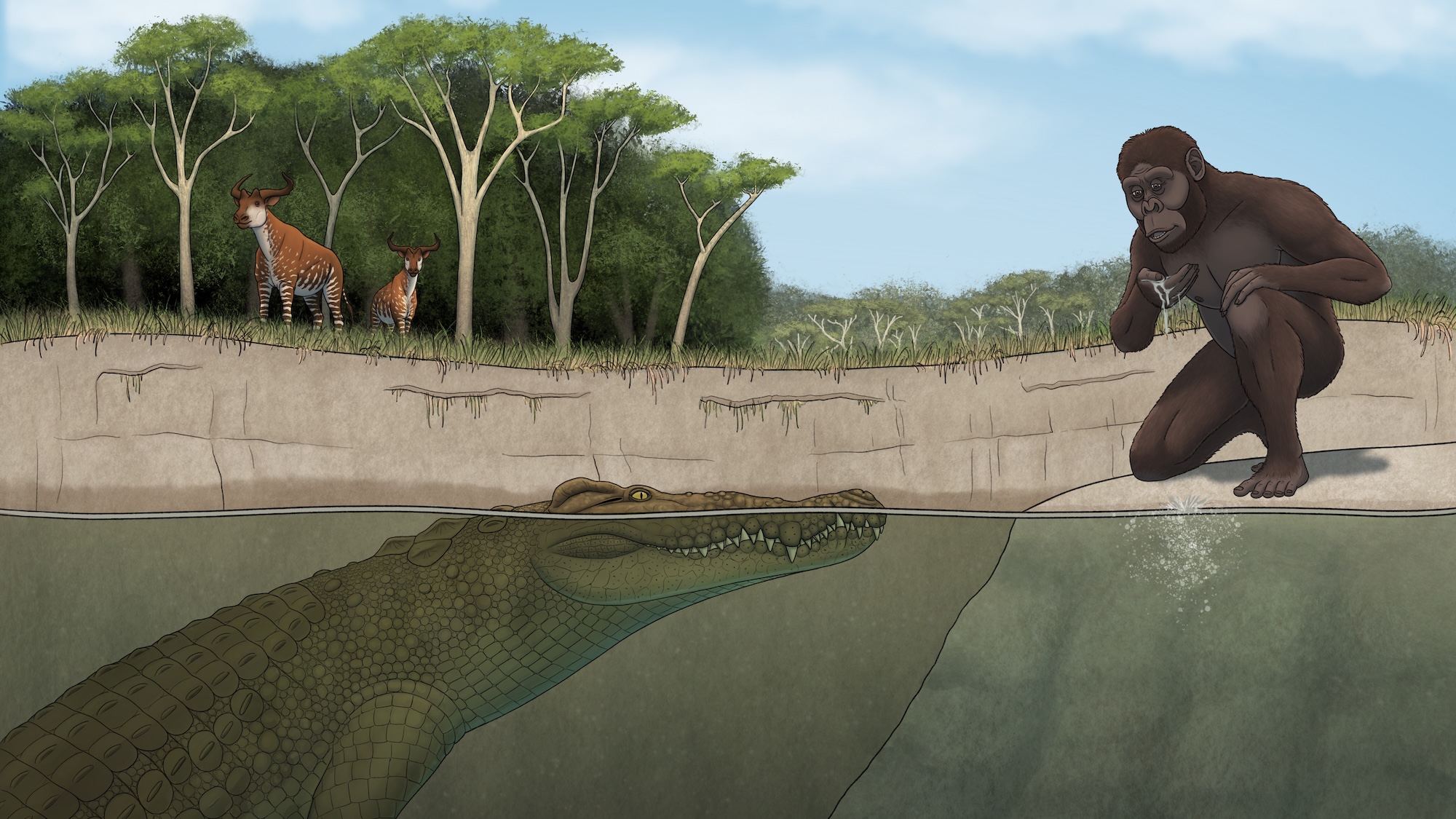
The species detailed in a study published today in the Journal of Systematic Palaeontology even likely went after anthropology’s most famous historical hominid—Australopithecus afarensis, better known as Lucy.
Today’s crocodiles—and the danger they pose—remain virtually unchanged since they first evolved on Earth over 200 million years ago. The newly described species Crocodylus lucivenator existed 3.4 to 3 million years ago in present-day Ethiopia, and looked similar to the American crocodile (Crocodylus acutus). While largely arid today, the region during C. lucivenator’s era was covered with shrubs and wetlands broken up by multiple rivers.
In 2016, researchers began to suspect the existence of a previously unknown croc species while examining archival remains from dozens of specimens at a museum in Addis Ababa, Ethiopia’s capital city. It’s clear that C. lucivenator was a sizable foe. Judging from the specimens, paleontologists estimate it grew up to 15 feet long while weighing as much as 1,300 pounds.
“It was the largest predator in that ecosystem, more so than lions and hyenas,” University of Iowa environmental scientist and study co-author Christopher Brochu said in a statement.
Apart from the apex predator’s size, C. lucivenator also showcased some unique physical traits.
“I was just blown away because it had this really weird combination of character states,” said Brochu.
The most noticeable feature was a large hump located in the middle of its snout. While a similar bony growth can be seen on present-day American crocodiles, they aren’t apparent on Africa’s Nile crocodile (Crocodylus niloticus).C. lucivenator’s distinctive snout likely functioned the same way, too.
“You see this in some modern crocodiles,” added Brochu. “The male will lower his head down a little bit to a female to show it off.”
The ancient reptiles weren’t afraid of one another, either. One specimen examined by Brochu’s team displayed multiple, partially healed jaw injuries indicative of a brawl with a fellow ambush predator.
“This kind of face-biting behavior can be found throughout the crocodile family tree,” explained University of Tennessee paleontologist and study co-author Stephanie Drumheller. “We can’t know which combatant came out on top of that fight, but the healing tells us that, winner or loser, this animal survived the encounter.”
Other animals weren’t so lucky—especially anything C. lucivenator eyed for its next meal. And this is where it gets particularly fascinating. At least three other crocodile species roamed an area to the south known as the Eastern Rift Valley.But C. lucivenator was the only creature of its kind in Hadar, a site in Ethiopia’s Afar region. Hadar is most famous for being home to the bones of humanity’s earliest known ancestor, A.afarensis. The hominid species is often exemplified by a remarkably complete specimen discovered in 1974. Affectionately known as Lucy, she likely had to watch her back whenever she neared a river.
“It was the largest predator in that ecosystem…and the biggest threat to our ancestors who lived there during that time,” said Brochu.
There is currently no direct fossil evidence of A. afarensis falling victim to an attack by C. lucivenator, but their overlapping timelines mean such scenarios were all-but-inevitable. In fact, the study’s authors are so confident that it’s illustrated in the crocodile’s name: Crocodylus lucivenator translates to “Lucy’s Hunter.”
“It’s a near certainty this crocodile would have hunted Lucy’s species,” said Brochu. “Whether a particular crocodile tried to grab Lucy, we’ll never know, but it would have seen Lucy’s kind and thought, ‘Dinner.’”
The post An odd-nosed crocodile ate our prehistoric ancestors appeared first on Popular Science.