When ‘Star Trek’ put the first Black astronaut into space
Popular Science...
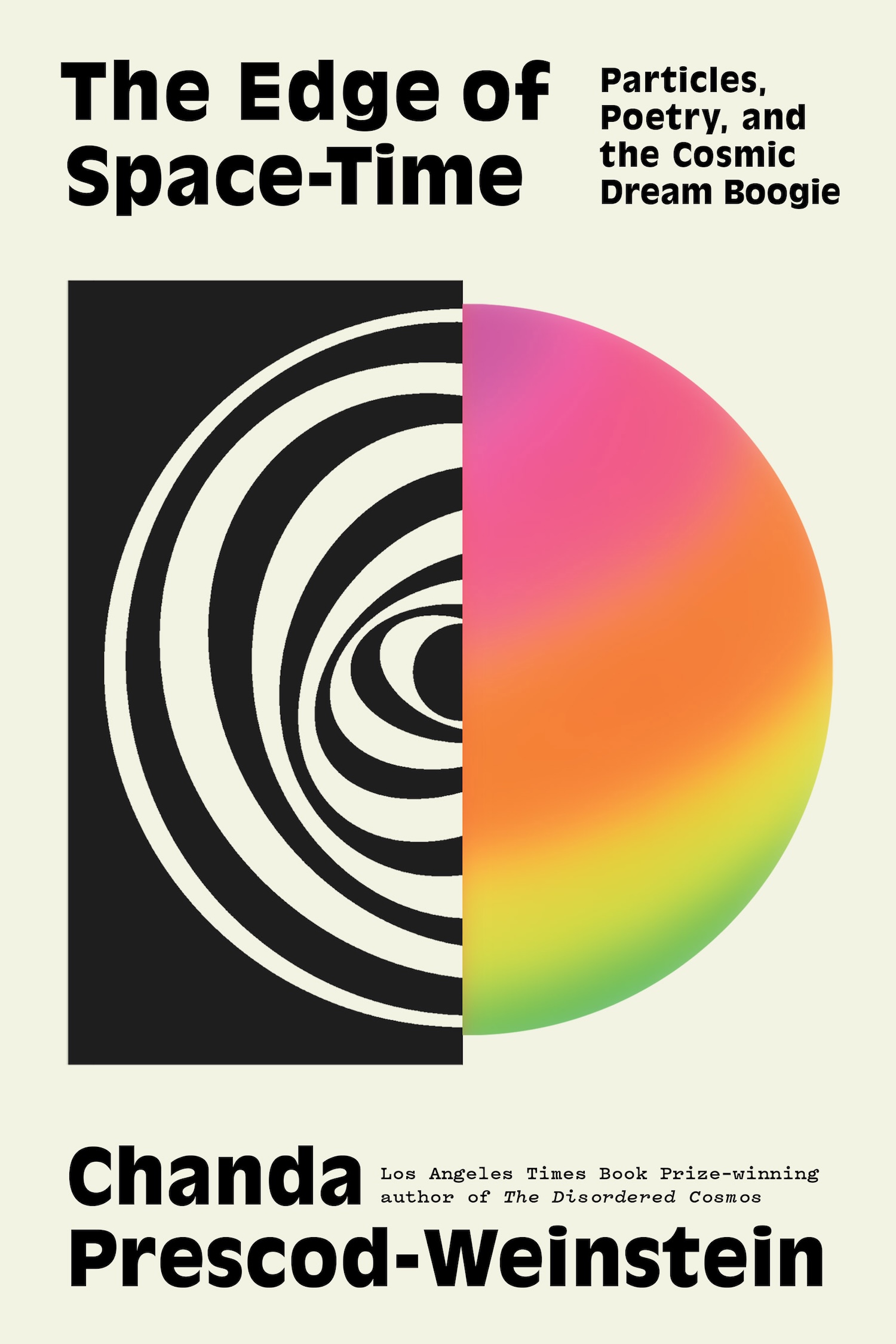
Excerpted from THE EDGE OF SPACE-TIME: Particles, Poetry, and the Cosmic Dream Boogie by Chanda Prescod-Weinstein with permission from Pantheon Books, a division of Penguin Random House. Copyright © 2026 by Chanda Prescod-Weinstein.
Halfway through Space Is the Place, Sun Ra muses that scientists are fed on research while Black people have been fed on freedom. As a Black physicist, I have been fed on both, and I have tried to grow the seeds that my ancestors passed on to me. The ancestors could fly. I do too, whenever I am able to escape into looking at the universe through the lens of quantum fields. I am not the first to escape into the abstractions of space and time. If you’ve read this far, then you have joined me. We are not the first. We will not be the last.
When I was younger, I knew I could be a scientist because I grew up watching LeVar Burton play one on television. As Geordi La Forge, chief engineer of the starship Enterprise on Star Trek: The Next Generation, Burton gave us a brilliant, Black nerd. Because I saw this early example, my child self never doubted that I had the freedom to be a professional nerd too. It was not a possibility that was, as it had been for Black generations before me, “Far Beyond the Stars”—the title of a powerful episode about twentieth-century anti-Black racism that aired during the sixth season of Star Trek: Deep Space Nine. DS9, as many fans know it, was the first Trek series to feature a Black lead. Avery Brooks’s Benjamin Sisko broke barriers in what is to this day the longest-running television drama with a Black man in the leading role. Like Burton’s Lieutenant Commander La Forge, Captain Sisko taught Black children like me that not even the sky was the limit.
In this sense, representation has real material meaning: Trek has continuously pushed the boundaries of our imaginations for as long as it has existed. Burton’s performance as Geordi La Forge has its origins in an earlier iteration of Trek—the first Black person Burton ever saw on television was Nichelle Nichols as Lieutenant Nyota Uhura in the original Star Trek series. This milestone was marked in the January 1967 issue of Ebony magazine, which also features a cover photograph of Nichols. In the photo, she’s wearing a form-fitting red synthetic velour dress with a respectably high black scoop-neck collar—the uniform of a liberated Black woman who is Earth’s chief communicator in outer space. The dress looks straight out of the 1960s except for the small patch over the left breast, which is roughly shaped like an arrowhead and features a swirly letter e (for engineering). The accompanying feature story declared that Nichols, then a star of the brand-new NBC Color television show Star Trek, was “the first Negro astronaut, a triumph of modern-day TV over modern-day NASA.”

The decision to feature the stunningly beautiful Nichols on the cover, complete with a lengthy feature describing her significant contributions to the production of Gene Roddenberry’s new humanistic drama of life in space, was both clear and pointed. Not only was Ebony celebrating a great Black actor; it was also offering political commentary on the whiteness of the political zeitgeist, asserting that NBC had imagination NASA utterly lacked. Of course, there are limits to this way of looking at things. Roddenberry had filmed the first Star Trek pilot featuring white actress Majel Barrett (his wife) as second in command of the Enterprise, but NBC hated the idea of portraying a white woman in such a powerful position and refused to pick up the series. The franchise might have died were it not for the intervention of Lucille Ball of I Love Lucy fame, who insisted that Roddenberry be given a second chance. So Roddenberry got rid of the white woman first officer and replaced her with not just any male but a male alien: Leonard Nimoy’s science officer Spock. He also added pilot Hikaru Sulu to the crew, played by Japanese American concentration-camp survivor George Takei. And he cast Nichols, already a star stage performer, in the role of the communications officer whose last name recalls uhuru—Swahili for “freedom.”
It would be nearly three decades before a Black woman would finally make the journey to space in real life. Roddenberry, of course, was not the first to dream of it. I imagine that Black women have dreamed of space throughout the centuries—for much longer than the idea of “Black people” has existed. Even Star Trek was a few years behind journalist Edward Murrow, who, as head of the U.S. Information Agency, wrote to NASA administrator James Webb in 1961 to suggest that the United States send “the first non-white man to space.” Webb replied that such a choice was “inconsistent with our agency’s policies.” And so in 1967, it was Lieutenant Uhura who first fulfilled that dream in the popular consciousness. Beamed into the living rooms of Black children across the country, Nichelle Nichols transformed how Black children saw themselves and their futures.
Media like Trek kept me open to the possibility that space represented. I am a child of the space shuttle era, so I never knew a world where humans, including Black people, weren’t annually flying to space. I was fascinated by the 1976 IMAX film To Fly!—and saw it at both the California Science Museum and the Smithsonian Air and Space Museum in Washington, D.C., where it brought me “past Mars, past Jupiter and its moons, past Saturn and beyond.” The script of the twenty-seven-minute film, juxtaposed with the larger-than-life IMAX movie screen, was the best kind of propaganda, designed to inspire awe. Toward the end, the narrator sums up the journey: “Today we look upon our planet from afar and feel a new tenderness for the tiny and fragile Earth. And so I learned early on from documentary as well as Star Trek that space was a tapestry for our dreams.
______________
Dr. Chanda Prescod-Weinstein is an associate professor of physics and astronomy and core faculty in women’s and gender studies at the University of New Hampshire. Her research in theoretical physics focuses on cosmology, dark matter, and neutron stars. She is also a researcher of Black feminist science, technology, and society studies. She is also the creator of the Cite Black Women+ in Physics and Astronomy Bibliography. Her first book The Disordered Cosmos: A Journey into Dark Matter, Spacetime, and Dreams Deferred (Bold Type Books) won the 2021 Los Angeles Times Book Prize in the science and technology category, the 2022 Phi Beta Kappa Science Award, and a 2022 PEN/Oakland Josephine Miles Award.
The post When ‘Star Trek’ put the first Black astronaut into space appeared first on Popular Science.