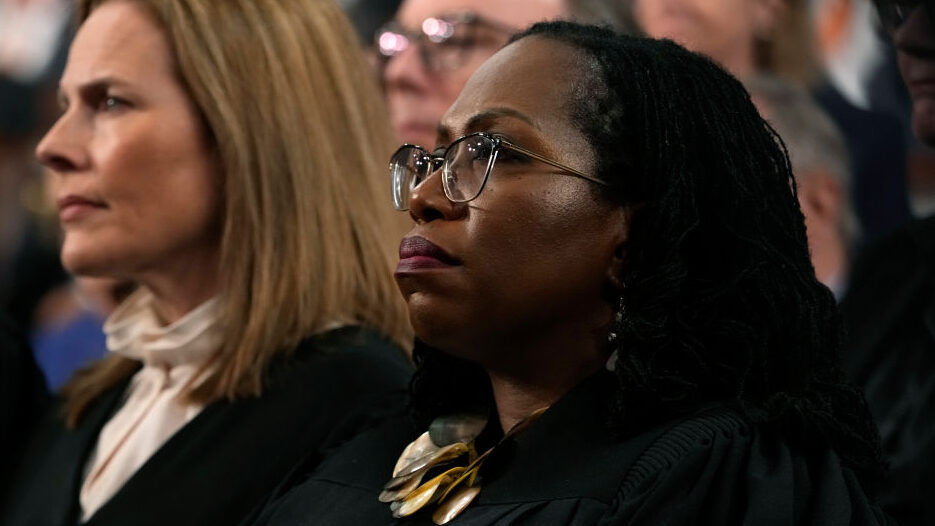
As the only Black woman on the Supreme Court, Ketanji Brown Jackson’s lone dissent in conversion therapy ruling stands out
TheGrio...

“People say Black women will save the democracy, but it’s like we can only do but so much,” Dr. Christina M. Greer, political science professor at Fordham University, tells theGrio.
In a rare occurrence for the U.S. Supreme Court, Justice Ketanji Brown Jackson issused a lone dissent in a recent ruling in Chiles v. Salazar on Colorado’s ban of conversion therapy for gay and transgender minors. The court’s only Black female justice disputed the court’s majority opinion–which included Jackson’s liberal peers Justices Sonia Sotomayor and Elena Kagan–that ruled in favor of the plaintiff, Kaley Chiles, a Christian counselor providing conversion therapy, who says Colorado’s ban infringed on her free speech under the First Amendment.
The high court ruled that because Chiles’s version of conversion therapy is talk therapy and not physical–geared toward helping gay and transgender minors change their sexual orientation and gender identity–the state law seeks to “regulate the content of Ms. Chiles’s speech.”
“It goes a step further, prescribing what views she may and may not express,” said the court led by Justice Neil Gorsuch.
Justice Jackson, noting that Chiles’s practice isn’t simply about free speech but provides a medical service to vulnerable children, writes in her 34-page dissent, “I respectfully dissent. Stated simply, the majority has failed to appreciate the crucial context in which Chiles’s constitutional claims have arisen. Chiles is not speaking in the ether; she is providing therapy to minors as a licensed healthcare professional.”
She adds, “In concluding otherwise, the Court’s opinion misreads our precedents, is unprincipled and unworkable, and will eventually prove untenable for those who rely upon the long-recognized responsibility of States to regulate the medical profession for the protection of public health.”
What’s more, Jackson cites scientific research showing that conversion therapy is not only harmful, but ineffective in altering one’s sexual orientation or gender identity.
She explains, “Studies show that children often feel the effects of the shame and stigma from conversion therapy even more vividly than adults due to their ‘increased emotional vulnerability and less developed capacity to cope effectively with the harm of discrimination.’”
Jackson explains that Colorado’s law does not target or prohibit Chiles’s views, as she can freely promote conversion therapy and “vociferously decry the State’s prohibition.” She simply could not “practice that therapy without being subject to professional discipline under Colorado law.”

The Supreme Court justice nominated by President Joe Biden says plainly, “Our First Amendment jurisprudence does not treat speech as existing in a vacuum.”
Jackson’s dissent is not only rare but symbolic. As the only Black woman on the nation’s highest court, Jackson is demonstrating the countless ways Black women have had to hold the line in defending democracy, says Dr. Christina M. Greer, a political science professor at Fordham University.
“People say Black women will save the democracy, but it’s like we can only do but so much. We can only hold the tide, but for so long, by ourselves,” Greer tells theGrio.
Kelley Robinson, president of the Human Rights Campaign–and the first Black woman to lead the nation’s largest LGBTQ+ advocacy group, tells theGrio, “Justice Jackson understands what’s at stake here: when licensed medical professionals are not held to a set of standards, patients suffer.”
The LGBTQ+ leader added, “Today‘s ruling means more American kids will suffer. To undermine protections that keep kids and families safe from these abusive practices is shocking — and our children deserve better. We are grateful Justice Jackson sees and values young people’s health.”
In another rare move, Justice Jackson delivered her dissent in from the bench–an act that is typically reserved to signify intense disagreement with the majority in high-stakes cases.
As Black women have often done throughout recent and past history, Jackson warned of the looming consequences of the Supreme Court’s decision. She cautioned that the ruling “opens a dangerous can of worms.”
“It threatens to impair States’ ability to regulate the provision of medical care in any respect. It extends the Constitution into uncharted territory in an utterly irrational fashion. And it ultimately risks grave harm to Americans’ health and wellbeing,” she said.
“This is the Black woman who’s making this argument for a group of people she is not even a part of, but understands the danger that this rule could present, not just to this group of people, but how it will be weaponized and expanded for other groups of people,” Dr. Greer tells theGrio. “I think this is just a classic case of like, sometimes good-meaning white people don’t understand the capacity of whiteness and how opening up that door will open it up to a lot more than just this conversation about conversion therapy for youth.”