500-million-year-old spider relative has claws where it shouldn’t
Popular Science...
The fossil was completely unremarkable. That’s what Harvard University paleontologist Rudy Lerosey-Aubril initially thought while examining an arthropod fossil dating back to the Cambrian period (538.8 million to 485.4 million years ago).
“As I prepared it, however, it unexpectedly revealed exquisitely preserved limbs—including a pair of frontal claws projecting from the head,” Lerosey-Aubril tells Popular Science.
Early arthropod specimens don’t have claws like these. Instead, Cambrian arthropods usually have an antenna in that position. In other words, the claws Lerosey-Aubril was seeing were not supposed to be there.
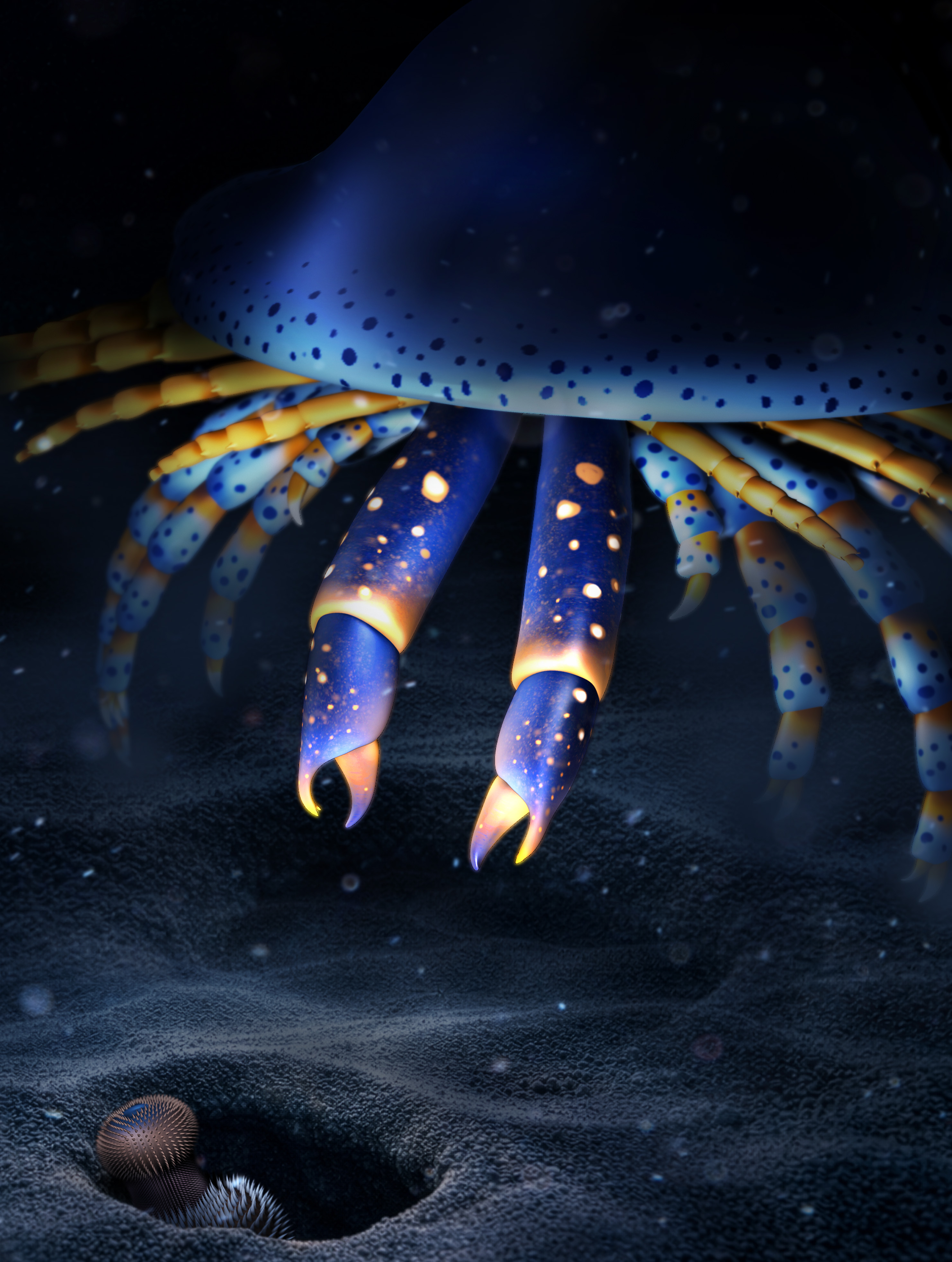
This unassuming fossil belongs to Megachelicerax cousteaui, a 500-million-year-old sea predator. The fossil was first dug up over 40 years ago in a desert in western Utah and is the oldest known chelicerate—the arthropod group that includes modern spiders, scorpions, horseshoe crabs, and sea spiders. This single strange specimen pushes the evolutionary history of chelicerates back by 20 million years and helps explain the evolution of claws. The findings are detailed in a study published today in the journal Nature.
Here come the claws
A co-author of the new study, Lerosey-Aubril spent over 50 hours cleaning the M. cousteaui fossil with a needle underneath a microscope to study its surprising anatomy. Its body is just over three-inches-long and has an exoskeleton made up of one head shield on top and nine separate body segments.
“Appendages beneath the head are adapted for feeding and sensory functions, while those along the trunk are used for respiration and swimming,” Lerosey-Aubril explains. “This degree of anatomical specialization is surprisingly advanced for an arthropod of this age.”
Chelicerate arthropods have a body divided into a cephalothorax on top and abdomen on bottom, four pairs of walking legs, and two front chelicerae and pedipalps to grab things. Before this discovery, the oldest known chelicerate arthropods dated back roughly 480 million years ago. M. cousteaui lived 20 million years earlier, making it the earliest known offshoot of the chelicerate family tree. Today, there are more than 120,000 living chelicerate species, including spiders and horseshoe crabs.

Just keep digging
Despite the fossil’s age, Lerosey-Aubril was surprised by just how much more modern M. cousteaui looks compared to animals living around the same time, including trident-wielding trilobites.
“Apart from a few telltale features of its antiquity, this half-a-billion-year-old chelicerate would look right at home in today’s oceans,” he says.
M. cousteaui is also a key transitional species that bridges Cambrian arthropods that don’t have these front claw-likes with the much younger horseshoe crab-like chelicerates who did have claws.
Previously, scientists were not sure about the order in which claws and a body with two regions that perform specific functions first evolved. M. cousteaui shows that they evolved before these head appendages disappeared and became more similar to the legs on today’s spiders.
“It reconciles several competing hypotheses; in a way, everybody was partly right,” study co-author Javier Ortega-Hernández, Curator of Invertebrate Paleontology at Harvard’s Museum of Comparative Zoology, explained in a statement.
Megachelicerax cousteaui is named in honor of famed French explorer Jacques-Yves Cousteau whose documentaries and environmental advocacy inspired generations to keep exploring. Lerosey-Aubril says that the fossil itself is also a reminder to keep digging.
“This particular fossil was discovered by a dedicated avocational paleontologist [Lloyd Gunther] and later donated to a museum, where it was carefully curated for decades before we were fortunate enough to reveal its scientific significance,” he says. “Fossils are found across much of the United States, so get out, explore, and see what stories might be hidden in the rocks around you.”
The post 500-million-year-old spider relative has claws where it shouldn’t appeared first on Popular Science.