In 1871, cities almost got moving sidewalks. Why are we still waiting?
Popular Science...
In 1872, New York City’s Broadway was a slow-moving snarl of horses, wagons, and pedestrians, all competing along the same well-worn corridor. Alfred Speer, a merchant known around town as “The Wine Man,” believed the congestion outside his Broadway wine shop, across the street from City Hall, was costing him customers. Speer’s solution was not modest: He proposed an elevated sidewalk, running the length of Broadway, moving constantly at 10 miles per hour, with settees for riders who wanted to sit or chat along the way. He called it the “Endless Traveling Sidewalk.” New York’s state legislature passed the proposal—twice. And the governor, John Dix, vetoed it—twice. More than 150 years later, Broadway is still a gridlocked nightmare, and our sidewalks still don’t move.
Despite its early failure, Speer’s vision would prove irresistible to inventors and engineers throughout the 20th century. Generations of urban planners and engineers has dusted off versions of Speer’s design, hoping to solve the transportation problems of their day. Every generation has come up short. The mechanical complexity of city-scale systems, the liability of pedestrians negotiating a continuously moving platform, and the exposure of both machinery and travelers to the weather conspired against every fresh attempt. The deepest blow came shortly after the turn of the century when cars decisively won the battle for street space. Moving sidewalks never had a chance.
Today, a confluence of factors, including aging populations in need of mobility assistance, the spread of “complete streets” to establish more car-free zones, and the climate-driven pressure to rethink mass transit, may be creating favorable conditions for new versions of Speer’s vision. But don’t hold your breath for a moving sidewalk along Broadway.

Alfred Speer elevates his game—but fails
Alfred Speer was equal parts tinkerer, entrepreneur, and civic leader, a 19th-century polymath who dabbled in just about everything. Born in 1823 in New Jersey, Speer trained as a cabinetmaker, patented a cylindrical piano, built the largest vineyard in the state, became a leading vintner, and helped establish the city of Passaic, publishing its first newspaper—all while promoting his Endless Traveling Sidewalk for the congested streets of Manhattan.
In the 1870s, industrialization fueled the rapid growth of American cities following the Civil War. Traditional modes of transportation, mainly horse-drawn carriages and carts, gave way to steam-driven light rail, like Manhattan’s Elevated Railway, the Third Avenue Elevated Railroad, and Brooklyn’s Sea Beach and Coney Island Railroad.
In response to the competition from streetcars and elevated rails, Speer began to embellish his moving sidewalk design. His new idea offered separate tracks running at different speeds, one for walking, one for outdoor seating, and a third for enclosed travel with accommodations. All would be moving at 12 to 16 mph in a continuous loop from The Bowery, a bustling neighborhood bordering Manhattan’s Lower East Side, to Central Park. According to a description in Frank Leslie’s Illustrated Weekly, “Mr. Speer proposes to have drawing-rooms every hundred feet: some of them to be fitted with toilet-rooms exclusively for ladies.” Speer also envisioned providing “gentlemen…with smoking-apartments at convenient distances.”
While accounting for the deficiencies of his original design, such as enclosed seating, Speer pressed its advantages. There would be no waiting at stations or street corners for the next train, streetcar, or carriage; passengers could choose to walk or sit, and they could disembark at will. Speer also claimed that his system would cost far less than an underground subway or elevated rail. But by 1890, Speer’s patent expired without any progress. Despite self-funding a well-received prototype, interest in his vision fizzled.
The World’s Fairs try again—and fail
Outside New York, however, moving sidewalks gained traction. The first moving sidewalk debuted at the 1893 World’s Fair in Chicago. For passengers arriving to the fairgrounds by steamship, a “movable sidewalk…convey[ed] them to the Peristyle entrance,” a special World’s Fair edition of The Chicago Tribune reported.
The moving sidewalk stretched more than a half-mile along Chicago’s Casino Pier, which connected the ferry terminal to the fairgrounds. The sidewalk had two platforms, one with seats that moved at two mph and a speedier four mph track for walkers. But the novel system was short-lived, suffering extensive damage in a fire a year later.

In 1900, a much more ambitious moving sidewalk was featured at the Paris World’s Fair. “The traveling sidewalk at the Paris Exposition, while by no means new in conception, is here carried out on a far larger scale than ever before attempted,” reported The New York Times.
The system looped around the main attractions for more than two miles. “It is especially interesting to observe the ease with which all persons, old and young, of either sex, mount and descend from the platform,” The New York Times noted, adding that the experience was smooth and showed “how entirely practicable the system is.”
But it wasn’t “practicable” enough to spread from the fairgrounds to the streets of Paris, or the streets of any major city. Nevertheless, a glimpse of the future for moving sidewalks resurfaced in New York City in 1903 in a proposed six-mile system that would traverse parts of lower Manhattan and Brooklyn in underground tunnels, connecting both sides of the East River via the Williamsburg Bridge.
“The plan is to dig a subway under these streets from 25 to 30 feet wide,” wrote Harper’s Weekly. A three-platform system, equivalent to Speer’s design, would run alongside one another at three, six, and nine mph. The fastest platform would have seating. “The tunnel [would] be lighted,” and “heated moderately in winter,” the same story reported.
The proposal failed, losing out to subway trains, but engineers had moved Speer’s vision underground and indoors.
Mid-century city planners try—and fail
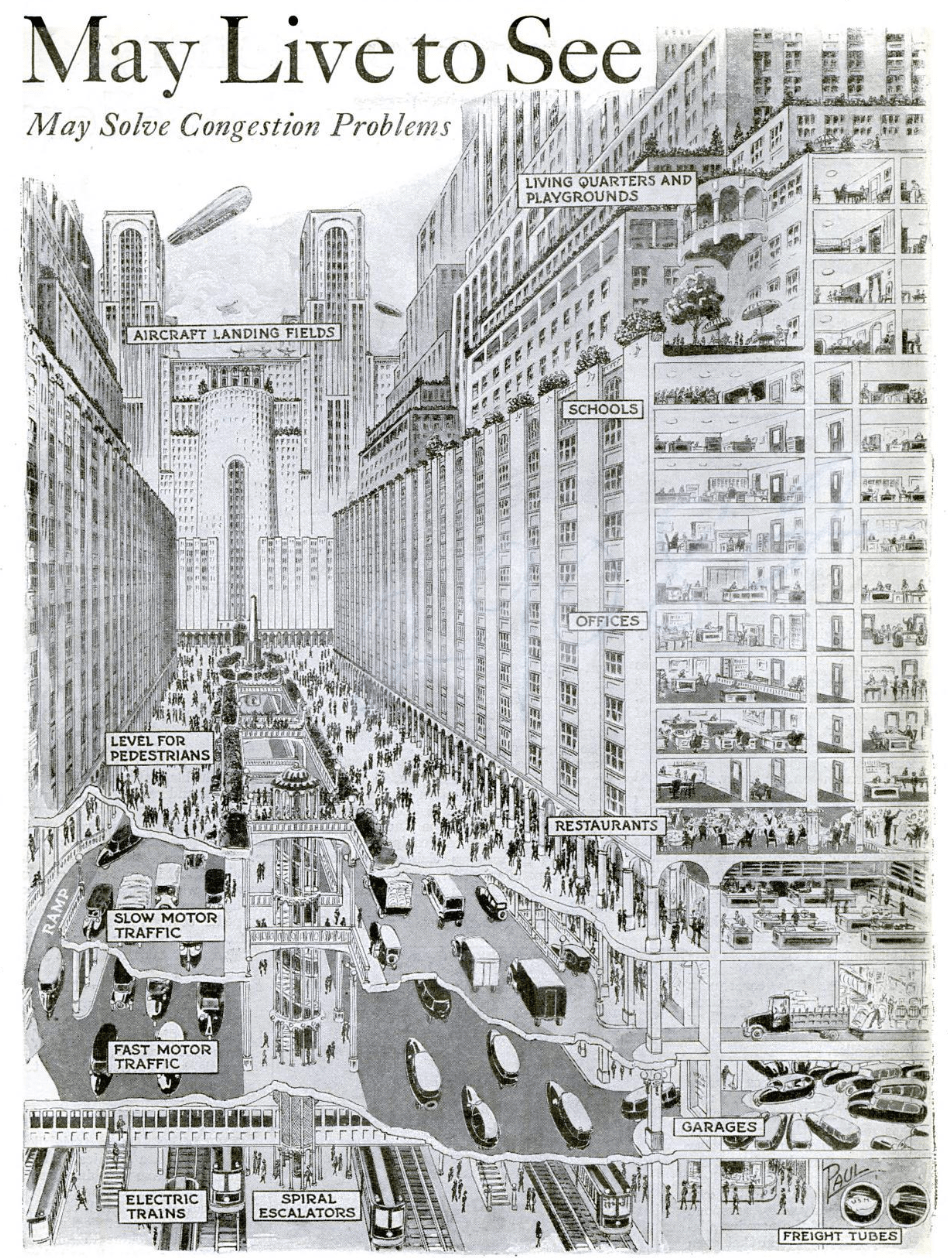
By the 1920s, more than half the U.S. population was concentrated in cities. The influx overwhelmed city streets and challenged urban planners. Popular Science began chronicling attempts to resurrect moving sidewalks in response to the crush of pedestrians and street traffic.
In 1919, Popular Science described plans to connect New York City’s Grand Central Station to Times Square with an underground moving sidewalk. In 1930, Detroit’s traffic supervisor Herman Taylor built an elaborate tabletop model of a system designed to move “at a constant speed of 20 to 25 miles an hour,” using a slower entry belt that accelerated up to cruising speed, another Popular Science story reported.
Westinghouse, which had built electric motors for the Paris Exposition’s traveling sidewalk, continued to be a persistent commercial champion. In 1932, Popular Science published plans for a moving sidewalk that would run underground and between buildings in elevated, glass-enclosed byways.
The proposals kept arriving from transit authorities, independent engineers, commercial sponsors, and city planners, and they kept dying in committee, defeated by the same combination of cost, liability, and political will that had killed Speer’s design. It took until the 1950s for anyone to prove the visionaries right, and it came from an unlikely sponsor.
Moving sidewalks find their niche
The engineers who finally cracked the moving sidewalk problem did it by asking a smaller question. Rather than reimagining the city, they reimagined specific corridors, running between one destination and another, with single entry and exit points.
In 1954, Popular Science featured the Goodyear Company’s first commercial moving sidewalk at the Hudson and Manhattan Railroad’s Erie station in Jersey City, New Jersey. The “Speedwalk” was a 277-foot rubber belt running up an inclined exit hall that commuters had long called “Cardiac Alley” for its steep slope. It moved at a modest one and a half miles per hour. No graduated speeds, no settees, no enclosed smoking rooms. Just a gentle, continuous assist up a single difficult stretch of floor. It worked perfectly until train line changes altered commuter flow and rendered it obsolete.
The next year, in 1955, Popular Science noted the installation of a moving sidewalk at the Houston Coliseum, an indoor venue for sporting events and concerts that seated roughly 9,000 people. Goodyear’s rival rubber manufacturer B.F. Goodrich spearheaded the project.
In 1958, the first airport moving sidewalk, or Trav-O-Lator, opened at Dallas Love Field. While it was popular, its moving belt was notorious for snagging and catching clothing and shoes. On New Year’s Day in 1960, a two-year-old girl was killed when her clothing was tangled in the machinery.
Despite the tragedy, moving sidewalks persisted. Airports offered the perfect conditions for the innovations—enclosed environments with long pedestrian corridors between specific destinations. In 1960, the “Astroways” moving sidewalk opened at Los Angeles International Airport. And in London’s Underground a Trav-O-Lator was installed at Bank station, the first in Europe, which remains in operation. The Jetsons era of moving sidewalks was born.
Dusting off Speer’s design in the 21st century
From the early years of the 20th century, the most daunting obstacles to outdoor moving sidewalks were not technical, but political. Cars had claimed the street. Highways had claimed public funding. As a result, urban planning doctrine, shaped by generations of engineers who shunted pedestrians to the side, had literally paved over the conditions that might have made Speer’s moving-sidewalk vision viable.
Today, the emphasis is shifting away from cars. The complete streets movement, which gained momentum in the early 2000s, has pushed cities to redesign roadways to better accommodate pedestrians, cyclists, and transit riders. New York’s pedestrianization of Times Square in 2009—a stretch of Broadway uptown from where Speer once watched the gridlock from his wine shop—demonstrates that the political calculus has been shifting.
In 2020, Paris, under Mayor Anne Hidalgo, launched an ambitious program to eliminate cars from the city center and build the “15-minute city,” where every daily need is reachable on foot or by bicycle. Congestion pricing, long delayed in American cities, finally arrived in New York City in 2025, redirecting revenue toward pedestrian and transit infrastructure.
Into this changed landscape, a handful of cities have been testing bounded, specific applications of the moving sidewalk concept—the kind Speer himself advocated for in the late 19th century. Bank station in London added two more moving sidewalks in 2022 as part of a capacity upgrade to move more commuters faster. The Central-Mid-Levels Escalator in Hong Kong is a covered escalator system with moving sidewalks that connect hillside neighborhoods with the city center. The Trondheim CycloCable in Norway, a mechanical assist that pushes cyclists up a single steep hill, offers a minimalist version, a moving sidewalk solution to one specific problem, free to use, and wildly popular.

Beltways, a Northern Kentucky startup with a patented moving sidewalk system that accelerates passengers gradually through modular sections, is targeting a top speed of 10 mph—approaching the speeds Speer first proposed in the 1870s—with a planned deployment in 2026 at Cincinnati’s CVG Airport.
A toast to the Wine Man
Alfred Speer, a man of diverse interests, eventually moved on from his Endless Traveling Sidewalk idea. With vineyards to manage in New Jersey, a robust retail wine business, and a newspaper he founded in Passaic, Speer had plenty to occupy him.
Meanwhile, on New York City’s streets, elevated railways went up, subways went down, and cars took over what street-level space was left. For a century and a half, the street where his Broadway shop once stood has remained more or less exactly what it was in 1872—a slow-moving snarl of vehicles and pedestrians competing for the same corridor. His moving sidewalk may have relieved that congestion. And maybe it still could—in the right places and under the right conditions.
Speer understood the potential of moving sidewalks before anyone else. His design—multiple tracks, graduated speeds, enclosed accommodations, continuous loop—may have been an extravagant solution. But stripped to its essence, a moving sidewalk is a practical answer to a specific transit problem: How do you move people comfortably along a single, predictable, relatively short route without making them wait?
Speer died in 1910. He’d lived long enough to see his idea implemented in World’s Fairs, but not long enough to see it spread through airports and mass transit systems. The Wine Man was not wrong. He was just early. In the end, he pointed us in the right direction.
In A Century in Motion, Popular Science revisits fascinating transportation stories from our archives, from hybrid cars to moving sidewalks, and explores how these inventions are re-emerging today in surprising ways.
Related Stories
During WWI, a daredevil pilot helped invent the first ‘drones’
In 1916, hybrid cars could’ve changed history. But Ford wouldn’t allow it.
A century ago, suspended monorails were serious mass-transit contenders
100 years ago, the battle for television raged
In 1928, Eric the Robot promised the robo-butler of the future
The post In 1871, cities almost got moving sidewalks. Why are we still waiting? appeared first on Popular Science.