The Waterdrop G3P800 water filter system provides clean, filtered water without a wait
Popular Science...
If you’ve ever Googled “what’s actually in my tap water,” you’ve probably scared yourself into at least considering a filtration system. The Waterdrop G3P800 is a tankless reverse osmosis system that promises to strip out PFAS and other contaminants while delivering filtered water fast enough that you won’t notice a difference from your regular faucet. After spending a month with it installed under my kitchen sink, I can say it largely delivers on those promises, while allowing a relatively simple DIY installation.
G3P800 RO System

Pros
- 800 GPD flow rate fills a cup in roughly 5 seconds—no waiting around
- Tankless design saves significant under-sink space compared to traditional RO systems
- NSF/ANSI 42, 53, 58, and 372 certified with independent lab-verified PFAS removal
- Smart faucet with built-in TDS meter lets you see water quality in real time
- UV LED sterilization adds a layer of protection against bacteria and viruses
- 3:1 pure-to-drain ratio is significantly more efficient than older RO systems
- DIY installation is genuinely manageable—no plumber required
Cons
- No built-in remineralization—filtered water can taste flat without the optional add-on
- Replacement filters add ongoing cost
- Smart faucet requires a hole in your countertop or sink if you don’t have a spare
Specs
-
Filtration type:
Tankless reverse osmosis -
Flow rate:
800 GPD (roughly 0.63 GPM) -
Filtration stages:
10 stages across 3 filter cartridges + UV sterilization -
Pure-to-drain ratio:
3:1 -
Certifications:
NSF/ANSI 42, 53, 58, 372 (IAPMO certified) -
Dimensions:
18.11" x 5.67" x 17.72" -
UV sterilization:
LED UV light, 99.9% sterilization rate -
TDS monitoring:
Built-in smart faucet with real-time TDS display -
RO membrane pore size:
0.0001 µm (16-layer composite) -
Installation:
DIY under-sink, approximately 30 minutes
Verdict: The Waterdrop G3P800 is a compelling modern alternative to the traditional tank-based reverse osmosis systems that have dominated the under-sink market for decades. Its 800 GPD flow rate effectively eliminates the biggest historical complaint about RO systems—waiting around for water—and its compact footprint means you won’t sacrifice all of your under-sink storage. The NSF certifications and third-party lab testing back up its filtration claims. It’s not cheap, and the ongoing filter costs are worth factoring in, but if clean drinking water is a priority, this system punches well above what most pitcher filters and faucet attachments can offer.
What reverse osmosis actually does
Before we get into the specifics of the Waterdrop G3P800, it’s worth understanding what reverse osmosis actually is, because it’s a fundamentally different approach from the carbon filters you’ll find in pitchers and fridge dispensers. Reverse osmosis works by pushing water through a semi-permeable membrane with pores so small—0.0001 micrometers in the G3P800’s case—that most dissolved contaminants simply can’t pass through. For context, that’s roughly 1/10,000th the diameter of a human hair. Standard carbon filters are great at catching chlorine and improving taste, but they can’t touch dissolved heavy metals, fluoride, or the per- and polyfluoroalkyl substances (PFAS) that have become a growing concern in municipal water supplies.
The trade-off with RO has always been waste water. The filtration process sends some water down the drain, carrying the rejected contaminants with it. Older systems often wasted 3 or 4 gallons for every gallon of purified water they produced. The G3P800’s 3:1 pure-to-drain ratio flips that dynamic—you get three gallons of clean water for every one that goes to waste, which is a significant efficiency improvement and something to consider if you’re water-conscious.
Design and build
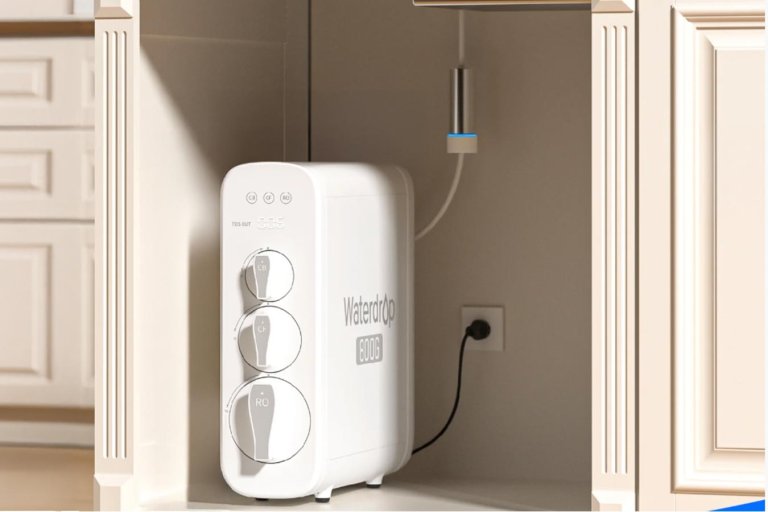
The most immediately striking thing about the G3P800 is its lack of a tank. Traditional RO systems store filtered water in a pressurized bladder tank that typically takes up a significant chunk of under-sink real estate. Waterdrop ditches the tank entirely, opting instead for on-demand filtration that purifies water in real time as you turn on the faucet. The result is a unit that measures 18.11 x 5.67 x 17.72 inches. Picture a thick textbook stood on its side. Waterdrop claims it saves about 70 percent of the under-sink space a traditional RO system would occupy, and in practice, that tracks.
The housing itself is a white plastic shell with a clean, minimalist look. Most people will never see it when they visit your house since it’s under the sink, but design still matters.. The three filter cartridges are accessible from the front panel, which is a thoughtful design choice since you don’t need to disconnect or move the unit when it’s time to swap filters. The whole thing has a distinctly modern, almost appliance-like quality that sets it apart from the jumble of tubes and canisters you’d associate with older RO systems.
Installation
Waterdrop says you can install the G3P800 in about 30 minutes without calling a plumber. The system connects to your cold water supply line via a quick-connect fitting and routes waste water to your drain via a saddle valve. I’m generally overcautious when it comes to DIY plumbing projects, so it took me closer to an hour to triple check everything.
The trickiest part of the installation is the faucet. The G3P800 comes with its own dedicated smart faucet, which means you’ll need either a pre-existing hole in your sink or countertop (like from a sprayer or soap dispenser you’re not using) or you’ll need to drill one. That’s probably the one step that could give a true DIY novice pause.
The included instructions are useful and there are online video resources to outline the process. Like most people, I’m spoiled by video walkthroughs at this point, so that’s a welcome bit of help. Once the physical connections are made, you run water through the system for a few minutes to flush the filters before the water is ready to drink.
Filtration: what it removes
The 10-stage breakdown
Waterdrop markets the G3P800 as a 10-stage filtration process. The system uses three physical filter cartridges—a CF (composite filter), a reverse osmosis membrane, and a CB (carbon block) post-filter—plus a UV LED sterilizer. Those 10 “stages” refer to the multiple layers of filtration media within each cartridge rather than 10 separate filters you’d need to individually maintain and replace. Here’s what each does:
The CF filter is a composite cartridge that handles sediment, chlorine, and organic compounds, which affect taste and protects the more delicate RO membrane downstream from getting clogged prematurely. Think of it as the bouncer that catches the obvious troublemakers before they get inside. This filter needs replacing every 6 months.
The RO membrane is the workhorse. This is a 16-layer composite membrane with pore openings of 0.0001 micrometers—small enough to reject dissolved heavy metals (lead, arsenic, chromium), fluoride, nitrates, and those now-infamous PFAS compounds that the EPA has been tightening regulations around. Independent testing by third-party labs has verified the system’s PFAS removal claims—dedicated 14-analyte PFAS panels returned every compound as “not detected” in filtered water. The RO membrane lasts about 2 years before replacement.
The CB post-filter is a carbon block that polishes the water after it passes through the membrane, catching any residual taste or odor compounds. It also serves as a final safeguard to ensure the water that reaches your glass tastes clean. This one lasts about a year.
Finally, a UV LED sterilizer hits the water with ultraviolet light just before it exits the system. UV treatment is well-established as a method for neutralizing bacteria, viruses, and other microorganisms, and Waterdrop claims a 99.9 percent sterilization rate. This is a nice additional layer, particularly if you’re on well water or have concerns about microbial contamination.
Certifications and testing
The G3P800 carries certifications from IAPMO R&T against four NSF/ANSI standards. NSF 42 covers aesthetic effects like chlorine taste and odor. NSF 53 addresses health-related contaminants including lead and specific volatile organic compounds. NSF 58 is the one specific to reverse osmosis systems and covers TDS reduction—basically a measure of how thoroughly the membrane strips out dissolved solids. And NSF 372 certifies the system uses lead-free materials in its construction. Having all four is a strong credential—some competitors skip one or more of these certifications, particularly NSF 53.
Flow rate and daily use
The 800 GPD rating is the headline spec, and it translates to filling a standard drinking glass in roughly five seconds. For context, many competing RO systems produce 50 to 100 GPD and rely on the storage tank to deliver water at a reasonable flow rate. Once that tank is depleted, you’re waiting. The G3P800’s tankless design means you’re getting filtered water on demand at a consistent flow rate.
That said, 800 GPD is the system’s maximum capacity under ideal conditions (typically rated at 77°F water temperature and 60 PSI pressure). If your incoming water is cold as is typical with northern climates, the membrane’s efficiency drops. This is true of all RO systems, not a Waterdrop-specific issue, but it’s worth noting that your real-world flow rate may be somewhat lower than the marketed number.
The smart faucet
The included faucet has a small LED ring at its base that displays the TDS (total dissolved solids) level of your filtered water in real time. TDS is measured in parts per million (ppm) and serves as a rough proxy for water purity—the lower the number, the fewer dissolved substances remain. Tap water in the US typically registers somewhere between 50 and 500 ppm depending on your municipal supply. A healthy RO system should push that down into the single digits or low teens.
The faucet uses a color-coded system: blue indicates the water quality is in the ideal range, while other colors signal that something may need attention, like a filter approaching the end of its life. It’s a genuinely useful feature, not just a gimmick, because it gives you a real-time indicator that the system is performing as expected. My tap water is particularly loaded with solids, so the filter has to work harder than normal. Still, the speed managed to keep up for the most part.
Water taste
This is where things get subjective, and it’s also where RO systems in general have a known quirk. They often strip out nearly everything dissolved in the water—including minerals like calcium and magnesium that contribute to what we perceive as “good” water taste. RO water can taste noticeably flat or even slightly acidic to some palates. This isn’t a flaw in the G3P800 specifically; it’s just how thorough reverse osmosis works. I prefer to use this kind of filtered water in my coffee machine and when adding flavored powders, so it doesn’t matter that much to me anyway. I also often take electrolyte supplements, whcih have soem of the same minerals.
Waterdrop sells an optional remineralization filter (the ALK16) for about $30 that adds calcium, magnesium, and other minerals back into the filtered water, raising the pH and giving it a more “natural” mineral water taste. Whether you need it comes down to personal preference.
Filter replacement and ongoing costs
No water filtration system is a one-time purchase, and the G3P800’s filter replacement schedule is something to budget for. Here’s the breakdown:
The CF filter needs replacing every 6 months (or after roughly 550 gallons). The CB post-filter lasts about 12 months (or 1,100 gallons). The RO membrane is the longest-lasting cartridge at approximately 24 months (or 2,900 gallons). The product linked here is the 1-year combo kit, which bundles two CF filters and one CB filter—essentially a year’s worth of the consumables you’ll go through most frequently. The RO membrane isn’t included in the combo since it lasts two years.
Who should buy the Waterdrop G3P800?
The G3P800 makes the strongest case for itself if you fall into a few specific categories. If you’ve checked your local water quality report (the Environmental Working Group’s Tap Water Database is a sobering place to start) and found elevated levels of PFAS, lead, or other contaminants that a basic carbon filter can’t handle, a reverse osmosis system is one of the most effective solutions available to consumers. The G3P800 is among the best-performing tankless options in this category.
It’s also a solid pick for anyone who’s been put off by the traditional downsides of RO systems. The tankless design eliminates the space problem, the 800 GPD flow rate eliminates the wait-time problem, and the 3:1 pure-to-drain ratio significantly reduces the water waste problem. If you tried an older-generation RO system years ago and gave up on it, the G3P800 represents how far the technology has come.
If your municipal water is already clean and you’re just looking for better-tasting water, a simpler (and cheaper) carbon filter setup might be all you need. And if you’re on a tight budget, keep in mind that the G3P800 system plus the ongoing filter costs adds up. But for the water quality-conscious household that wants serious filtration without serious compromises, this system hits a compelling sweet spot.
The post The Waterdrop G3P800 water filter system provides clean, filtered water without a wait appeared first on Popular Science.