Nebraska’s Wide, Rolling Domain
NASA...
Editor’s Note: Today’s story is the answer to the June Puzzler.
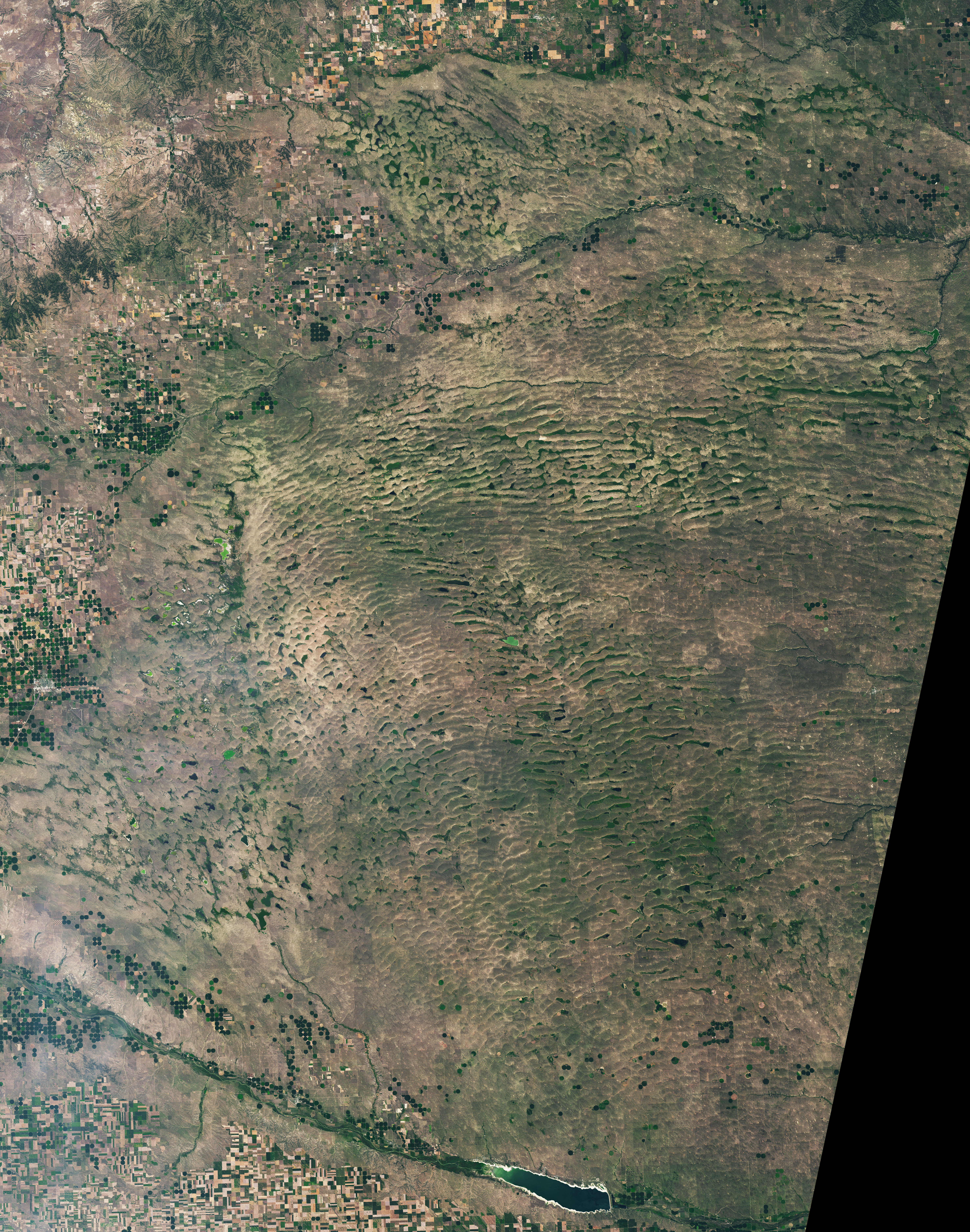
The undulating landscape of north-central Nebraska may be easy to overlook among the iconic dune fields of the world. Far from any coast or desert, the Nebraska Sandhills—comprising the Western Hemisphere’s largest system of sand dunes—bring their own brand of beauty and value. Grasslands blanket the rolling hills, providing grazing grounds for livestock, while lakes and wetlands dot the landscape, supporting diverse plant and animal life.
Much of the sand forming the hills originated in the Rocky Mountains. Rivers carried the eroded material down from the mountains and deposited it across the Great Plains during the Pleistocene. In times of drought, winds blowing predominantly from the north or south lofted sand out of dried riverbeds, gradually building and shaping dunes. About 3,500 years ago, grassland vegetation stabilized the features. Today, the rippled pattern spans about 20,000 square miles (52,000 square kilometers), about one-quarter of the state of Nebraska.

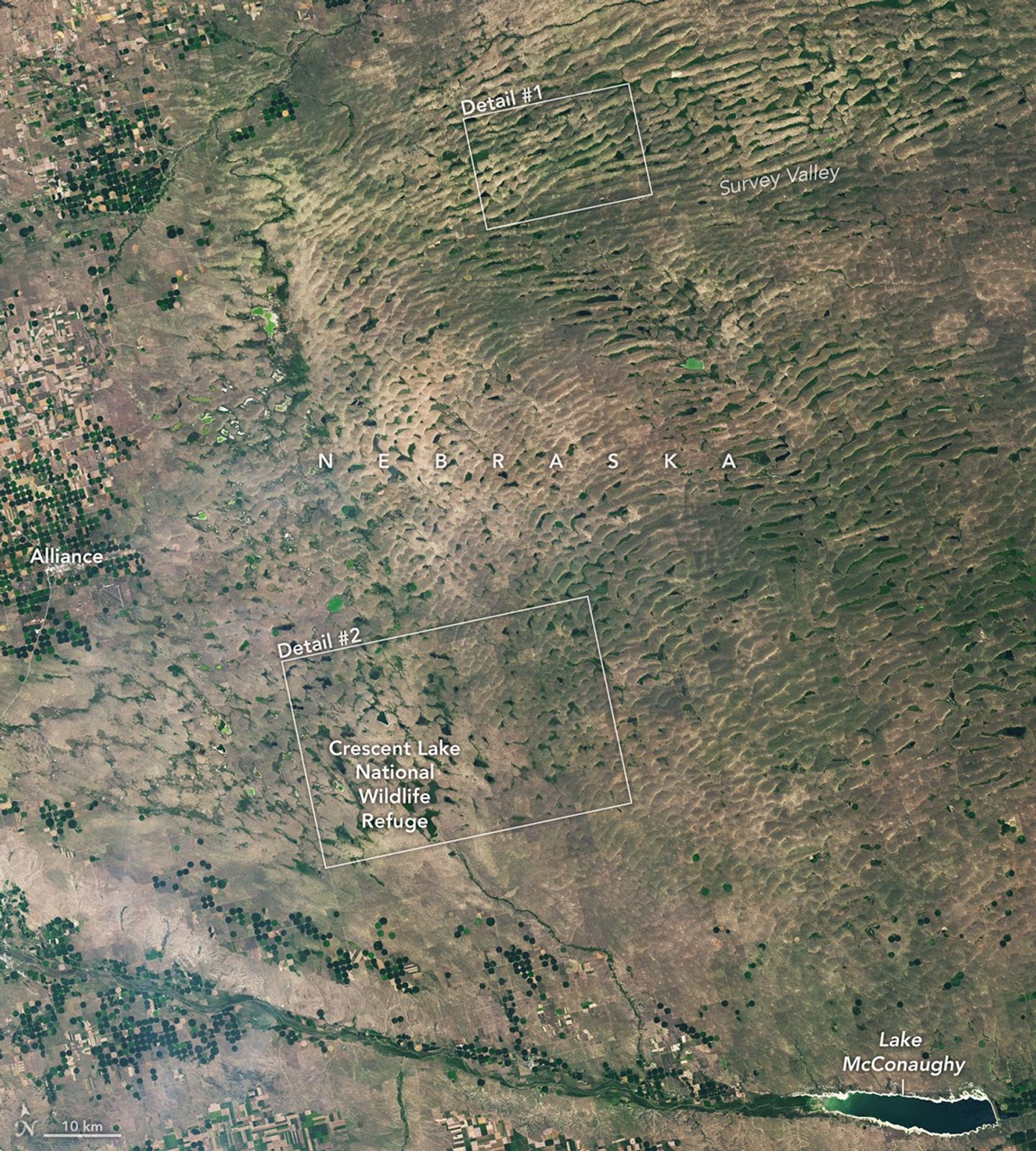
Some of the largest dunes occur in and around the area shown in the detailed image above, near the northern edge of the Sandhills region. These transverse dunes stand as high as 400 feet (120 meters) and extend for several miles. Their northern slopes are gentler than their southern slopes, reflecting the dominant influence of northerly winds. In other areas, dunes are more symmetric, suggesting that winds blew with nearly equal strength from the north and south, alternating with the seasons.
The grasslands that now cover the hills constitute pastureland for grazing livestock. Ranching expanded significantly in the area after passage of the Kinkaid Act in 1904, which allotted 640-acre parcels of land to ranchers who would settle it. Today, far more cattle than humans occupy the region, and half of Nebraska’s nearly 23 million acres of rangeland and pastureland are in the Sandhills. Some ranchers graze their cattle in patterns meant to approximate the large bison herds that once roamed the land.

Though much of the land in the Sandhills is privately owned, some is set aside in protected public lands. One of these areas, Crescent Lake National Wildlife Refuge on the southwestern edge of the Sandhills region, is shown above. Wetlands, including shallow lakes, marshes, and wet meadows, fill some of the valleys between the dunes. The land here is sponge-like, with precipitation seeping down through the soil and recharging groundwater instead of flowing off through stream channels.
Located along the Central Flyway, the refuge is a haven for migratory birds, and dozens of species of waterfowl, marsh birds, and shorebirds utilize the area. Among other wildlife, several types of turtles thrive in the ponds and prairies. Wetlands across the Sandhills support rare species such as the whooping crane, western prairie fringed orchid, and Topeka shiner.
NASA Earth Observatory images by Lauren Dauphin, using Landsat data from the U.S. Geological Survey. Story by Lindsey Doermann.

References & Resources
- Nebraska Game and Parks, Sandhills wetlands. Accessed June 15, 2026.
- University of Nebraska–Lincoln (2024, October 23) Groundwater: How the High Plains Aquifer Shapes the Sandhills. Accessed June 15, 2026.
- University of Nebraska–Lincoln (2024, October 23) Rotational Grazing and Sustainable Grasslands. Accessed June 15, 2026.
- University of Nebraska–Lincoln (2024, October 23) What It Takes to Form a Giant Dune Field. Accessed June 15, 2026.
- U.S. Fish and Wildlife Service, Crescent Lake National Wildlife Refuge. Accessed June 15, 2026.
- USDA Forest Service, History of the Nebraska Sandhills. Accessed June 15, 2026.
You may also be interested in:
Stay up-to-date with the latest content from NASA as we explore the universe and discover more about our home planet.

Dry, warm, and windy conditions across the U.S. Great Plains led to extreme fire activity in March 2026.

The glacial lake left a layer of silt and clay in southeastern Manitoba, creating fertile farmland that was divided during…

Beaver Island is one in a string of verdant and scenic jewels in a northern Lake Michigan archipelago.