ESPN’s ‘Saban’ docuseries goes as deep as Nick Saban allows it to

NCAAF College Football News, Photos, Stats, Scores, Schedule & Videos...

But who is Nick Saban, really?
That’s the question college football fans have been asking themselves for decades. We all know he’s the Terminator-like coach who won seven national titles and carved a path through the sport unlikely to be topped in our lifetimes. We know he has an unhealthy desire for his team to decimate its opponent and that nothing, not even a championship, can satiate him.
But, like, who is the guy underneath all of that? What does he think about when he looks in the mirror? What memory forever nags at him in quiet moments? What niggling fear in the back of his mind can’t he shake? What does he feel about the summation of his life and career now that he’s retired?
I don’t know that we find all the answers to those questions in the six-part ESPN Original docuseries, which premieres at 6 p.m. ET Thursday on ESPN, with all six episodes available immediately on the ESPN App, but we do get glimpses.
For much of the series, Saban puts his motivations and desires into analytical, coachspeak terms. He revels in “The Process.” He offers high-level concepts about what he wants to see from his players. But he never lifts the hood on his psyche to explain why he chose football, specifically. (In fact, he goes out of his way to say he never intended to be a football coach on several occasions.)
However, in the second episode, he and Alabama linebacker Rolando McClain recount an incident with an unnamed safety who was mouthing off in practice. As Saban tells it, McClain “kicked his ass from the 50-yard line all the way through the goalpost.” The head coach’s eyes light up in a way we haven’t seen until now as a Cheshire cat grin spreads across his face.
There he is.
The series, ably directed by Russell Dinallo and produced by Words + Pictures, does a lot of the labor to peel back the layers on Saban even if he’d rather not (Dinallo told Awful Announcing they interviewed Saban seven times). In the third episode, “Black Diamonds,” we can draw a line from his demanding father, Nick Sr., whose love was never more apparent to Nick Jr. than when he was yelling at him to be perfect while practicing and playing youth football. But even then, the coach refuses to connect the dots for us.
The docuseries deserves to be considered on its own merits, but it’s hard not to be reminded of The Last Dance, since they share the same storytelling scaffolding. It uses Saban’s 17-year tenure at Alabama as the hub from which the rest of his life and career branch out. Saban hangs a little shaggier on that framing than Last Dance, if only because his tenure at Alabama ends anticlimactically compared to Michael Jordan’s final season.
On its own merits, however, it’s an engaging watch, as much as the ornery coach tries to fight off his own introspection. Dinallo wisely lets Saban’s peers, former assistants, players, and wife (Miss Terry, also an executive producer) fill in the blanks, often against a visual backdrop of Saban fighting not to say what he really thinks. The sheer number of interview appearances impresses and reminds you of how far-reaching Saban’s impact still is on college football coaching trees and NFL rosters.
The most insightful talking head may be the one viewers will know the least about. Sports psychiatrist Dr. Lionel “Lonny” Rosen, whom Saban met at Michigan State, became an integral partner in developing “The Process” and fine-tuning his motivational strategies. Rosen, a fascinating character who deserves his own docuseries, offers unique insight into Saban and what drives him, ultimately comparing him to a predator running on instinct rather than someone motivated by wins.
As someone who followed former Syracuse coach Jim Boeheim’s career for a decade, and has covered sports media for just as long, I’ve become quite experienced in deciphering curmudgeonly coaches. The detachment they try to project in how they talk about their jobs doesn’t match their actions, ego, or aspirations. That is very much the case with Saban.
Saban uses “we” a lot when describing his teams and success, employing a process that de-individualizes players, but he also gladly let Alabama build a statue of him and name a field after him.
He says that he has no opinion on the fact that he won as many championships as Bear Bryant, but he also stuck around long enough to match that number.
Time and time again, he tries to make it clear that it was always about eschewing the ego and committing to the whole, but he also admittedly jumped from job to job, either for money, prestige, or the perception of a higher ceiling, leaving players in the dust.
I don’t doubt Rosen’s conclusion that Saban is like a tiger, but he’s still very human, even as he tries to cut himself off from his emotions (the wall Saban builds in his mind to keep himself from crying at several moments is confronting). In the end, he makes it seem as though he has no emotional attachment to anything that happened in his coaching career. But he is also complicit in his own myth-making, whether he chooses to believe that or not, considering he sat down for a six-part documentary about himself.
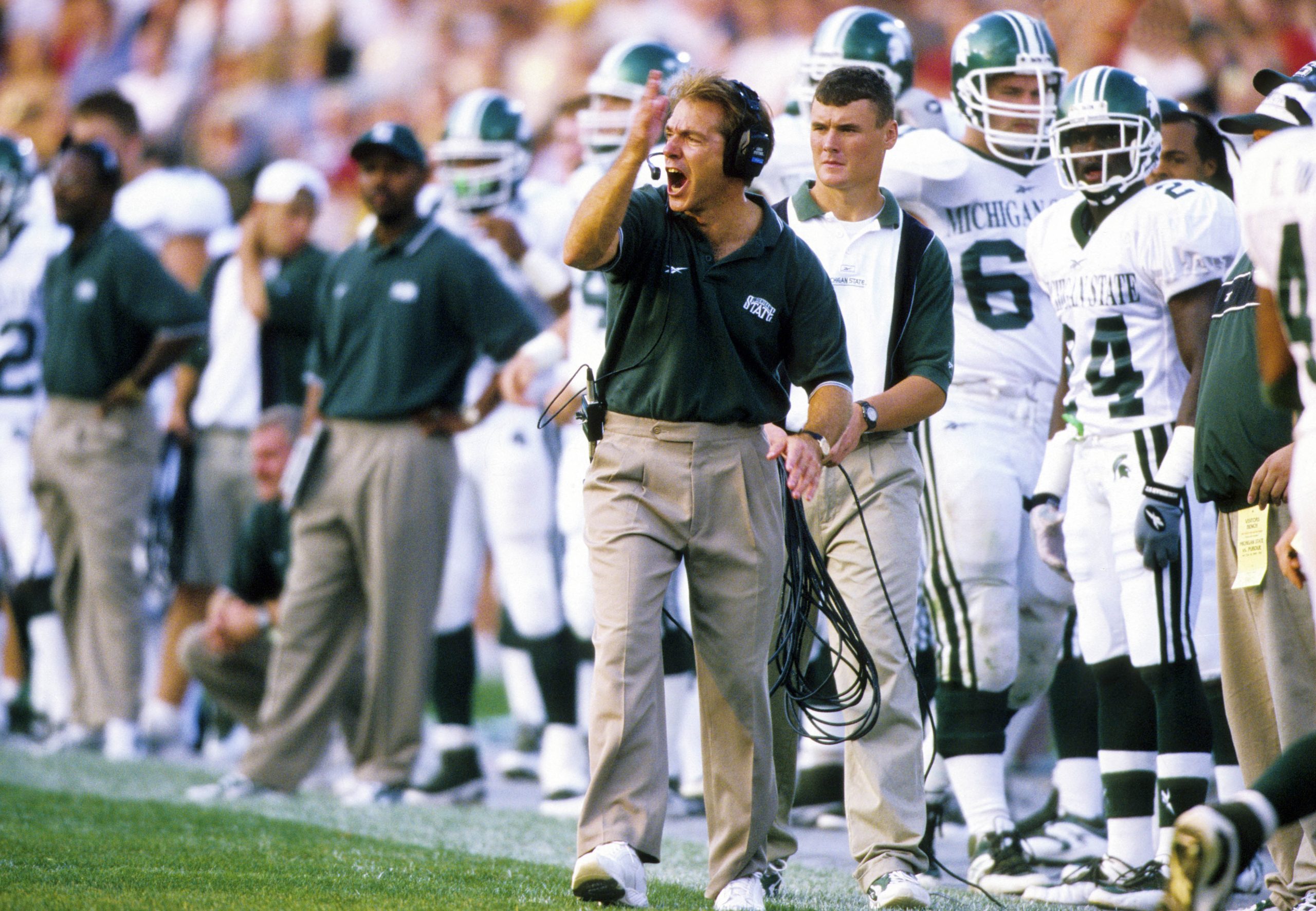
Saban shines a light on much of this, leaving the viewer to draw their own conclusions about what it all means. The series makes some deliberate choices about what to focus on and what to leave out. Most of the choices are logical, including insightful footage from Alabama’s national title wins, the infamous Kick-Six loss to Auburn, and what it was like when Saban told quarterback Jalen Hurts he was being benched for Tua Tagovailoa in the national championship game against Georgia. Other choices may raise an eyebrow, such as showcasing Saban’s support for players during the Black Lives Matter movement but avoiding moments like his NIL feud with Texas A&M coach Jimbo Fisher or the compliance concerns that often plagued his program. Segments like his contract negotiation fallout with Michigan State or his dalliance with the University of Texas can also be read as more sympathetic to Saban than the real story might suggest.
Both Dinallo and ESPN were adamant that they told the story the way they wanted, free from influence. But of course, you can’t help but wonder: if Saban’s wife isn’t an executive producer, does the docuseries dig a little deeper into the anger he displays on the football field and how that trickled outward, or lift up a few more rugs to see what was happening behind the scenes in the competitive world of SEC football recruiting?
One of the more ironic takeaways is that it’s impossible for Saban to understand what makes college football great while also being such a dominant force in it. So much of college football is about tradition, rivalry, and the fans. In the docuseries, Saban seems completely oblivious to all of that. Despite coaching Alabama for 17 years, he admits he has no idea what “Roll Tide” means. And he seems completely perplexed that LSU fans would hate him so much after leaving and eventually becoming the coach in Tuscaloosa.
It’s a fascinating dichotomy that makes you question what it takes to succeed in college football and how diametrically opposed that is to what we love about it.
Saban forces you to reflect on the cost of dynastic winning. While we see so much success, Saban himself often doesn’t make it seem like it was worth it, at least not in the way you’d expect. Bill Belichick, whom Saban worked under in Cleveland, shows up several times as a reminder that all the Super Bowls in the world can’t satisfy whatever’s inside you. And you can’t help but wonder: if college football hadn’t evolved into something he could no longer control, would Saban still be roaming the Alabama sidelines, or would he pull a Belichick and take another job just because he’s still got something to prove?
Ultimately, it’s a thought-provoking watch, and you’ll learn a lot about the legendary coach, despite his best efforts.
The post ESPN’s ‘Saban’ docuseries goes as deep as Nick Saban allows it to appeared first on Awful Announcing.
More at NCAAF College Football News, Photos, Stats, Scores, Schedule & Videos