'The JMU Way': Why James Madison keeps winning, no matter who's in charge

NCAAF College Football News, Photos, Stats, Scores, Schedule & Videos...
The old-timers in Harrisonburg, Virginia, remember where this all started.
It wasn't so long ago, in fact.
In September of 1972, a 30-year-old man named Challace McMillin recruited 60 men to form the first-ever football team at what was, just five years before, an all-women's university called Madison College. As the story goes, McMillin wandered through class registration lines plucking the most burly of men.
Half of them quit before the very first practice.
It did nothing to slow then-president Ron Carrier's plans of creating a football program to "change the psychology" of a campus still transitioning to coeducational.
Three years later, in 1975, Madison College finished undefeated and won the Virginia College Athletic Association.
More than a half-century later, James Madison University's athletic program buzzes with fervor.
Almost every fall sport is currently in first place in the Sun Belt; the school won 15 contests against power league programs last academic year; and the football program hasn't had a losing season since 2002. JMU's last two football coaches, Curt Cignetti (Indiana) and Bob Chesney (UCLA), are leading undefeated Big Ten teams, and its current leader, Billy Napier, has won his first six games as coach.
On Monday morning, more good news arrived: The school accepted membership in the American Conference, just four years after transitioning from FCS to FBS.
JMU administrators raised $5 million from donors to fund the Sun Belt exit fee and another $23 million from school-affiliated corporate sponsors to fund the American entrance fee.
"If you are asking if I would have predicted 25 years ago or even 15 years ago, this level of success, no," said Charlie King, a now-retired, longtime JMU vice president.
Join or create a Yahoo Fantasy Basketball league for the 2026-27 NBA season
King, and others interviewed by Yahoo Sports, help answer a vexing question.
How did this former all-women's college, tucked amid the rolling hills and blue crest mountains of the Shenandoah Valley, become one of the nation's fastest-ascending athletic programs in NCAA Division I?
Perhaps it's something in the clear mountain water? Maybe it's the recruiting lure of the spectacular setting; the hospitable comfort of a university whose mantra is "we hold doors open for people"; the passion of a football-craved fan base who bought the entirety of season ticket packages for four consecutive years?
Next man up: Billy Napier
In reality, it's all of it, plus darn good coaching hires (just look at the last three!) and some aggressive administrative support. The decades-long approach of university leaders is that successful athletics drives enrollment. The school subsidizes about 75% of JMU's $78 million athletic budget, most of which is from annual student fees ($55 million).
But this place, its culture, people, beauty and mystique, transcends coaches, administrators and even fans.
Napier realized that during one of his first interactions with a fifth-year senior. The player turned to the coach with a message: No matter who's in the head coach's office up there, we win.
There's a core group of local, longtime players who carry and ultimately pass the proverbial torch to new players and new staff.
"There is a player-led culture and a drive and standard that will not be compromised. They teach that to the new players who come in," Napier said. "I feel the same sense of urgency as these players have taught me."
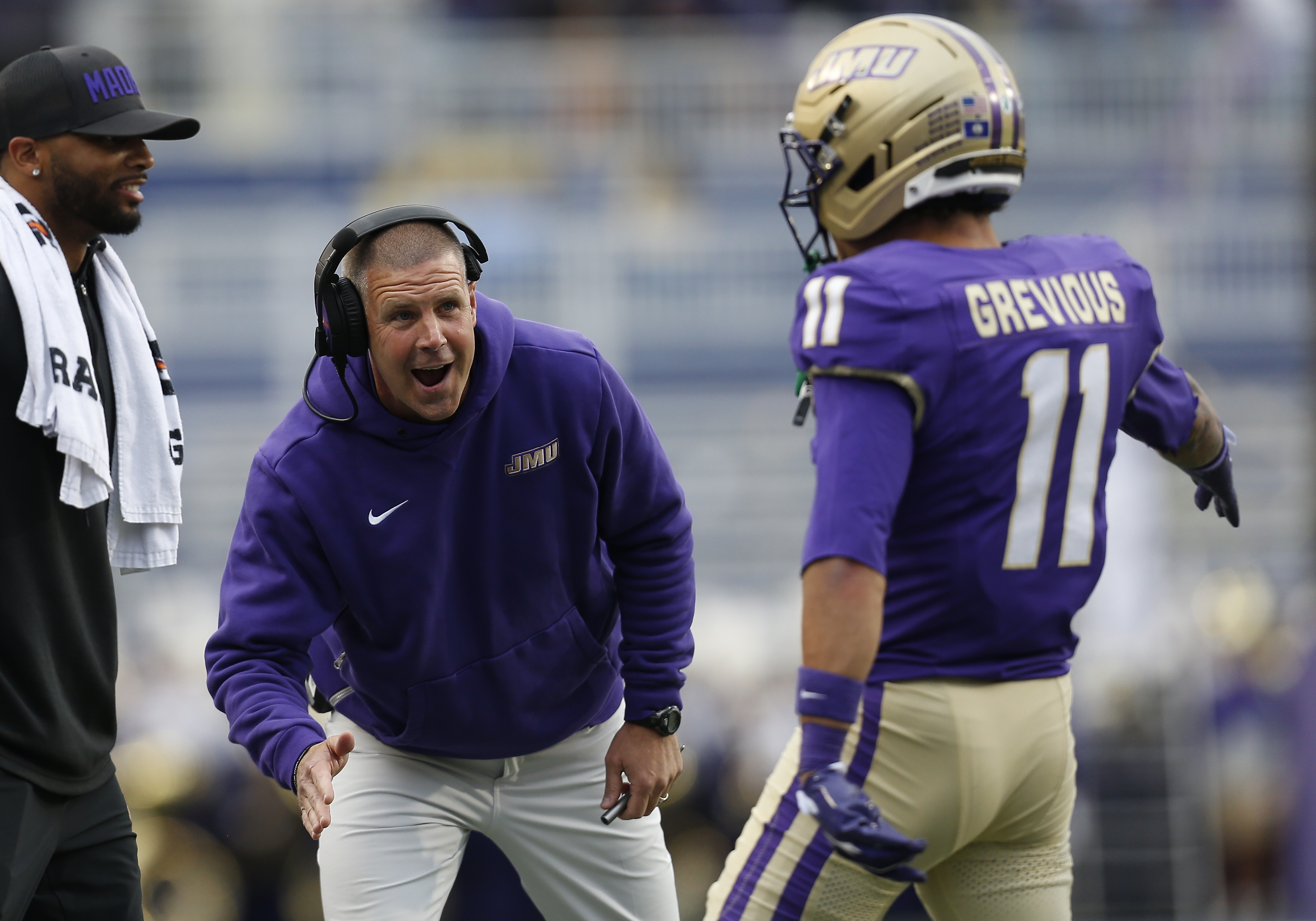
Ahead of a game against Georgia State this Saturday, Napier's 6-0 Dukes are receiving enough votes in the AP Top 25 that, in an extended poll, they'd be ranked No. 31, eight spots behind their leading challenger for the Group of Six playoff spot, No. 23 Boise State. The Dukes possess the nation's 10th-best scoring offense (41.8 points a game), 10th-highest producing running back (former North Carolina RB George Pettaway) and nation-leading return man (Michael Scott: 565 yards and two punt return TDs).
It wasn't easy to get here. Napier and staff held 64 official visits over 19 days in January that resulted in the addition of 63 new players.
A year removed from a firing at Florida after a 22-23 record in three-and-a-half seasons, he speaks like a changed man. He's "tweaked" his plan and "adjusted" things, he says, including surrendering offensive play-calling duties to coordinator Cam Aiken, a former offensive assistant at Clemson during its national title runs and for Lane Kiffin at Ole Miss.
For Napier, there's something else too.
"I have a lot to prove," he said. "I'm highly motivated as a result of the things that have happened in the past."
He's got plenty to live up to in Harrisonburg.
The school's football success is elite: FCS national championships in 2004 under Mickey Matthews and 2016 under Mike Houston; first-place finish (or tie) in the division or conference in nine of the last 11 years; and 24 consecutive non-losing seasons that has spanned six different coaches (counting Napier).
How JMU built itself up
The athletics boom here really started about 25 years after that first football team formed. As one of his last acts before retirement, Carrier hired and positioned King to oversee athletics from a university vice presidential role. King and new president Linwood Rose hired in 1999 as athletic director a former Georgia Tech and Virginia Tech fundraising whiz, Jeff Bourne.
Seven years later, Bourne and King made a tough decision that, they believe, remains the catalyst for the school's current athletic success: They eliminated 10 sports programs due to non-compliance with federal Title IX laws.
As a result, the school devoted more resources into the remaining 18 athletic programs. Scholarships increased to maximum NCAA levels, recruiting travel restrictions melted away and staff salaries rose.
"We had so many sports that we weren't funding any of them the right way," King acknowledges. "It turned the whole athletic program."
Meanwhile, Bourne led the school's first real fundraising effort. The year he took over the department, the Dukes raised $110,000. When he left, that number had ballooned to more than $3 million.
"There were a lot of years there where it felt like pushing the stone up the hill," he says with a laugh now years later.
But would any of this have happened without the Dukes winning the FCS crown in 2004? The school nearly fired Matthews in 2003 after his fifth season produced a record of 6-6.
"I remember there was a group of students behind the home bench chanting 'Fire Mickey!'" said Kevin Warner, a former student in the 1990s and a longtime administrator at the school. "We stuck by him, the next year we won the national championship and the new end zone facility opened. It was like, 'Boom! The program looked different.'"
A few years later, JMU famously beat Virginia Tech to become just the second FCS program to knock off a ranked FBS team, joining App State's 2007 victory at Michigan.
Over the years, each new football coach, in a different way, added to the foundation that Matthews and administrators created in the early-to-mid 2000s. Everett Withers followed Matthews, winning 18 games in two seasons, a conference title and establishing a small donor group, the Alpha Dogs, that still exists in funding the football program to this day. Houston won that national title in his first season, created a recruiting machine, won 37 games in three seasons and set up Cignetti for his five-year, 52-win stint.
It's an easy place to recruit to, Houston says — kind people, idyllic setting, wonderful weather. Harrisonburg is a quaint, 51,000-population town with ski resorts in the winter and water parks in the summer, a botanical garden and forest, and a booming culinary and arts district.
When Houston decided to leave his job at The Citadel for JMU, his wife questioned the move.
"Are you sure?" she asked him.
"When you see this place, you'll understand," he told her.
Three years later, after he'd left for East Carolina, Houston remembers Cignetti calling to ask about the job.
"Curt," he told him, "don't overthink it."
After Cignetti, Chesney won 21 games in two seasons and took the Dukes on that first FBS playoff run. Bourne hired all of those coaches before retiring and giving way to now-athletic director Matt Roan, a Virginia native and the man who not only gave Napier a chance at redemption but mobilized donors and sponsors to pay a $28 million price tag for the move to the American.
Moving to the American
The shift won't come without some lumps. At the top of spending in the Sun Belt, JMU may no longer be "the best resourced in its new conference," says Cliff Wood, a longtime donor and former CarMax executive who operated the school's collective and is now general manager.
"We're going to need money to maintain," said Wood. "Same as moving from FCS to FBS. In order for us to be successful, people have to put their money where their mouth is."
The American invitation is a testament to the elevation of JMU's national athletic brand, Wood says. In fact, five years ago, the Dukes made an attempt to transition from FCS to FBS to join not the Sun Belt but the American.
American officials weren't interested.
"I'll leave that as a no-comment," Wood said with a laugh, "but I think [their stance] has changed."
Still, an increase in resourcing is necessary and that starts with the roster. Believed to be now spending $5-7 million combined on its two most prominent sports, football and men's basketball, JMU may now need to reach the $10 million or more mark. American schools like Memphis and South Florida are poised to reach or get near the athlete revenue-share cap of around $21 million.
Already, the school is planning a multi-billion-dollar university facilities project expected to include new commercial and retail properties, academic buildings and athletics improvements. It features a rebuilt east side of Bridgeforth Stadium with a new football operations center.
"Culture is a key word here. Alignment exists," Roan says. "[Cignetti and Chesney] experienced it here and took it to Bloomington and Westwood. People pull the rope in the same direction and there is an appreciation of the value that athletics brings."
There are literal ropes being pulled here.
This summer, as a team-building exercise, football players hiked into the mountains. In groups of 10, players held onto a rope, shared a single gallon jug of water and alternated at the lead position.
"That was pain," said Jayden Mines, a fifth-year senior and one of the core group of older players here who pass on the "JMU Way" to the newbies.
"As soon as players get here," Mines said, "you flush where you came from or what you're used to. We've had a whole lot of transfers the last few years. You've got to take guys under your wing and teach them the JMU Way."
Amar Thomas, another fifth-year player, often hears from transfers that the JMU Way is unlike anything they've experienced elsewhere. "They've never played this hard for the man next to them," he said.
And, so, as No. 5 Indiana hosts No. 4 Ohio State and No. 12 UCLA hosts Wisconsin this Saturday, a former all-women's college tucked amid the Virginia mountains perhaps deserves a dash of credit.
And just think, 55 years ago no football program existed at all.
More at NCAAF College Football News, Photos, Stats, Scores, Schedule & Videos