College football coaching carousel: Why do so many big-money hires flame out?
NCAAF College Football News, Photos, Stats, Scores, Schedule & Videos...
(Editor's Note: This is the second piece of a two-part series on this year's college football coaching carousel and what will go into the decisions being made over the next two months.)
In the days before Auburn hired Hugh Freeze as head football coach, its athletic department worked with an outside consulting firm to gather data about how it would be received on social media and prepare a brief of all the negative stories that could pop up in traditional media. The results were unambiguous.
“Hugh was not a popular candidate,” a person with knowledge of that search told Yahoo Sports. “There was just so much in his past.”
Freeze’s overwhelmingly negative social media score was mostly related to his messy firing at Ole Miss in 2017, which arose from a toxic stew of NCAA recruiting violations and the discovery of a phone call to an escort service from his university cell phone.
Auburn athletic director John Cohen was aware if he hired Freeze, the public relations side would need a lot of work. Nowhere, though, was there much concern about the football part.
Cohen’s view, according to a person familiar with that search, was simple: “I don’t care about the court of public opinion. I want to win.”
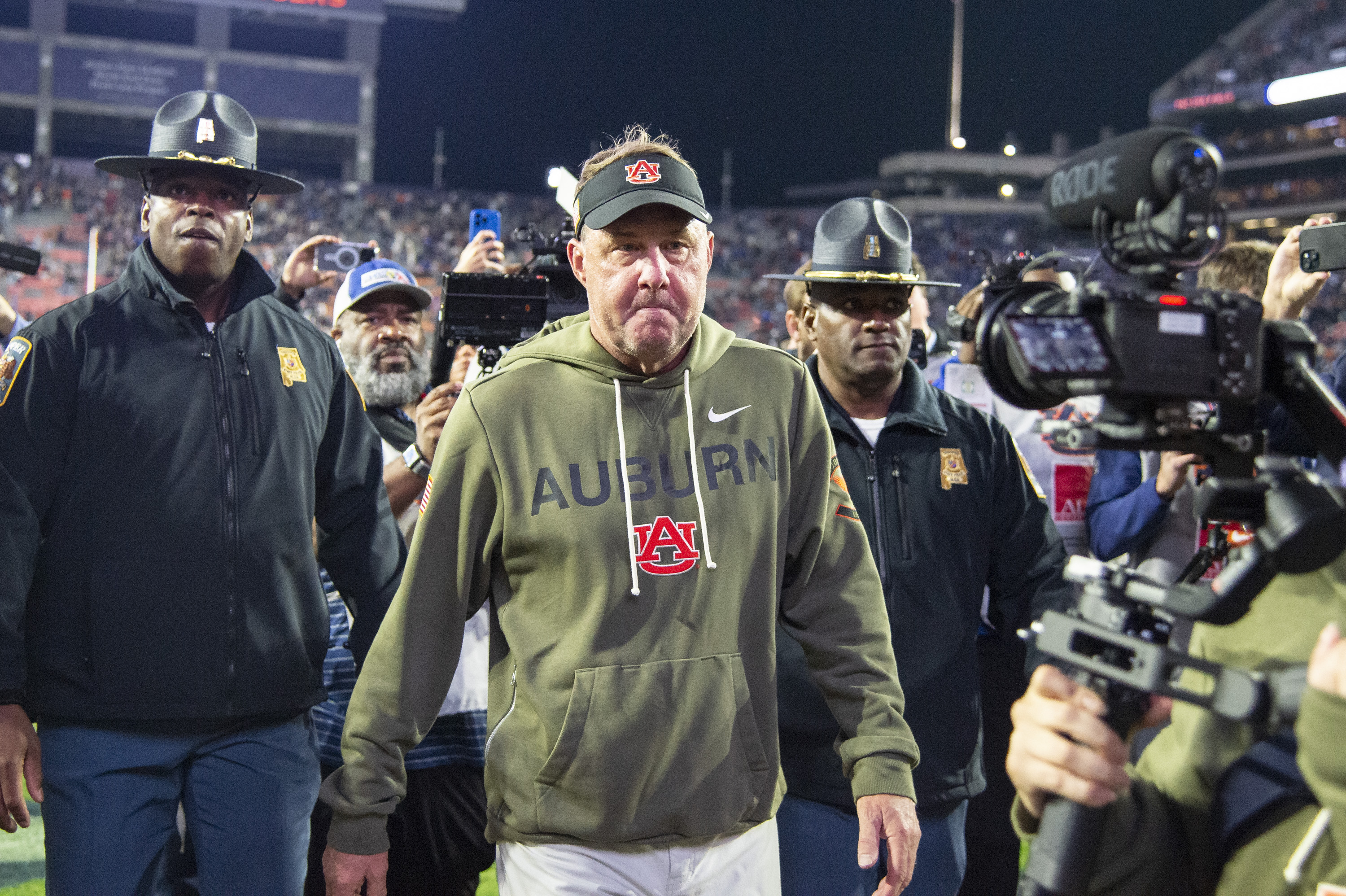
Freeze, of course, did not win. He was fired last weekend after his 19th loss in 34 games at Auburn, felled by an offense he couldn’t fix.
If you rewound the clock to November 2022 when Auburn was vetting Freeze and tried to anticipate all the ways he could have failed, this wouldn’t have been among the most likely. In fact, it may not have even been on the board. If there’s one thing Freeze had demonstrated at every level from Lambuth to Arkansas State to Ole Miss and a career resurrection at Liberty, it was the ability to score points.
And then at Auburn it just … didn’t happen.
It was an expensive mistake, with Freeze set to collect roughly $15 million to not work. It’s also far from the most egregious mistake made that cycle.
Of the 23 coaches hired in 2022, Freeze was the seventh to be fired, with Kevin Wilson (Tulsa), Ryan Walters (Purdue), Troy Taylor (Stanford) and Biff Poggi (Charlotte) not even making it to Year 3. Another high-profile coach hired around the same time as Freeze, Luke Fickell, is on the ropes at Wisconsin despite a strong consensus that it was the perfect pairing between school and coach.

For Part 2 of this Yahoo Sports series on the 2025 coaching carousel, we asked industry insiders why so many hires go so spectacularly wrong and whether the mountain of buyout cash schools have committed to spending this year — including Penn State’s $49 million to James Franklin, LSU’s $54 million to Brian Kelly and Florida’s $21 to Billy Napier — will prompt a rethink in how schools evaluate coaches and hand out contracts in the player compensation era.
“A lot of presidents and ADs would love to say, ‘You know what? We’re going to hire this rising coordinator and pay him $2 million because we need to invest in players,’” a person with an inside view into multiple searches told Yahoo Sports. “But they know if it backfires, they’ll lose their career. It would take a lot of courage.”
By the time any coach gets hired these days, they’ve been searchfirmed and background checked and put through the public relations car wash. Particularly since 2017, when an online mob of Tennessee fans revolted against hiring Greg Schiano — ultimately leading to the firing of athletic director John Currie — the notion of a candidate’s social acceptability with a fan base is always a consideration.
One wonders, if Twitter wasn’t still in its infancy in December of 2008, would Auburn have been scared away from hiring Gene Chizik, whose 5-19 record at Iowa State drew hecklers to the airport when athletic director Jay Jacobs brought him to campus?
And yet, just a couple years later, the stars aligned and made Chizik a national championship coach.
“This is like what Hollywood’s been dealing with for 1,000 years,” said another person who works with schools to evaluate coaches. “Who knows what’s going to make a hit? You really don’t know. The problem is, their jobs are dependent on knowing.”
Given the amounts of money at stake and the implications for an entire university when it goes wrong, hiring a college football coach is perhaps even more of a whimsical process than picking a movie script.
Why are so many bad hires made?
Everyone can see a head coach’s record or where a coordinator’s offense ranks in various statistical categories. But evaluating the why of it all is a struggle for most administrators. Why did their previous coach fail? And when evaluating candidates, will the skills that helped them succeed previously apply in a different environment?
Yet every time a power conference job comes open, athletic directors and presidents are making a minimum $50 million decision, largely in secret, and often with limited face-to-face interaction with the candidate himself. And then, once the hire is made, they are expected to essentially hand over autonomy of a nine-figure business with relatively little oversight by the athletic director into key decisions like coordinator hires that will make or break their tenure.
“The process is just so bad,” another veteran of the coaching industry told Yahoo Sports. “The search firms will get guys on these 30-minute Zooms and the ADs don’t know what questions to ask because they don’t have football expertise and then everyone’s surprised it doesn’t work out. If you don’t know the intricacies of what matters in the game today, and you don’t know what affects winning, how can you know who to hire next?”
The red flags are always easier to spot in retrospect.
Maybe Florida should have given more credence to the fact that Napier’s 40-12 record at Louisiana came in the pre-NIL era at a school that was far more invested in football than its Sun Belt counterparts.
Perhaps Wisconsin, a program with a long track record of winning with its offensive line and running game, should have vetoed Fickell’s decision to import the air raid via offensive coordinator Phil Longo.
And LSU, instead of buying into Kelly’s name and track record at Notre Dame, should have done more legwork on his recruiting strategy rather than let him come in and get rid of key staff members who were plugged in on Louisiana high school talent.
But the hiring track record probably won’t get much better because the job of head coach is so unique and ever evolving in this era that matching skill sets with an individual program’s needs will ultimately require some level of guessing. And when you factor in the influence of boosters or politicians on the decision-making process at certain schools — people who certainly have less expertise than even the athletic director — it can be a messy process.
“You think of our industry and how dumb it is, you have somebody who has expertise in some particular area that is so substantial that they get promoted, right?” Texas A&M athletic director Trev Alberts said. “And of course everybody wants to be the head coach because you get the salary, you get the trappings and all that stuff. But so many times, the one thing that was a differentiator for them professionally, they now go into a role that they’re not performing any of what they were an expert at and now they’re in a role that they’re not great at. As an administrator, I think that gets harder and harder to identify. Look at the NFL and all the money that’s thrown around there. They’re certainly not perfect in their hires either.”
As the coaching carousel takes shape over the next month and beyond, many schools will find themselves caught in between two models of college sports.
While the game now looks much more like the NFL in terms of parity and building a roster through a structured payroll, college coaches are often still evaluated by old metrics. What worked for Kelly and Freeze in the pre-NIL era clearly did not work for them now, and the same could be said about other struggling high-profile coaches like Dabo Swinney at Clemson.
While NFL coaches make a lot of money, too, consider that the NFL salary cap of $279 million is 19 times bigger than the reported $20 million salary of Andy Reid, the league’s highest-paid coach.
In college football, the most expensive rosters — around $40 million including revenue sharing and NIL — are only about three times bigger than the $13 million salary for Georgia’s Kirby Smart.
In other words, college football directs a significantly larger percentage of its total spending toward the head coach even though the buildout of a program increasingly mimics an NFL structure.
That’s why, for all the public mocking of LSU and Gov. Jeff Landry’s apparent meddling, some corners of the college athletics world quietly applauded when he criticized the ways coaching agents manipulate the market and called for contracts with significantly less guaranteed money.
Doing something about it, though? That’s another story.
“Across the country, it made a lot of people think and say, ‘Wait a minute, should we be doing these contracts?” one person currently involved with multiple searches said. “But you and I know, if LSU signs Lane [Kiffin], Jimmy Sexton isn’t letting him go there without $12 million a year fully guaranteed. So you’re going to be right back where they were. I don’t know what the answer is.”
Is there a good answer for schools on the hunt?
Franklin’s next move will be an interesting test case. Despite the implosion at Penn State, he is among the hottest commodities on the coaching carousel, with Virginia Tech pushing to hire him and other schools keeping a close eye on his availability.
It makes sense in a traditional mindset: Franklin went 104-45 at Penn State and reached the College Football Playoff semifinals last year. But after so long as a head coach, Franklin’s major weaknesses — tactical deficiencies and game-management issues — are not likely to change when he takes a new job. If anything, they’re likely to be magnified at a school with fewer talent advantages than he enjoyed at Penn State.
Because of his name and track record, hiring Franklin will buy an administration credibility with their fan base. But it’s impossible to look at the Freeze and Kelly flameouts and not question whether Franklin will go somewhere else and suffer the same fate.
At the same time, it’s much easier to tell schools that they need to invest in the next Marcus Freeman like Notre Dame did or identify the next Dan Lanning like Oregon did than it is to go figure out who that’s going to be.
Often, it’s a spin of the roulette wheel.
When Georgia Tech hired Brent Key, it did not know that the former offensive line coach was going to be an elite culture-setter and toughness-builder who understood how to delegate authority to his coordinators and engage donors on NIL. After all, the school initially tried to hire Tulane’s Willie Fritz before the deal fell apart late in the process.
Similarly, Texas A&M only hired Mike Elko because boosters vetoed former athletic director Ross Bjork’s attempt to hire Mark Stoops. He turned out to be the perfect fit, bringing a level of accountability and seriousness that a talented roster had lacked under Jimbo Fisher.
“If you looked at the reaction when Arizona hired Jedd Fisch, it was catastrophic,” a person close to that situation told Yahoo Sports. “Then within two years, they’re killing the AD for letting him go to Washington. But most presidents and ADs can’t make that hire in the first place because they’re making decisions out of fear. Do you want to win the press conference or do you want to win games?”
More at NCAAF College Football News, Photos, Stats, Scores, Schedule & Videos