5 remarkable engineering innovations of 2025
Popular Science...
(Editor’s Note: This is a section from Popular Science’s 38th annual Best of What’s New awards. Be sure to read the full list of the 50 greatest innovations of 2025.)
Grand Award Winner, Engineering
Superwood by InventWood: Stronger than steel and 6 times lighter, no blast furnace required

Steel is responsible for roughly 8 percent of greenhouse gas emissions, but is so reliable that builders don’t want to go without.
Researcher Liangbing Hu found a new approach to this problem through serendipity. As a young researcher at UCLA and then Stanford, Hu was trying to figure out how to assemble batteries out of carbon nanotubes—but finding that constructing at the nanoscale was challenging and expensive. He had an “aha!” moment looking at wood fibers, realizing that the nanofibers within wood cells are about 100 times as strong as regular wood. And in terms of scaling up efficiently and in a way that sequesters carbon? Just grow a tree.
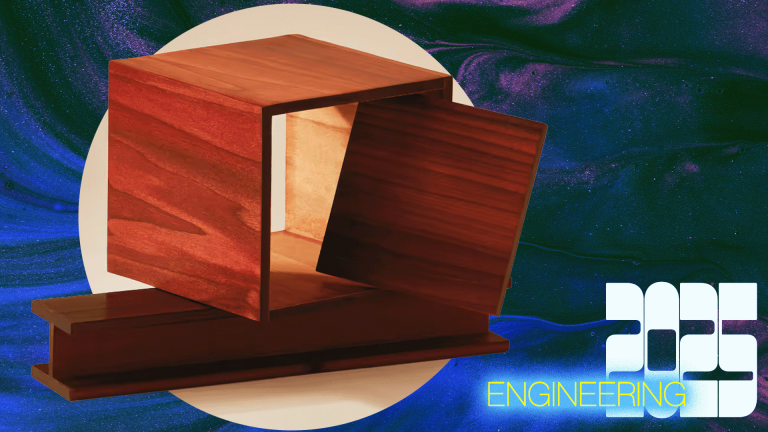
Hu devised a chemical bath to remove the lignin that holds the cellulose in wood together. By then heating the resulting fibers, he was able to compress the wood by roughly 80 percent of its original thickness, using his knowledge of the nanoscale. He collapsed the internal structure in a way that eliminated weaknesses and strengthened bonds. (You can think of it as getting rid of all of the space inside the wood fiber.) His process also darkens the wood, and renders the material stronger than steel, not to mention six times lighter. The result is Superwood.
Experts question whether the famously risk-averse construction industry will embrace such a radical replacement for steel, and not without reason. If you’re building a $2 billion skyscraper, would you want to tell your lender that you’re rolling the dice on treated wood without a decades-long safety record?
But Alex Lau, CEO of InventWood, the company that licensed Hu’s discovery, says that once the company scales up, he aims to sell Superwood at half the price of steel. But for now, he will win hearts and minds in the construction industry by first targeting the wood-friendly markets for decking and roof materials, before moving in on structural elements and Superwood-optimized buildings. And then there are the environmental benefits. Superwood can be made out of many different kinds of tree—you can even make the stuff out of the roughly 10 to 20 percent of forestry products that are discarded as the wrong species, or the 40 percent of sawmill wood deemed non-premium that would otherwise be chipped or burnt. Lau says he can displace half of US steel demand, or 50 millions tons, with just 12.5 million tons of Superwood. That sounds like a lot, but he points out we send that much waste wood to the landfill each year—and there are 14 million tons of excess capacity wood in Southern lumber mills.
Sand Battery by Polar Night Energy: An industrial-scale thermal battery out of sand to avoid fires and mining pollution
Industrial-scale batteries provide one way to keep renewable power going when the wind stops blowing or the sun stops shining. But manufacturing batteries from lithium, cobalt, or iron has a significant greenhouse gas footprint and can also lead to metal and water pollution.
A Finnish company called Polar Night Energy is tackling the intermittency problem by upcycling crushed soapstone, a byproduct from a local fireplace factory, to create the largest sand battery in the world. Instead of storing electricity, this thermal battery stores heat in a roughly 43-by-49-foot insulated steel cylinder. The system takes excess electricity from the grid to heat up the sand. Then, pipes built into the battery direct cold air in, allow heat to transfer from the sand, and then send hot air out, at temperatures between 140 and 752 degrees F. The hot air can then be used to make steam for industrial processes, or to warm up buildings or water. Unlike conventional batteries that become less efficient over time, the sand does not degrade, and the battery has an expected useful life of 30 years. And unlike lithium-ion batteries (or oil refineries), the sand will never catch on fire.
Though using hot sand as a battery is an ancient idea, the tool is modern and industrially rated, storing up to 100 MWh of energy for months at a time. This is enough for a month of heat demand in the battery’s small hometown of Pornainen, and a week during the icy Finnish winter.
And this is just the first industrial-scale project from Polar Night Energy; the company plans to compete with lithium-ion batteries for certain industrial applications at smaller sizes—between 2 MW and 10 MW—across Europe. The cost per stored kilowatt hour is lower too, though high upfront costs and builders who don’t like unfamiliar tech are obstacles. Nearly 40 percent of industrial applications for heat are in the sand battery’s temperature range.
Willow Quantum by Google: A chip that actually makes fewer errors as the number of physical qubits increases
Error correction is a crucial feature in any computer chip, and it’s even more important in quantum computers. That’s because minor material glitches, changes in temperature, and even cosmic rays can alter the way the computing entities known as qubits store or transmit information.
Google logged a major milestone in the road to an actually practical quantum computer with a new approach to quantum-error correction. With a new machine called Willow, Google has created a 105-qubit machine with the unprecedented ability to reduce errors even as the number of qubits in operation increases. Because qubits are inherently error-prone, traditionally, the more qubits in a chip, the greater the likelihood of a glitch. By placing qubits assigned to store data in a grid with error-correcting qubits, the Google research team was able to actually make the number of errors go down even as the number of qubits increased. That means that the 7-by-7 array had better error correction than the 3-by-3—an unprecedented achievement. Google reports that Willow completed a benchmark number test in five minutes that would have taken a conventional “classical” supercomputer 10 septillion years—that’s older than the age of the universe. And that points to the power of unleashing quantum effects on problems.
It’s not all puppies and rainbows in quantum land, however, where research computers typically start at a million dollars yet can’t solve any real problems. But they won’t be able to without robust error correction, and so Willow is a dramatic step forward.
Populus Hotel by Urban Villages/Studio Gang: an Eco-Hotel That Takes Sustainability Seriously and Looks Like an Aspen Tree
With windows inspired by the black “eyes” in white Aspen trees made when branches fall off, Populus is more than just a curvilinear visual feast: The shading also helps reduce the amount of heat the building takes in the summer.
The ample use of timber in construction reduces (but doesn’t eliminate) the need for carbon-intensive concrete in construction. The builder used a special lower-carbon concrete containing the coal waste product known as fly ash, which resulted in 30 percent less emitted carbon than conventional concrete. There is an on-site digester that converts food waste into compost. Plus, there is no on-site parking, both to reduce the need for cement and reinforced steel, and to incentivize the use of transit and ride-sharing.
The hotel has sponsored the planting of 70,000 thousand trees in Colorado to offset the carbon footprint of materials, and then purchased other carbon offset. (In part, because most of the tree seedlings died due to drought and a beetle infestation). They also buy wind energy credits from their electric company. In an online dashboard, the hotel says it has already sequestered 116 percent of the carbon that was released during construction and ongoing operations.
University of Colorado environmental studies professor Joel Hartter is not sure all of the claims pencil out. For example, he points out that offsets are like paying someone else to eat vegetables so that you can keep eating fast food. After all, the lowest-footprint solution would be to not build a beautiful wintry destination heated with methane to have people fly in to visit. But he doesn’t want to make the perfect the enemy of the good. He says the Populus Hotel helps show the tourism industry, which is badly in need of improvement, of what a commitment to sustainability requires. In comparison with a typical luxury hotel, it’s like looking at apples and oranges.
Delivery Zip by Zipline: An autonomous drone system safely winching burritos down into the front of Dallas homes
Drone-based delivery in a crowded urban area has long seemed too complicated and dangerous to undertake—but now it’s real, and starting to feel, well, normal. Beginning in April, Zipline began a service in which a 5-propeller drone copter collects a burrito or a smartwatch from retailers like Chipotle or Walmart by reeling up a robotic rectangular cargo vehicle called a “Delivery Zip.” The copter then flies autonomously to the customer location and winches down the Delivery Zip for delivery. Sounds like sci-fi, but Dallas-area senior citizens and single parents in particular love the new service. (The company reports serving “tens of thousands” of DFW customers). Around the world, Zipline has made over 1.85 million drone deliveries, and flown more than 120 million miles without a single serious injury. Those delivery numbers leave deep-pocketed competitors funded by Google and Amazon in the dust.
Zipline began delivering blood transfusions and then other medication in Rwanda in 2016, from the capital of Kigali to far-flung rural regions where roads were inaccessible. Among the results was 51 percent fewer deaths from postpartum hemorrhaging in facilities served by Zipline. Today, after expanding service to the Ivory Coast, Nigeria, Ghana, and Kenya, and with medical trials in the UK and the US, the company has delivered more than 25 million doses of vaccines. Zipline is rolling out retail and food delivery to various sub-regions of the Dallas-Fort Worth area—there are 20 and counting as of press time. The first-generation Zipline platform used a fixed wing drone that dropped medical supplies by parachute; the team invented the second-generation P2 platform with the Delivery Zip given the more precise landing requirements of a crowded city.
The post 5 remarkable engineering innovations of 2025 appeared first on Popular Science.