12 Black women in history who pushed U.S. politics forward
TheGrio...

As champions for civil rights, voting rights, women’s rights, and democracy, Black women have always led the charge in shaping U.S. policy.
While Black women have been on the frontlines of every social and political movement in the United States, they have often been sidelined or not fully recognized for their contributions. As champions for civil rights, voting rights, women’s rights, and democracy, Black women have always led the charge in shaping U.S. policy, making the nation more free and just for its citizens. As the United States approaches 250 years, here are twelve influential Black women in history who stand out in advancing U.S. politics over the years.
Shirley Chisholm

There is probably no name more frequently mentioned in discussions of U.S. politics and Black women than that of Shirley Chisholm, a trailblazer for more reasons than one. A native of Brooklyn, New York, Chisholm became the first Black woman elected to the United States Congress in 1968, serving in the U.S. House of Representatives until 1983. During her time on Capitol Hill, the outspoken and unapologetic New Yorker–who faced both racism and sexism from her white and Black male colleagues–helped to expand opportunities for inner-city Americans, including education, health care, and social services. Chisholm played a critical role in the creation of the Special Supplemental Nutrition Program for Women, Infants, and Children (WIC) in 1972, which remains a vital resource for low-income mothers more than 40 years later. Chisholm was also a founding member of the Congressional Black Caucus and is probably most revered for her historic 1972 run for president of the United States, becoming the first Black American and Black woman to seek the highest office in the land. Chisholm’s bold championing of women’s equality, including in electoral politics, inspired the historic presidential campaigns of Hillary Clinton and Kamala Harris.
Fannie Lou Hamer

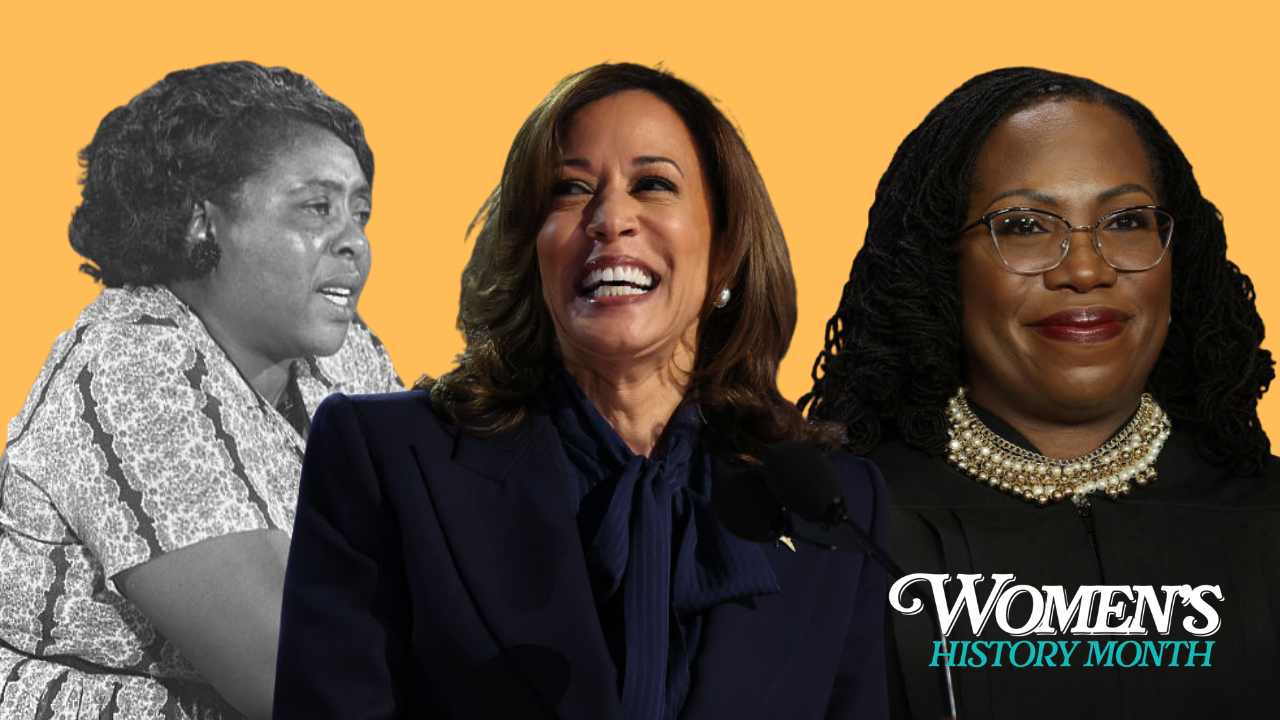
Though she served as an organizer rather than a politician, Fannie Lou Hamer’s advocacy for Black Americans’ voting rights undoubtedly paved the way for equal access to the ballot, equal representation in U.S. electoral politics, and the elected Black politicians who followed. During the 1960s, Hamer stood up against the disenfranchisement of Black voters throughout the Jim Crow South. After being shot at, attacked by racists, and forced to temporarily flee her home for attempting to vote in Mississippi in the early 1960s, Hamer emerged as a prolific voting rights organizer, eventually co-founding the Mississippi Freedom Democratic Party (MFDP). The anti-discrimination party challenged Democrats to address its silencing of Black voices within its party, culminating in their presence as delegates at the 1964 Democratic National Convention. Hamer famously delivered a televised testimony before the DNC’s Credentials Committee, which was notably interrupted by a staged press conference by President Lyndon B. Johnson. Hamer’s unrelenting advocacy eventually led to the MFDP being seated at the 1968 DNC convention and the party adopting a clause demanding equality of representation from all of its state delegations. Fannie Lou Hamer unsuccessfully ran for the U.S. House of Representatives in 1964 in a district where only 3% of Black voters cast ballots, despite making up more than 52% of the population. She compiled witness testimony from Black voters who shared stories of disenfranchisement in the former slave state. The testimony she compiled was instrumental in passing the Voting Rights Act of 1965, which federally prohibits racial discrimination in voting.
Coretta Scott King

Coretta Scott King was not just the wife of civil rights giant Dr. Rev. Martin Luther King Jr.–she was a fierce advocate in her own right who notably championed civil rights, women’s rights, and LGBTQ equality. Mrs. King, like many Black women of her time, is an unsung hero of the Civil Rights Movement. She actively advocated for the passing of the Civil Rights Act of 1964, including an unsuccessful push to add an amendment to add gay and lesbians as a protected class. Following the assassination of Dr. King, Coretta Scott King carried out her husband’s mission of calling the nation to a moral high ground to advance equality. Mrs. King used her political power to advocate against apartheid in South Africa, resulting in her 1985 arrest during a protest outside the South African embassy in Washington, D.C. Mrs. King also broadened her advocacy focus to women’s rights, LGBTQ rights, world peace, and various other policy issues. Mrs. King most notably helped to secure a federal holiday in honor of her late husband, marking the first such holiday for an African American.
Kamala Harris

Vice President Kamala Harris’ entire career has been filled with breaking glass ceilings for women and women of color. Before being elected the first Black and first South Asian vice president in United States history, Harris served as the first Black U.S. senator in California, the first Black and first female California attorney general, and the first Black and first female district attorney of San Francisco. As the 2024 Democratic presidential nominee, Harris aimed to make history again as the first woman, first Black woman, and first South Asian person to be elected president of the United States; however, she was unsuccessful. Still, Harris made history as the first Black and South Asian woman to win a major party presidential nomination — and managed to pull off a national campaign in just 107 days after President Joe Biden dropped out of the 2024 election.
As a graduate of Howard University and member of Alpha Kappa Alpha Sorority, Inc., Harris is the first vice president to graduate from an HBCU and to be a member of a historically Black Greek Letter organization, also known as Divine Nine. She has used her role as VP to increase visibility for the legacy and value of HBCUs and Divine Nine organizations.
As vice president, following in the legacy of former President Obama, Harris has established a renewed representation of Black power both domestically and abroad. Her unique role as an African-American and as a Black woman has been leveraged in the Biden administration’s effort to improve U.S. relations with African and Caribbean nations, as well as taking the lead on the White House’s efforts to protect reproductive rights after the Supreme Court overturned the federal right to an abortion. Harris has also used her powerful position to continue advancing the policy issues she worked on as a U.S. senator, including addressing Black maternal health and investing in Black- and minority-owned businesses.
The Colored Girls: Donna Brazile, Yolanda Caraway, Leah Daughtry, and Minyon Moore

Collectively, Donna Brazile, Yolanda Caraway, Leah Daughtry, and Minyon Moore — known as “The Colored Girls”– transformed U.S. politics over the span of 30 years. Their leadership, mostly behind the scenes of Democratic politics, helped build and advance Black political power. The four women document their unsung storied political careers in the 2018 book, “For Colored Girls Who Have Considered Politics.” Getting their start on the 1984 presidential campaign of the Rev. Jesse Jackson, Brazile, Caraway, Daughtry, and Moore went on to work on the presidential campaigns of Walter Mondale, Michael Dukakis, Bill Clinton, Al Gore, Barack Obama, and Hillary Clinton. The four political operatives helped transform the Democratic Party, propelling it into its modern form, steeped in pro-justice and racial equality. The women have served in critical roles within the Democratic National Committee, including serving as chair of the national party. The Colored Girls were also notably influential in Joe Biden’s decision to select a Black woman as his vice presidential running mate.
Carol Moseley Braun

Carol Moseley Braun is a trailblazer whose historic election to the U.S. Senate in 1992 paved the way for Kamala Harris, who would go on to become the nation’s first woman and first Black woman Vice President of the United States. Moseley Braun became the first Black woman and first African American from the Democratic Party elected to the Senate in U.S. history, representing the state of Illinois from 1993 to 1999. Moseley Braun also followed in the footsteps of Shirley Chisholm by launching a bid for U.S. president in 2004. The Chicago native eventually withdrew from the race before the consequential Iowa caucuses. Though Moseley Braun never again served in elected office, she has spent nearly the last three decades serving in various capacities, including United States Ambassador to New Zealand and Samoa from 1999 to 2001 and chair of the board of directors of the United States African Development Foundation under President Joe Biden.
Ketanji Brown Jackson

Justice Ketanji Brown Jackson’s confirmation to the U.S. Supreme Court in 2022 has already been consequential. As a member of the ideological minority on the nation’s high court, Jackson’s judicial dissents are sought after by legal scholars and have been embraced for grounding consequential and controversial decisions by the Supreme Court. Jackson expressed strong opposition to the court’s striking down of affirmative action based on race at colleges and universities, accusing the court’s conservative majority of improperly framing the Equal Protection Clause under the 14th Amendment, and explained that affirmative action was used as a corrective measure to address racial discrimination because “our country has never been colorblind.” Jackson’s questioning of litigants in the case has been credited for influencing Chief Justice John Roberts not to go so far as to completely ban race as a consideration in college admissions. As ensuing marquee cases are set to be decided by the Supreme Court by June 2026, including the future of the Voting Rights Act, and the Trump administration’s attempts to end birthright citizenship, Jackson’s judicial voice on the court, in the dissent or not, stands to be forever etched in history.
Maxine Waters

Maxine Waters remains one of the most beloved and recognized Black women in politics, having served in the United States Congress since 1991. Affectionately called “Auntie Maxine” within the Black community, the California U.S. congresswoman and former chairwoman of the Congressional Black Caucus has been a vocal advocate for racial justice, particularly in housing and the banking industry. In 2019, Waters made history as the first woman and first Black woman to serve as chair of the powerful U.S. House Committee on Financial Services. Waters gained national attention during the 1992 Rodney King riots in Los Angeles (the district that she represents). Waters used her influence to humanize Black residents in LA who were outraged by the beating of King and continued police brutality in the city, which was a microcosm of an issue impacting Black Americans across the country. At 87 and running for her 18th term in Congress, Waters isn’t slowing down. Should Democrats win back the majority in the U.S. House in the November 2026 midterm elections, Waters is set to return as chair of the Financial Services Committee–where she has advocated for the protections for Black and minority consumers–making her the oldest chair in history.
Stacey Abrams

Despite the gains Black women have made in U.S. history, a Black woman has never been elected governor of any U.S. state. Stacey Abrams remains the closest Black woman to achieving that feat when she ran for governor of Georgia in 2018 and 2022. Abrams remains the only Black woman to secure a party’s gubernatorial nomination. Over the years, Abrams has emerged as a tactical and savvy voting rights activist and organizer. In 2018, the Spelman College and Yale Law graduate founded Fair Fight Action to combat voter suppression. Abrams’s efforts to register Black and Brown voters across the state of Georgia led to her being credited for boosting voter turnout in Georgia in the 2020 election, handing Joe Biden a shocking victory in a state that had not elected a Democrat for president in nearly 30 years. Abrams has gone on to use her political influence to educate American citizens about the rise of authoritarianism in the United States under the second Trump presidency. In her “10 Step Campaign,” Abrams lays out the 10 simultaneous actions autocrats have used throughout history to backslide a democracy into an autocracy. Abrams urged Americans to fight back against authoritarianism with her “10 Steps to Freedom and Power.”