College football's new reality: Schools can't fire their way out of trouble anymore

NCAAF College Football News, Photos, Stats, Scores, Schedule & Videos...
At this point in the college football season one year ago, Mike Gundy had been dismissed from Oklahoma State, James Franklin was working on his next job at Virginia Tech (which had fired Brent Pry a month earlier), Bobby Petrino had taken over as interim coach for Sam Pittman at Arkansas and UCLA was having a midseason renaissance after getting rid of DeShaun Foster.
But this fall, as we head into Week 7, the coaching carousel is oddly frozen in place.
Nobody's been fired yet. Call it college football's October surprise.
While the industry predicted a quieter coaching market after last year's bonanza, which resulted in more than $200 million worth of buyouts, something else is bubbling beneath the surface.
After decades of unfettered spending, the rising cost of rosters might finally be slowing down the coaching churn — at least a little bit.
"It's a money thing," one agent told Yahoo Sports. "People who don't have any money to pay players are having to rethink what their ceiling is with their current spend."
If this year's coaching cycle were like those of recent vintage, you'd have expected jobs like Maryland, Rutgers, Florida State and maybe even South Carolina to be open by now. Though nobody liked the optics of early-season firings, the trends were undeniable as the transfer portal increased the pressure on administrators to have their new coaches locked up by early December. Schools saw an advantage in getting into the coaching market as quickly as possible so they could start engaging freely with agents and search firms.
Join or create a Yahoo Fantasy Basketball league for the 2026-27 NBA season
Instead, across college football this year, there has not been much urgency to make moves, even though some power conference jobs are certain to come open.
Why has it been slow to materialize this time around?
In conversations with sources who represent various sectors of college sports, a picture has emerged of an industry being forced to confront its new reality in a world of $40 and $50 million rosters. At each school, administrators are having to consider two questions before pulling the trigger on a significant buyout:
Do you have a coaching problem or an infrastructure problem?
How, specifically, will spending tens of millions to swap out a coaching staff fix it?
While a thorough cost-benefit analysis may seem like common sense, college football has long operated on the principle that firing a coach is the cure-all. Buyouts, no matter how expensive, were treated like line items in a budget that could be recovered by a boost in ticket sales or donor excitement. It was, in a sense, the last vestige of a fixed market where schools didn't have to pay the players.
This season, though, lessons are being learned on several different fronts.
The schools where coaching changes have paid the most immediate dividends — think Bob Chesney at UCLA and Will Stein at Kentucky — made under-the-radar strategic hires rather than splashy ones.
Schools that thought about firing their coaches last year but decided to hold on and invest more in the roster — think Baylor and Wisconsin — are not currently on a trajectory to fire those coaches this year because they've managed to rebound.
And traditional powerhouses that thought they could immediately turn their fortunes by replacing big names with "win the press conference" names — think Penn State and LSU — are among the biggest disappointments in the country.
"If you're an athletic director, you're better off letting it play out," one highly placed industry source told Yahoo Sports. "I felt like last year the American Conference was really down but the SEC hired three coaches from that league [Alex Golesh from South Florida to Auburn, Jon Sumrall from Tulane to Florida and Ryan Silverfield from Memphis to Arkansas]. Nothing against those guys, but if that was the market last year, what's the market now? Who are you going to get?"
Coming into this season, the expectation across college football was that Southern Cal and Florida State would be the two large dominoes that kickstarted much of the coaching activity.
As of today, it's unclear that either will open.
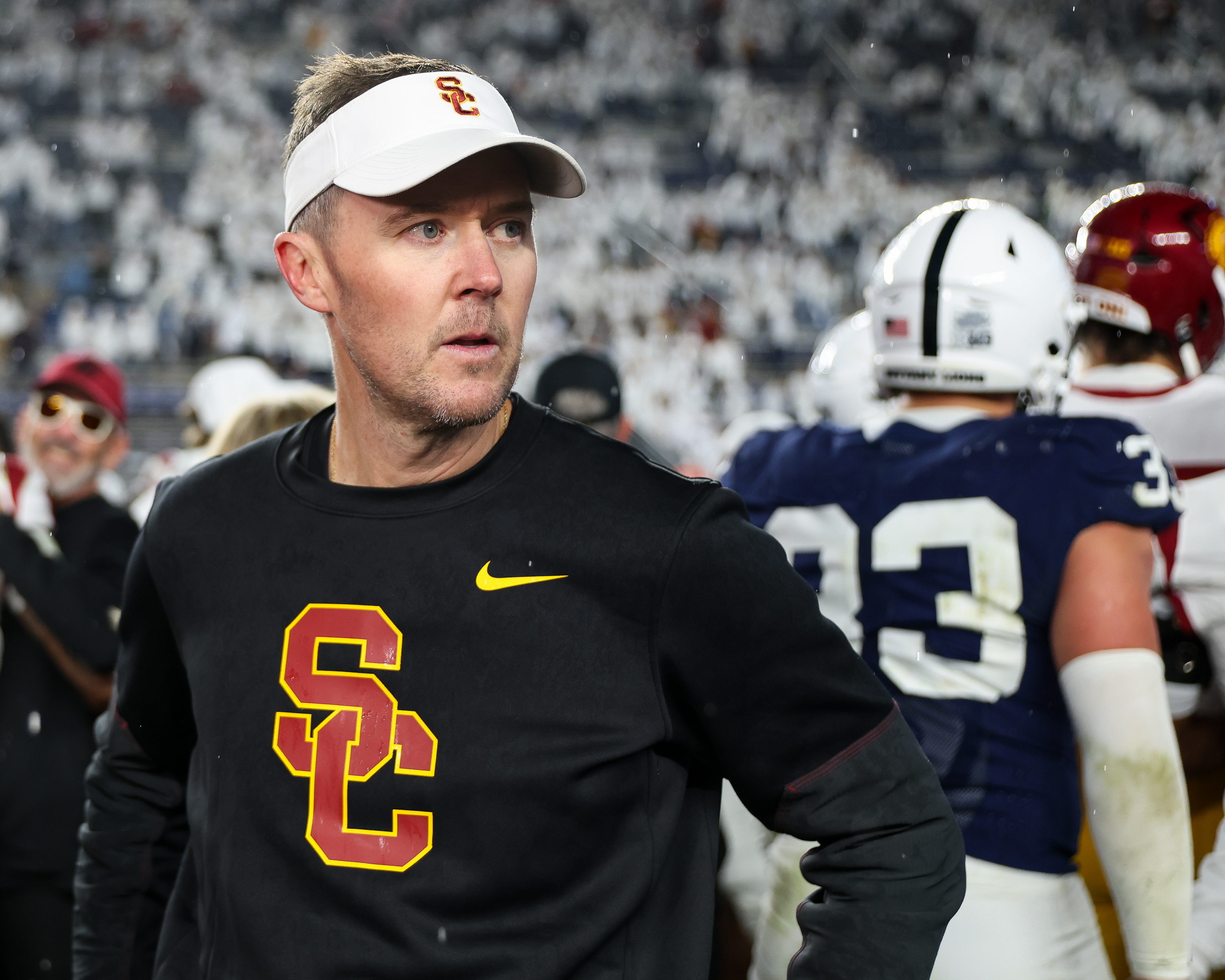
At USC, Lincoln Riley is 6-1, with last week's win at Penn State calming some of the discontent that has been bubbling around the program all year. While the tenor of the season could still turn sour in November after games against Ohio State and Indiana, the USC situation is complicated by two factors.
First is Riley's estimated $70 million buyout, which is obviously significant no matter how much money resides in Beverly Hills. But think about the logistical problem athletic director Jen Cohen would face if she fired Riley in November or early December when the hottest coaches in the country — the ones that would be at the top of USC's list in the first place — are preparing for the College Football Playoff and potentially advancing deep into January.
There is a lot of precedent for that kind of search going sideways. Just look at Penn State last year, which struck out on one candidate after another until it ended up with Matt Campbell. Though Campbell built a strong reputation at Iowa State and might be fine in the long run, it has undeniably been a rough beginning at 3-3.
"If you're Jen, you'd really be putting yourself out there," another agent told Yahoo Sports. "You can't fire the guy on Dec. 1 and then sit and wait for a month."
The only easy resolution for USC is either Riley solidifying himself there by making the playoff or leaving on his own for a job that might fit him better like TCU, where there has been increasing discontent with Sonny Dykes.

The Florida State situation is more complicated. Though fan reaction has been ugly toward Mike Norvell, to the point where he's been booed multiple times in Doak Campbell Stadium during game introductions, the administration has spent this season looking for reasons to keep Norvell rather than get rid of him.
That's because school officials recognize, sources said, that they painted themselves into a corner financially by committing $400 million to facilities including a stadium renovation and football operations center right when NIL started to explode.
"It created a massive debt service and everybody else had gotten their facilities done in the previous 12 years," one person familiar with the situation told Yahoo Sports. "In 2023 [when Florida State went 13-0 but got snubbed by the CFP], they had money to go get NFL players out of the portal but it was like $8 million. Now, when you look at what a good portal class costs, they couldn't keep pace and now they're really behind. They're in the middle of the pack in the ACC, and when Miami is just about doubling what you have and you're competing in that corridor of Auburn, Georgia, Florida, it's a tough spot."
Florida State may ultimately decide the situation is untenable, even at a buyout cost of roughly $50 million. After an ugly collapse against Louisville last week, getting blown out by Miami this weekend could certainly tip the scales. But the fact Florida State hasn't already submitted to the pitchfork mob shows both an understanding at the administrative level of the limitations Norvell has been navigating and how financial considerations are a much bigger part of the evaluation than they were even a year ago.
In a way, Florida State may be the best test case we have yet of college football's financial realignment: If you don't have the resources to play at the highest level of roster spending, how much will changing the coaching staff really move the needle?
Industry observers are currently trying to game out two different scenarios in the coming weeks. One would be a world where one or two high-profile jobs come open and create at least a little bit of a domino effect. Another would be that the coaching carousel is limited to lower-profile jobs like Maryland and Rutgers, which are almost certain to open regardless, and maybe some others like Boston College and Syracuse. And if the latter bears out, are there schools on the fence like South Carolina, NC State and TCU that might make a move because their candidate pool would be better than another cycle where they'd potentially be competing against blue bloods?
In most years, we'd already have a good sense by mid-October of how the coaching carousel would shape up because we'd already have coaches collecting buyouts. But this time around, the math isn't mathing — not yet, anyway — leaving the job market stuck for at least a little while longer.
More at NCAAF College Football News, Photos, Stats, Scores, Schedule & Videos