Florida primary could reshape Black representation and make history

TheGrio...

Black congressional representation, LGBTQ+ history and the possibility of Florida’s first Black governor are among the stakes in Tuesday’s primary.
All eyes are on Florida‘s Tuesday primary election, where some Black candidates stand to make history in key races to determine representation in the Sunshine State.
From a historic Republican gubernatorial primary that could pave the way for Florida’s first Black governor to a Democratic primary that could set the way for Florida’s first openly gay Black member of Congress, as well as the first ever from the U.S. South, the primary contests could shape or reshape Black political power and history.
Here are three key races Black voters should watch in Tuesday’s primary election.
White congresswoman threatens Black representation in Broward County

Tuesday’s primary elections come after the Florida Republican state legislature redrew its congressional maps following the United States Supreme Court’s ruling in Callais v. Louisiana, striking a key provision in the Voting Rights Act of 1965 and making it harder for Black voters to prove racial discrimination in voting laws. As a result, the voting power of Black and brown Floridians has been diluted and has made certain congressional districts more competitive.
In Florida’s 20th Congressional District, a crowded Democratic primary could see the loss of Black representation for the first time in more than a decade. U.S. Congresswoman Debbie Wasserman Schultz, who represents the 25th Congressional District, declined to run for re-election in her current district, which was redrawn to be more competitive for Republicans. Instead, she is running in the 20th Congressional District, which remains heavily Democratic.
The seat is currently vacant; however, it has been represented by a Black member of Congress since 2013. Wasserman Schultz, who is white, is threatening that representation. As a longtime congresswoman who has served on Capitol Hill since 2005 and a former chair of the Democratic National Committee, Wasserman Schultz holds political and fundraising power in Washington, D.C., and strong name recognition. She decided not to fight for re-election in her Fort Lauderdale-area district and instead take her chances in the safer, majority-Black district in Broward County near Palm Beach.
Wasserman Schultz has been criticized for prioritizing her own political survivability over Black representational politics, which has taken a hit this year following the Callais decision and several southern states eliminating majority-Black districts in Louisiana, Alabama, and Tennessee.
The messy primary contest also includes former U.S. Congresswoman Sheila Cherfilus-McCormick, who resigned in April amid a U.S. House of Representatives ethics investigation of alleged laundering of $5 million in COVID-19 funds. Cherfilus-McCormick, who was charged with theft, money laundering, and making illegal campaign contributions, has pleaded not guilty and has framed the criminal case against her as political weaponization.
Wasserman Schultz and Cherfilus-McCormick are running against three other Black candidates for the Democratic nomination, including activist and organizer Elijah Manning, real estate broker Dale Holness, and football coach, businessman, and cultural pioneer, Luther Campbell. The winner of the primary race will almost certainly win the general election against the Republican nominee, setting up a comfortable victory in November.
Florida could see the South’s first openly Black gay member of Congress

The retirement of U.S. Congresswoman Frederica Wilson has resulted in a crowded field to replace her seat in the Miami-Dade County area of Florida’s 24th Congressional District.
The leading candidates in the race, according to public polling, are State Senator Shevrin Jones, Miami-Dade County Commissioner Oliver Gilbert, and lawyer Kendrick Meek, Jr., who is the son of former Congressman Kendrick Meek and grandson of former Congresswoman Carrie Meek. The other candidates running for the office include Rudy Moise, who previously ran against Congresswoman Wilson; former Miami-Dade County Commissioner Jean Monestime; Marshall Davis; and Roderick Vereen.
Jones and Meek are two openly gay Black men, putting them in a position to potentially make history. If either candidate is successful in Tuesday’s primary race, he would become the first openly gay Black member of Congress in Florida and the first in the U.S. South.
To date, there have been only two openly gay Black men in Congress: U.S. Congressman Ritchie Torres and former U.S. Congressman Mondaire Jones, both elected in New York in 2020.
A Florida poll released by St. Pete Polling shows Jones with a comfortable 17-point lead (39.3%), which is also backed by early voting ballots, followed by Gilbert (22%) and Meeks (20.5%). Jones already made history as the first openly gay Black member of the Florida State House and State Senate. His national profile has been elevated over the years as a vocal opponent on cable news programs against Florida Gov. Ron DeSantis, including the Republican governor’s infamous “Don’t Say Gay” bill and Stop WOKE Act.
As the Trump administration continues to make DEI and trans issues a political lightning rod, the advancement of another Black LGBTQ+ member of Congress brings added representation in opposition to President Donald Trump’s culture wars.
Florida’s first Black governor could come from the Republican ticket
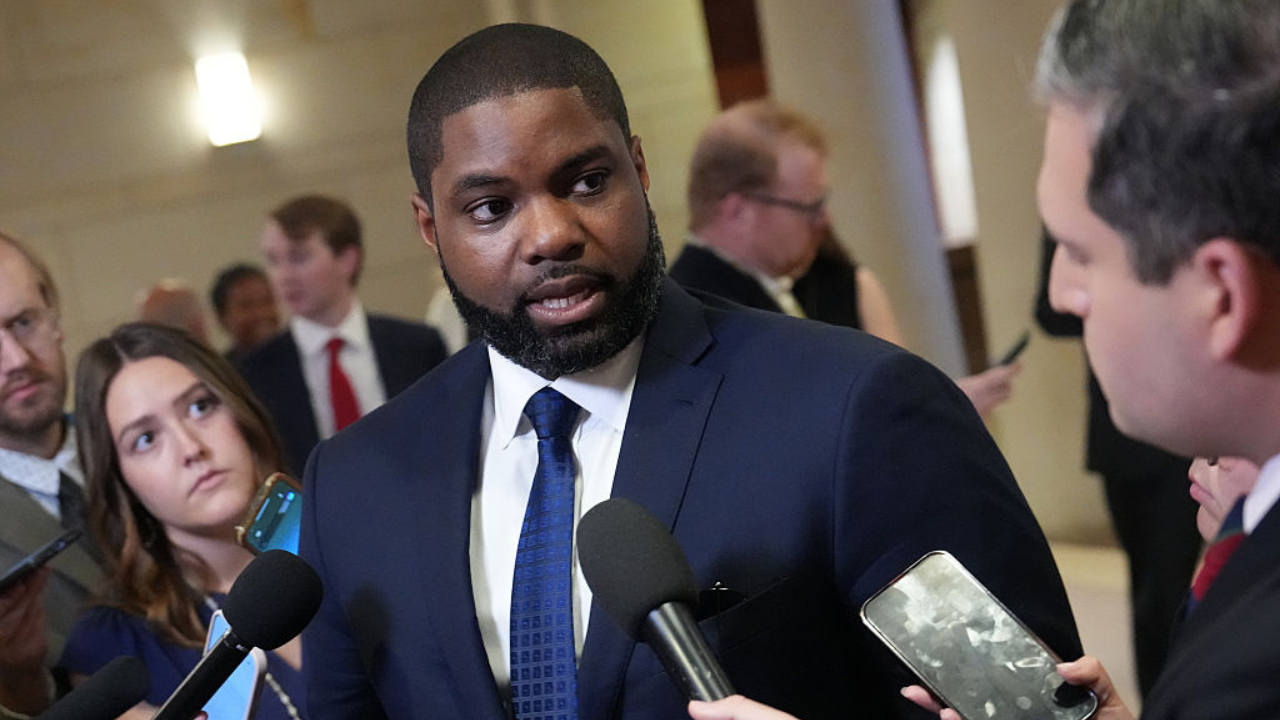
U.S. Congressman Byron Donalds is the leading candidate to win the Republican gubernatorial nomination, inching him closer to becoming Florida’s first Black governor. Donalds, a prominent MAGA Republican backed by President Donald Trump, is the overwhelming favorite among polled Republican voters over his opponents in the race: hedge fund investor James Fishback and Florida Lt. Gov. Jay Collins.
Donalds, a Brooklyn native known for his strong communication skills, emerged as a top national Republican after being unsuccessfully nominated for Speaker of the U.S. House of Representatives by members of the Republican Caucus. From there, Donalds began using his newfound national microphone to defend Trump during the 2024 presidential election. The 47-year-old, who took office at the beginning of the Biden administration, became a prominent Black Republican voice trying to convert Black voters, who traditionally vote Democratic, to support Trump’s re-election bid.
Donalds’ rise is likely a sore spot for Florida Democrats, who almost elected the state’s first Black governor in the 2018 gubernatorial contest between Governor Ron DeSantis and Democratic Andrew Gillum. Gillum, who later faced controversy over criminal charges and drug addiction, lost the 2018 election by less than 1% of the vote. While Democrats are often touted for their diversity and massive support among Black voters, Donalds’ candidacy tests the theory of the Republican Party’s inability to elevate with strong Black candidates.
Florida has not elected a Democratic governor since 1994, a positive sign for Donalds in a state where Republicans continue to dominate. However, it won’t come without strong efforts by Democrats, who have their own crop of Black candidates seeking the governorship. The crowded primary includes Black Floridians: Florida State Rep. Dortie Joseph, educator Dayna Foster, retired health professional Thomas Fernandez, and Stephann Norman.
Any win for a Black gubernatorial candidate for either political party would add to what is a historic number of Black gubernatorial nominees, which include Maryland Gov. Wes Moore, who is running for re-election, Keisha Lance Bottoms in Georgia, David Crowley in Wisconsin, Jermaine Johnson in South Carolina, and Aaron Ford in Nevada.