For the first time, astronomers witnessed the birth of a ‘magnetar’
Popular Science...
In December 2024, astronomers watched a star around 25 times the mass of our sun die in a blaze of glory. Located one billion light-years from Earth, SN 2024afav was a prime example of a superluminous supernova—an event that’s at least 10 times brighter than a large star’s explosion. Researchers around the world used the Las Cumbres Observatory’s global network of 27 telescopes to document the spectacle for more than 200 days.
While the supernova’s brightness peaked at around Day 50, astronomers noticed something strange. Instead of slowly fading as expected, the luminosity oscillated downward while the time between each fluctuation shortened. Past examples of superluminous supernovae exhibited one or two bumps, but SN 2024afav displayed four of them.
After months of calculations—as well as some help from Albert Einstein’s theory of general relativity—researchers believe they have an explanation. For the first time ever, astronomers witnessed the birth of a magnetar—a fast spinning, immensely magnetized neutron star. The ramifications, detailed in a study published today in the journal Nature, imply that such cosmic powerhouses are fueling some of the universe’s most explosive supernovae.
The role of the magnetar
The findings confirm a theory first proposed 16 years ago by University of California, Berkeley theoretical astrophysicist Dan Kasen. Kasen and his colleagues hypothesized that at least some superluminous supernovae got their juice from magnetars—just one of many possible outcomes during stellar demise.
A star’s mass dictates the end of its life. If it isn’t quite massive enough to collapse into a black hole, it will crush into a neutron star. However, stars that had a strong magnetic field over their lifetime don’t lose it. They become magnetars instead with fields between 100 and 1,000 times stronger than spinning neutron stars, or pulsars. Both magnetars and pulsars are only around 10 miles in diameter, but they’ll start out spinning more than 1,000 times per second.
Kasen’s team theorized that a spinning magnetar will accelerate charged particles so fast that they collide with the expanding supernova’s debris. According to the team, this is what makes some supernovae much brighter than others.
“For years the magnetar idea has felt almost like a theorist’s magic trick—hiding a powerful engine behind layers of supernova debris,” Kasen, who was not involved in the new study, said in a statement. “It was a natural explanation for the extraordinary brightness of these explosions, but we couldn’t see it directly.”
The latest study from a team including UC Santa Barbara astrophysicist Joseph Farah finally explains the magic trick, but it took some trial-and-error to get there.
“We tested several ideas, including purely Newtonian effects,” Farah explained.
Wobbly disks
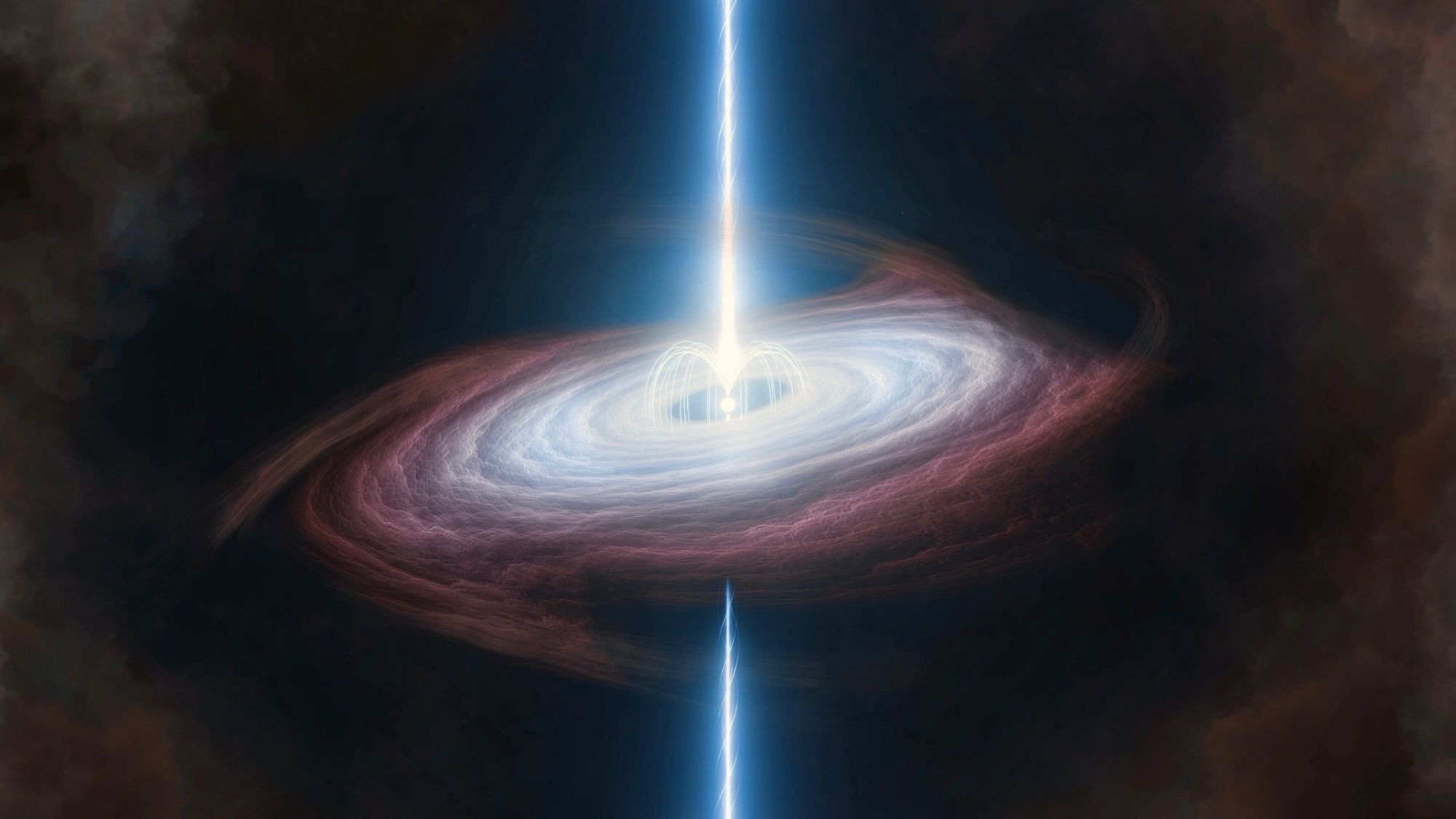
The solution came not from Newtonian physics, but general relativity. Farah’s model for SN 2024afav involves material from the explosion falling inward toward the magnetar and forming what’s known as an accretion disk. This debris field in the disk is almost certainly asymmetrical, meaning the spin axis of both the accretion disk and magnetar are misaligned. General relativity says that a spinning object drags space-time as it twirls. When applied to a magnetar, the spinning would hypothetically create something called a Lense-Thirring precession.
To put it (very) simply: the misaligned accretion disk starts to wobble. When it does, it may occasionally block and reflect a magnetar’s light like a blinking turn signal. As the disk moves closer to the magnetar, its radius decreases and makes it wobble faster. Taken altogether, this explains the decrease in time between SN 2024afav’s luminosity oscillations and confirms Kasen’s magnetar theory.
“It is the first time general relativity has been needed to describe the mechanics of a supernova,” said Farah.
“I think Joseph has found the smoking gun,” said Andy Howell, a senior scientist at Las Cumbres Observatory, UCSB physicist, and study coauthor. “He’s tied the bumps into the magnetar model and explained everything with the best-tested theory in astrophysics—general relativity. It is incredibly elegant.”
‘The science I dreamed of as a kid’
A magnetar still is not a one-size-fits-all explanation for superluminous supernovae. Another theory proposes an exploding star’s shockwave may sometimes smack into nearby material and increase its brightness. Kasen has also suggested that a newly formed black hole with a misaligned accretion disk may also briefly fuel a bright supernova.
But even if magnetars power a small percentage of superluminous supernovae, it marks a major moment in both astronomy and general relativity.
“This is the most exciting thing I have ever had the privilege to be a part of,” said Farah. “This is the science I dreamed of as a kid.”
The post For the first time, astronomers witnessed the birth of a ‘magnetar’ appeared first on Popular Science.