How COBRA is puttering around with 3D printing to push forward the club production process
Popular Science...
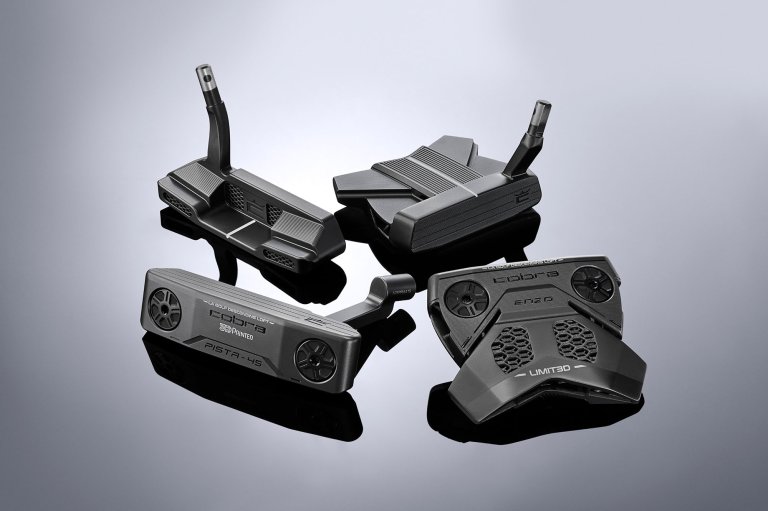
Walk onto the green with a COBRA LIMIT3D flat stick in hand and, unless the person next to you reads putts like they’ve got access to the tournament setup sheet, you could well get a double-take. There are stranger silhouettes you can crouch over waiting for the line to whisper its secrets, but the 3D-printed COBRA PISTA blade and ENZO mallet putters have enough stealth-fighter energy to pull some attention away from trying to outthink a slope.
Released in early 2025, these boutique clubs have a dark finish and disciplined lines, so they come across less science project and more project that happens to be made with science. But they don’t really reveal all their secrets outside of the lab, because that’s where you can truly see how these heads are not simply CNC milled from one-piece blocks or cast in molds. There’s less carving, less compromise, no chunky concessions. Just tight tolerances and precise internal dimensionality that you can’t achieve with a bit.
They’re born layer-by-layer from powdered metal fused in printers, and that shift has allowed COBRA’s engineers to play a sophisticated shell game with mass, intelligently calibrate forgiveness, and shape sound without resorting to weight-saving cavities or bloated sole plating. They’re hiding aerospace-grade secrets inside the form and feel of forged offerings that golfers trust. And that, in turn, informed the 3DP MB and 3DP X irons and trickled down to recently released, more affordable putters in the 3DP TOUR family.
As Ryan Roach, director of innovation, explains via phone, 3D printing isn’t just a case of weird for weirdness’s sake, but rather structures that better suit each putter’s job. “The advantage Cobra has by using 3D printing is that we can create designs that generate the performance and forgiveness necessary without having to compromise in areas of appearance, shape, and impact feel.
“The reason we’re doing it is not just because we can, but because it actually improves the product.”
COBRA splits the PISTA and ENZO between manufacturing methods because the designs ask for different physics enablers.
“We are agnostic to printing method,” says Roach, “considering each method’s strengths and weaknesses when evaluating which works best for a particular design.”


The blades are built with Direct Metal Laser Sintering [DMLS]—fusing thousands of layers of corrosion-resistant, industrially mature 316L stainless steel alloy powder into intricate, closed-off latticework inside a compact head, with unfused particles shaken out of small ports like the last grains from a stubborn spice jar. You can’t mill a weight pocket behind a face without thickening the entire design, so this lightweight but still internal scaffolding lets discretionary grams be pushed to the perimeter without swelling the footprint.
The mallets, by contrast, leverage HP’s Metal Jet binder-jetting, which prints the body about 20% oversized in loose powder, cures it, then sinters it to its final shape, making it better suited to wide-span wings and a long alignment rail in expansive forms that won’t deform. Different processes, same material.
The 316L steel is used for its ductility and its ability to have its acoustic signature tuned through lattice density to ensure it doesn’t ping or echo. “Its hardness and properties are a decent proxy for, say, a carbon steel that we use for forging,” says Roach. “And we’re doing modal analysis on the heads to see where they’re vibrating, to try to make sure if we don’t have the right sound that we know how to fix it.”
That last part matters more than CAD porn. You have to prove it feels right, not just looks right on a render or reader. That’s why this isn’t COBRA’s first additive manufacturing foray. The iconic, half-century-old Carlsbad, Calif.-based company started along the print-what-you-can’t-machine path with the KING Supersport-35 in 2020. “It was not a smooth development, but it taught us a lot,” says Roach. “A lot about what we could get away with geometrically.” But also acoustically, aesthetically, revealing what kinds of post-processing aligns with golfers’ expectations.
It had a kind of oversized sci-fi industrial vibe that stirs bar cart debates, and proved durable and precise enough to keep the R&D sluice gates open and establish HP Metal Jet as more than a rapid-prototyping shortcut for skipping toolmaking, shape validation, and iterating concepts in metal.
COBRA’s LIMIT3D irons followed in 2024 as the first commercially available 3D-printed steel sets, amalgamating dodecahedral structures in a compact, blade-ish look with strategically placed tungsten for game-improvement forgiveness.
“To the public, it looks like we came out with irons first,” acknowledges Roach. “But internally, we identified putters early on as more low-hanging fruit when it came to 3D printing. Single-stick item. Maybe the loads aren’t as severe as a full-swing club.”
What has come since, however, feels even more mature. And feel is where traditionalists often narrow their eyes with printed products, but the LIMIT3D line’s sculpted chambers help remove “dead” mass while preserving a responsive profile and controlled stiffness. No fireworks off the face, just steady starts and more tolerant mishits as the rounds add up, proven by both robot and player testing. And nothing sounds like an empty can. It’s got that ‘thump,’ not a chime.
PISTA is the compact blade with toe-hang options for arcing strokes. It comes in two necks: PISTA-45 [plumber’s neck, 45° toe hang, full-shaft offset] and PISTA-60 [small flow neck, 60° toe hang, half-shaft offset]. The single-bend ENZO or short-slant ENZO-30 is the higher-MOI [moment of inertia] mallet aimed at golfers who like the face to track straight back and through. The point-and-press option that’s easy to square and easier to trust, promoting consistent roll and feedback. Both ship with an adjustable weighting system, KBS CT Tour Putter 120 shafts, and SuperStroke Zenergy 2.0PT grips; production, however, was limited to 500 heads per model, and each runs $599.
Released March 13, 2026, the follow-up 3DP TOUR models [profiles shown below] take design lessons learned and translate them to new multi-material builds at a more attainable, less tech-demo MSRP of $379. Internally, the structure shifts to a nylon honeycomb rather than 316L, the polymer paired with a 304 stainless face/carbon fiber crown, an adjustable tungsten weighting system, KBS CT Tour shaft, SuperStroke Pistol 1.0 grip (or 17-inch SuperStroke 3.0 grip on counterbalanced models). And, like on the LIMIT3D line, LA Golf Descending Loft Technology helps keep speed losses from getting too punitive. The result looks familiar, sounds dampened, and feels tuned thanks to the engineering mischief within.

So, what does 3D printing actually get you when you’re dialing in a read like you’re negotiating with gravity? We took the LIMIT3D putters to the green and, while no one poured in a 40-footer, there were some interesting observations. In testing, the selectively thinned PISTA was lively but composed, with solid contact and very little wobble. It had a slight pop, but wasn’t clicky. As for the mallet, it was no hollow clamshell. It came across planted and assured, with a decisive tock, not a tinny tink. With its dropped center of gravity, it made a convert of our tester [shown below]. Neither putter is magic, so you still need a proper fitting and to line up right and pick a pace. Aim and exhale. But they’re also not alien or alienating.
As for what the future holds, Roach says COBRA would love to take the aesthetic shackles off so the money saved on finishing can be passed downstream. That’s when commercializing printed clubs can truly scale. Post-processing is the most expensive part, so if golfers can embrace more industrial-chic textures instead of hand-lathed heirloom vibes—really “love the layers,” as the lab mantra goes—even more investment can go into exploring atypical materials and performance enhancements [within regulations] that benefit the impact event. After all, complex anatomy is what helps both distance and control, from irons to golf balls.
Beyond that, the door could be opened to hyper-personalized fit, one-off geometry, on-demand head traits. Tour players already get bespoke tinkering with slightly shifted components. Additive could make that kind of customization less cost-prohibitive for the average or aspiring players.


The post How COBRA is puttering around with 3D printing to push forward the club production process appeared first on Popular Science.