‘Morally dangerous’: Black theologians slam Trump’s spiritual advisor comparing president to Jesus Christ
TheGrio...

“Policies that target immigrants, weaken protections for vulnerable people, or treat marginalized communities as expendable stand in deep tension with the life and teachings of Jesus.”
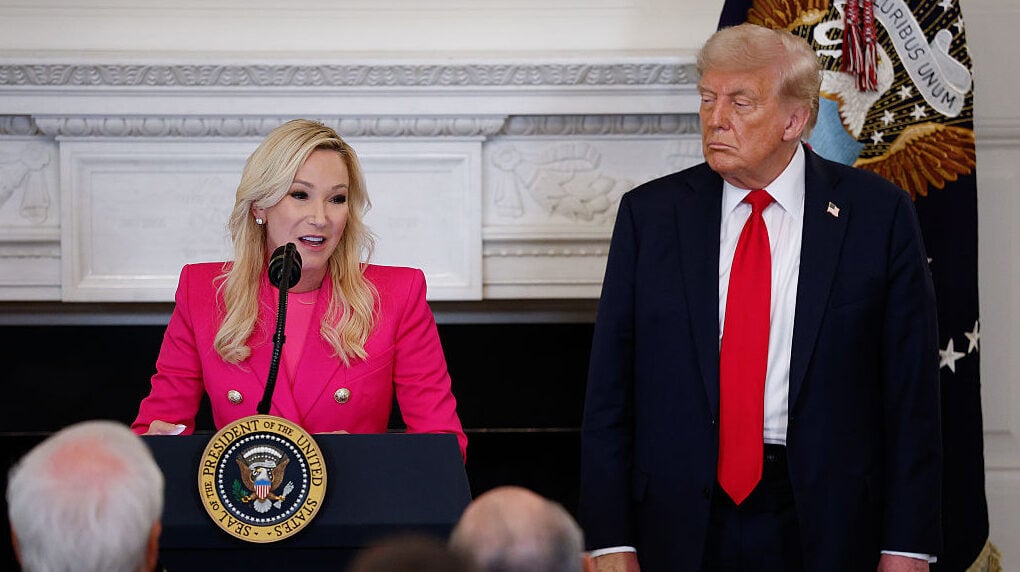
Paula White-Cain, the TV Christian evangelist and personal spiritual advisor to Donald Trump, is catching heat after comparing the U.S. president to Jesus Christ at a recent White House Easter lunch.
“Jesus taught so many lessons through his death, burial, and resurrection. He showed us great leadership, great transformation requires great sacrifice. And Mr. President, no one has paid the price like you have paid the price. It almost cost you your life,” White-Cain said on Wednesday, referencing the attempted political assassination of Trump in July 2024.
The former pastor also referenced President Trump’s criminal indictments and felony conviction, which included hush money payments to cover up an alleged affair with an adult film star.
“You were betrayed and arrested and falsely accused. It’s a familiar pattern that our lord and savior showed us,” said White-Cain, who leads the White House Faith Office.
Black theologians who spoke with theGrio scoffed at White-Cain’s comparison of Trump to Jesus, considering the president’s policy agenda and many public statements while in office.
“The comparison of Donald Trump to Jesus Christ is not only theologically absurd — it is morally dangerous,” said Bishop Joseph Totlon, a Pan-African activist and executive director of Interconnected Justice.
The bishop, whose missionary work in the U.S. and Africa seeks to connect the shared struggles of Black Americans, Africans, and LGBTQ+ communities, told theGrio that White-Cain’s framing of Jesus’ persecution was because his message “invited the colonized and dispossessed by the Roman empire into spiritual unity that threatened imperial domination.”
He explained, “The cross was not a symbol of conquest; it was God identifying with the least of these — those without political leverage, economic security, or social standing. To equate that witness with a war-driven nationalism animated by racial grievance distorts the Gospel beyond recognition.”
Since running for president in 2016 and his subsequent terms in office, Trump has been widely embraced by white evangelicals. Many align with the president’s positions on abortion and efforts to root out so-called Christian persecution. However, many non-evangelical Christians have pointed out hypocrisy in the religious right’s support of Trump’s immigration and anti-DEI policies and cuts to critical programs for the poor and disadvantaged.

“The continued uncritical embrace of President Trump by many white evangelicals and segments of the religious right reflects a long and troubling pattern in American Christianity: the conscription of Jesus into the service of political power. Pastor Paula White’s recent remarks are a vivid expression of a prosperity theology that equates divine favor with wealth, victory, and dominance,” said Dr. Brad R. Braxton, president and professor of Public Theology at Chicago Theological Seminary and the founding senior pastor at The Open Church.
Despite the religious right’s embrace of Trump, the president has admitted that he does not believe he would make it into heaven and admitted in 2024 he’s “not Christian,” despite previously claiming to be a non-denominational Christian. Trump’s comments on Christianity, including mispronouncing a book in the Bible and not being able to cite his favorite verse, have also led to criticisms of the president that his knowledge of Christianity is perhaps erroneous or superficial.
Bishop Tolton notes that the Gospel has “fortified Black resistance” and has always “proclaimed freedom, dignity, and inclusion, not empire cloaked in piety.” He added, “Liberationist Christians must reclaim that mantle and declare clearly: Jesus stands with the oppressed, not authoritarian power; with the stranger, not supremacy.”
Dr. Braxton similarly told theGrio, “The Jesus of the New Testament was a first-century African-Asiatic Jew whose ministry centered on radical solidarity with the vulnerable: the widow, the foreigner, the prisoner, the sick. Whatever one’s political commitments, policies that target immigrants, weaken protections for vulnerable people, or treat marginalized communities as expendable stand in deep tension with the life and teachings of Jesus.”
Bishop Tolton warned that the “distortion” of the religious right is “not confined to American politics,” but is happening globally. He noted that a few months ago, Paula White-Cain visited Uganda, where she praised its president, Yoweri Museveni, who has long been accused of having citizens killed and committing human rights abuses. Tolton blasted White-Cain for “aligning herself with an authoritarian regime widely criticized for repression and political violence.”
“For a white American religious figure to bless strongman governance in an African nation — while invoking Christian language — echoes a long history of paternalistic religious meddling that has harmed Black people globally,” he told theGrio. “That posture betrays the liberationist faith tradition that sustained African American Christians through slavery and segregation.”
As Easter Sunday approaches, Dr. Braxton referenced the teachings of womanist theologian Delores Williams, who he said reminds Christians that “our healing does not come from the method of Jesus’s death but from the message of his life—a life lived in steadfast opposition to the dehumanizing forces of empire and in joyful solidarity with the marginalized.” He added, “That is the Gospel of Jesus. It cannot be conscripted, and it will not be silent.”