Robots can’t replace guide dogs
Popular Science...
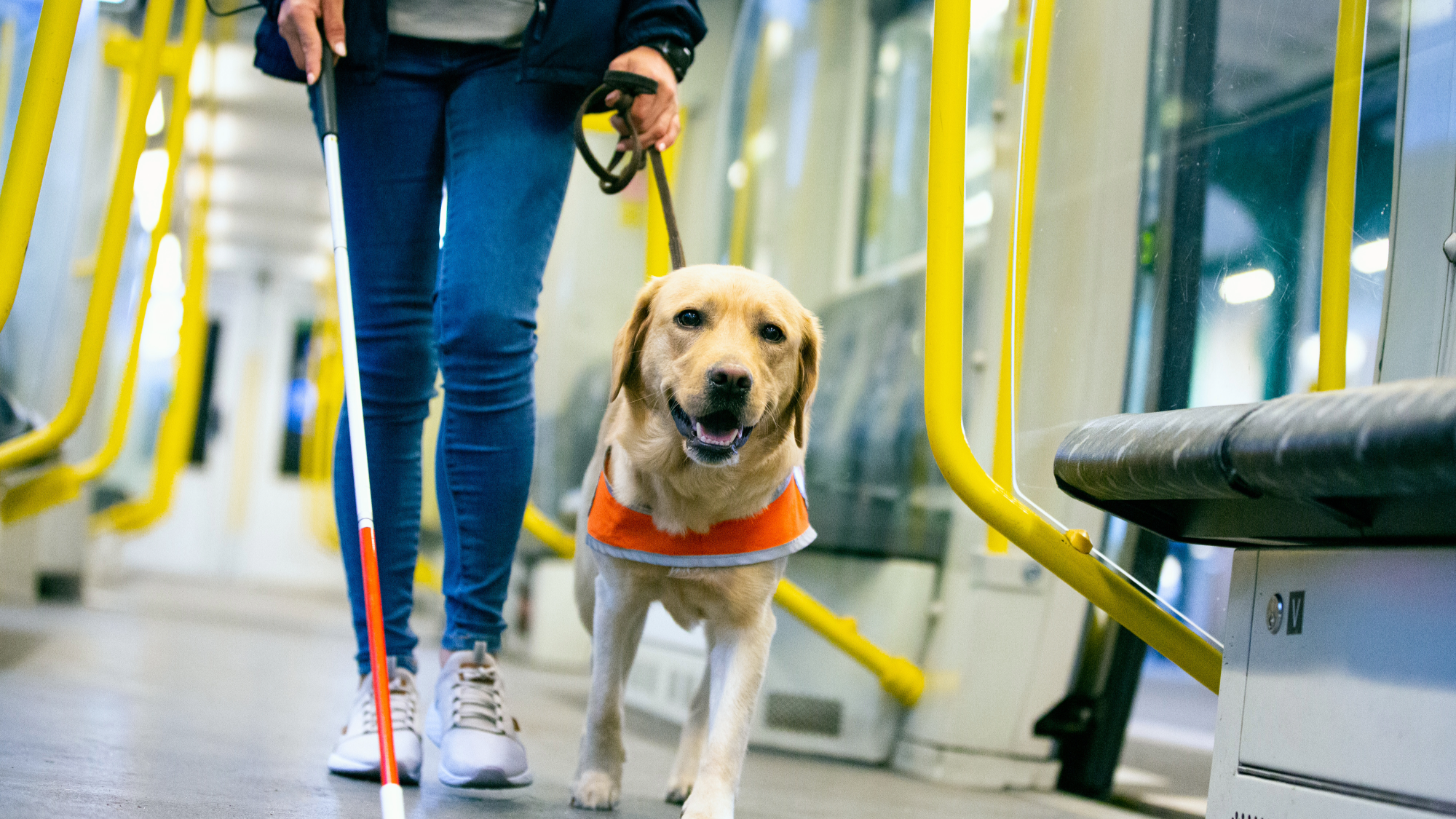
On paper, few physical jobs seem as ripe for AI takeover as that of the loyal service dog. These four-legged assistants undergo years of intensive (and expensive) training to help people with vision loss or other physical impairments navigate their world, open doors, and retrieve items. Some can even use their impeccable noses to detect dangerous blood sugar spikes in people with diabetes.
But getting a dog to that point is no walk in the park. Guide dog school is rigorous, with only a portion of puppies graduating every year. That selectivity means training one can cost upwards of $50,000 per dog. Even when the select few do get paired with an owner, the human in need now has the extra responsibility of caring for an animal that needs to eat, exercise, and poop. And let’s not even get started on all of the hair.
Robot dogs seem like an elegant solution. The machines have benefited from major advancements in robotics, can’t be killed, and won’t smell up the house. More recent integration of large language models (LLMs) like ChatGPT means these robots can understand a far wider dictionary of commands than a guide dog’s typical mastery of just 20 to 30. GPS integration means users can simply type in a destination for their dog to follow like they would on Uber.
And yet, if given the opportunity to choose between a top-of-the-line furry dog or robot, man’s friend is still the better choice by far. But understanding the reasons why guide dogs outrank robots requires thinking in more qualitative, abstract terms that don’t lend themselves well to the metrics robotic engineers tend to optimize for.
To learn more, a group of researchers from the University of Turku and Aalto University in Finland studied the everyday lives of 13 assistance dogs and their owners to understand what made their relationship unique. They uncovered what they described as an “invisible care world,” underpinned by mutual trust between humans and dogs. Rather than one solely looking after the other, both creatures in the relationship cycle between the roles of caregiver and cared-for.
On the dog’s side, it‘s able to gain the necessary trust of its owner by anticipating their health or emotional status and constantly interpreting their subtle gestures, movements, and tics in ways a robot simply can’t match. While robots are great computational machines, service dogs are unmatched masters of intuition and emotional intelligence. And while they may not have the same library of words at their disposal as an LLM-connected robot, they have the added ability to “understand” a vast amount of subtle, nonverbal cues. The dog can’t speak English, but its job nonetheless requires it to “understand” its humans on a profoundly deep level.
“When I received a guide dog after losing my sight, it was a holistically stopping experience in my life,” one of the anonymous study participants said. “I realized I had to relinquish control and trust the dog, who would now be responsible for guiding me and caring for me in our everyday encounters.”
The team’s findings were published this week in the journal Human Relations.
Related Stories
Service dogs make their own decisions…sometimes
The researchers say they focused on dogs in an effort to challenge the common assumption that animals are “passive agents” simply doing what humans tell them. While there is plenty of that—service animals that can’t sit and stay won’t last long—the dynamic is much more complex. Instead, the team describes service dogs as active, sentient creatures that are engaged with their environment and help their humans make everyday decisions. They also draw a distinction between the mandatory tasks assigned by humans and voluntary ones. A specific verbal command is mandatory, but the dog voluntarily chooses to provide additional emotional support and bonding. The guide dog doesn’t need to curl up beside its companion as part of its job description. It generally does so by choice.
“Assistance dogs, as caregivers, act through their own perceptive and relational capacities. Although shaped by meticulous training, they do not act according to human norms or judge vulnerable humans; in so doing, they further challenge and nuance this power-laden dualism,” the researchers write.
That dynamic is illustrated through numerous quotes and accounts provided by the human participants in the study. Several volunteers had not owned dogs before receiving them as service animals. They described a gradual process of having to “relinquish control” and learning to trust their animal.
Additionally, that trust is a two-way street. The dog trusts that its basic needs will be met by its human, and the human in turn learns to rely on the dog’s instincts and defer to it in certain situations. Other participants described their relationship with their service animal as a kind of partnership, with each filling their own role as part of a larger team.
“She [the dog] wants us to already have some kind of physical contact. And she also has this kind of ‘weighted blanket’ function,” a guide dog handler interviewed by the researchers said. “It’s usually this kind of symbiosis, where ideally it has to be that way, that we are a duo, and it’s hard to say where the human begins and the dog ends.”
Don’t sleep on the robot dogs just yet
While real dogs still have a major leg up over robots, the machines are catching up. Popular Science previously highlighted a company called Glide that sells a vacuum cleaner shaped mobility aid that uses AI and passive kinetic guidance to help people with impaired vision navigate.
And that’s just the tip of the iceberg. This week, Boston Dynamics announced it was integrating Google’s Gemini LLM into its dog-like Spot quadruped robot. That integration means it can use its camera to read natural language instructions, understand what they mean, and then attempt to carry them out autonomously.
A video demonstration of the new and improved Spot shows it reading a whiteboard with a list of to-do items. After processing the information, the “Good Boy” diligently sets about putting loose shoes away, taking out the garbage, and loading stray clothes into a laundry bin. As the cherry on top, it even approaches a real dog in the house and takes it out for a walk.
For what it’s worth, it’s unclear how much of that demonstration video was organic versus what was carefully staged for dramatic effect. Still, artistic flair notwithstanding, it’s clear the robot dogs are learning new tricks
Even with all those added bills and whistles though, the high-tech robots still lack something fundamental to their slobbery, hairy, inspirations. A robot that takes the dog for a walk is impressive, but a dog that knows when to take you for one is something else entirely.
The post Robots can’t replace guide dogs appeared first on Popular Science.