The 2026 Aston Martin Valhalla Supercar is truly a super car
Popular Science...
If you want to look like a million bucks, pose for a photo next to the $1,058,400 2026 Aston Martin Valhalla, the company’s first production mid-engine supercar. As an Aston Martin, the car is predictably gorgeous and you can bask in its reflected beauty.
If you want to feel like a million bucks, slide into the Valhalla’s driver’s seat and take the 1,064-horsepower hot rod for a drive. It can be on a winding country road or on a racetrack, because the car is equally comfortable in both places. This is new for Aston, because while its cars have offered high performance previously, they were generally better suited to brisk road drives than all-out track work.
A look at some of Valhalla’s technical highlights provides an immediate clue as to why. Obviously, the car’s Formula 1-style carbon fiber chassis and mid-engine layout provide instant advantages in terms of chassis stiffness and balance compared to Aston’s traditional front-engine, aluminum-chassis models.
Indeed, the Valhalla’s carbon fiber tub that serves as the car’s foundation is designed and manufactured by the Aston Martin Formula 1 team’s Advanced Manufacturing Park Technology Centre subsidiary. It uses a precision resin transfer mold (RTM) process for the lower section and traditional carbon fiber cloth that is pre-impregnated with resin for the upper half.

Consider this as an example of the change in Aston Martin’s product philosophy, especially with regard to the Valhalla. While previous models may have referred emotionally to the James Bond series of action films, Valhalla sees Aston looking to Brad Pitt’s F1 movie instead for inspiration.
Front suspension? Yep, more stuff straight from Brad Pitt’s movie race car. The Valhalla has pushrod-actuated inboard front shocks and springs that are mounted horizontally across the top of the car’s hood, which is cut away to expose their cool appearance. This installation was necessary to keep the top of the hood low, so the driver can see where they are going.
The front axle’s hybrid drive system and the demands of suspension geometry would have made the shock assemblies too tall for good forward vision otherwise, according to chief engineer Andrew Kay. At the rear end, the Valhalla has a typical-for-a-supercar five-link suspension design.
Successful use of these fundamentals depends on the execution of myriad details, and Aston has nailed all of those to produce a car that unfailingly delivers on the driver’s expectations. The Mercedes-AMG-supplied twin-turbocharged 4.0-liter V8 incorporates a racing-style flat-plane crankshaft. The better airflow through the engine that creates contributes to the engine’s output of 817 horsepower. Some of that power also comes from Aston-specific camshafts and pistons, bumping this engine’s power up by nearly 100 hp compared to the Mercedes-AMG version.
The transmission is a paddle-shifted dual-clutch transmission, as is typical of current-generation super sports cars. Aston uses a Graziano-supplied gearbox, as does the McLaren Artura PopSci tested previously.
Aston Martin’s hybrid-electric drive adds a conventional radial-flux electric motor inside the gearbox to provide electric assist to the combustion engine, while McLaren’s configuration uses a pancake-shaped axial-flux electric motor mounted between the engine’s flywheel and the gearbox.
Aston has two more radial-flux e-motors at the front axle, each driving one wheel. These contribute drive to the front wheels, so the Valhalla has all-wheel drive and torque vectoring, so that power distribution helps stabilize the car at speed. For EV driving mode, which has about 7.5 miles of plug-in EV driving range, the Valhalla uses only the front electric drivetrain, which also provides reverse.
The paltry plug-in EV range is because the front drive system’s main purpose is contributing balanced performance to the car and Aston wants to have as light a battery pack as possible, so the Valhalla’s pack only holds 6.1 kilowatt-hours.
It doesn’t hurt that this is more than enough range for drivers to tip-toe out of their neighborhoods in the morning without igniting the fury of the flat-plane crank-equipped race-ready V8. Also, some European cities prohibit running combustion engines in their downtown areas.
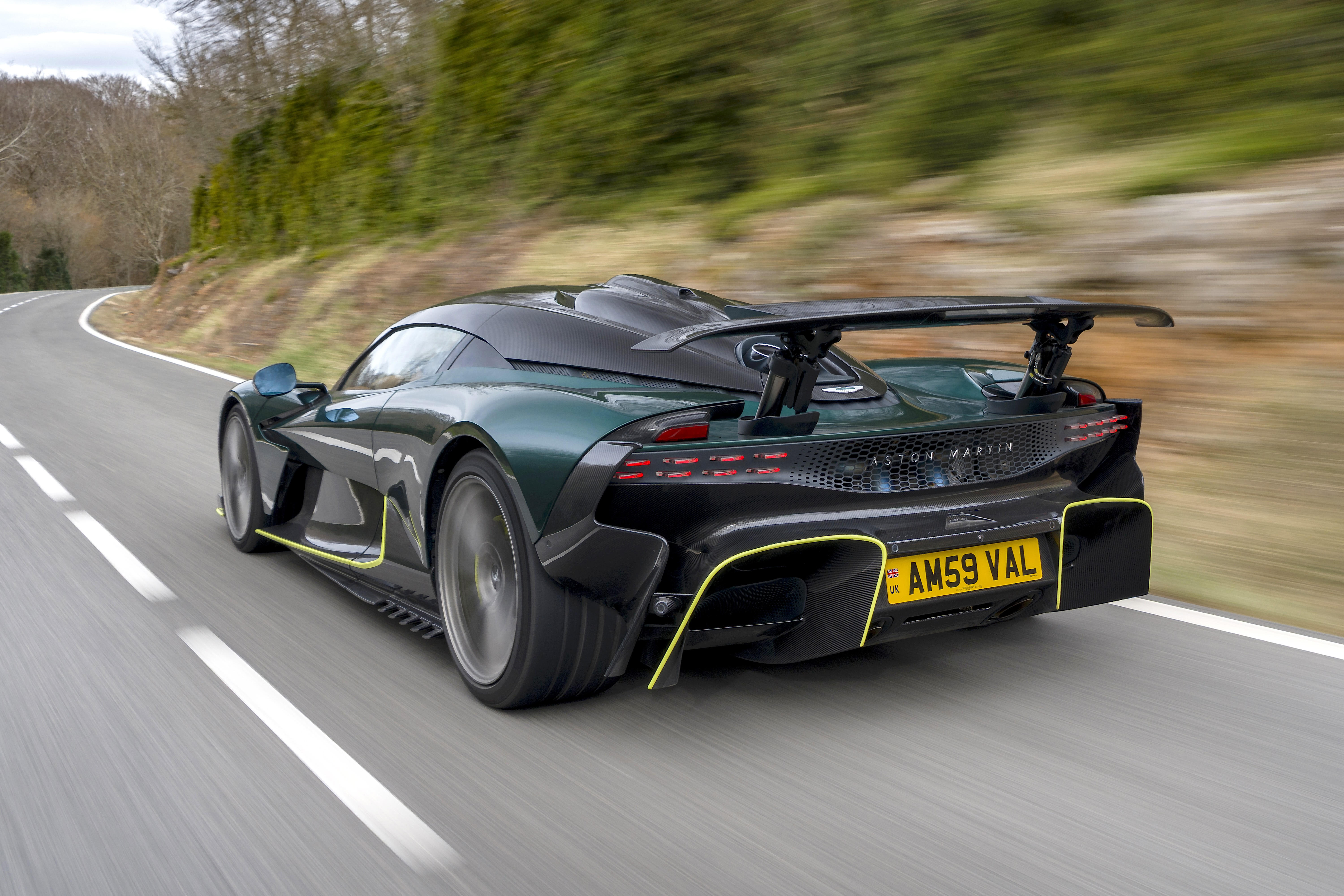
If the Valhalla has a party trick, aside from its all-wheel-drive, torque-vectoring, hybrid-electric powertrain, it is the car’s active aerodynamic system, which is more advanced than the systems permitted in F1 racing. The Valhalla’s system produces a peak of 1,340 lbs. of downforce, starting at 150 mph. That level remains steady all the way to the car’s top speed because the active system adjusts to prevent the downforce from increasing any further as speed increases.
That’s because 1) 1,340 lbs. of downforce is plenty and 2) because additional downforce would require stiffer tires, shock absorbers, and springs, so the Valhalla wouldn’t be able to provide the compliant highway ride that Aston Martin customers expect.
Although it isn’t visible like the one on an F1 car, the Valhalla has a front wing. It is hiding under the front of the car and it is adjustable to provide variable downforce as needed. It can tip as steeply as 45 degrees for maximum downforce or it can turn flat to reduce drag during straight-line driving.
The car also has aerodynamic turning vanes on its bottom side. These steer airflow from beneath the car out the sides, reducing the pressure underneath to increase downforce. When the front wing lies flat for reduced drag, a flap hangs beneath it to block airflow to the turning vanes, neutralizing them.
The rear wing’s function is more self-evident. When the driver selects Race mode, the wing rises 10 inches on its hydraulic struts. Its maximum downforce angle is 11.5 degrees. But under heavy braking, the wing snaps to 51.5 degrees in just half a second to provide an air brake.
The wing also has a drag reduction mode for straight-line driving. In that setting, the wing tips upward at the front by 8.5 degrees. While this would seemingly produce lift, as well as drag, the airflow off the car’s roof strikes the wing at that angle, so it is actually a neutral setting.
The brakes also enjoy a heap of cutting-edge technology. The Valhalla uses a brake-by-wire system, so there is no direct hydraulic connection between the brake pedal and the front 6-piston and rear 4-piston monobloc brake calipers. Braking is entirely computer controlled, so the computer can blend in the appropriate amount of regenerative braking from the car’s electric motors. It also considers the effect of the rear air brake.
Before my drive, Kay insists that the system’s function is invisible. I have what I consider to be a very justifiable skepticism. “We wanted this to feel super-consistent,” he explained. “You won’t be able to tell what the car is doing. It is consistent under trail braking so you can push the car and have confidence on the track,” he promised.
Alas, my inner curmudgeon has to admit Kay is right: these brakes feel fantastic while providing the most stable high-speed braking I’ve experienced on the track. The car’s systems are all working together, with the active aero and torque vectoring assisting the stability, so heavy braking on the racetrack produces none of the hunting around in the lane that we see, especially in Lamborghinis, and none of the fade I’ve experienced in previous Aston Martins during track testing.
This car is rock-solid and confidence inspiring while braking on the track. My track laps came under the guidance of pro driver Rianna O’Meara-Hunt, who showed me the way around the Circuito de Navarra in northern Spain. This is where I can test the Valhalla’s track mode, after finding the car to be sublime on area mountain roads in Sport and Sport+ modes.
Once I’ve learned my way around and begin to gain speed, O’Meara-Hunt councils me to be more patient going from the brake to the throttle when apexing corners. “Let it roll,” she advises. And it works. The Valhalla goes faster still.
For braking, she wants me to brake hard, early. This exploits the additional downforce available at higher speed, rather than trying to brake harder as the car slows and loses the grip benefit of downforce. As I mentioned, the brakes are otherworldly, with no hints of instability.
Accelerating through the turns, it is impossible to tell that the Valhalla routes as much as 20 percent of its power through the front wheels. The car’s balance and steering feel is the unadulterated feedback of a rear-drive car.
The steering in most all-wheel-drive supercars gets numb as power routes through the front tires, and the cars tend to then lose front grip, causing them to understeer on corner exits. Which leads in turn to the driver having to lift off the accelerator to get the car to turn. None of this happens in the Valhalla.
Throughout every lap, the Valhalla is trailed by an otherworldly roar of serious performance thanks to the flat-plane crankshaft-equipped V8. It is the sort of sound you’d hear outside an Air Force base. It means that something wicked, this way comes. I think it is hugely better than the sound of the V6 engines in too many supercars, most notably the flatulent-sounding exhaust note of the Maserati MC Pura.
Britain is the effective home of Formula 1 because that country’s engineers established preeminence in developing cars’ handling dynamics and the Valhalla shows that reputation remains true. None of the Valhalla’s amazing hardware would deliver the potential benefits without the correct programming and calibration, and Aston’s team has absolutely nailed those attributes.
The hybrid-electric powertrain’s power delivery, the hybrid’s regeneration, the brake-by-wire, the active aerodynamics. Every one of these areas was ripe with opportunity to fumble the execution of a good technology. Aston nailed every one of them
All hail the new World’s Easiest Car to Drive Fast. Drivers just need to be aware that it is the car producing the astounding results, so they don’t get overconfident. It would be a shame to wrinkle the Valhalla’s lovely bodywork on a guardrail by making a mistake. Because then you would only look like a million bucks to the body shop.
The post The 2026 Aston Martin Valhalla Supercar is truly a super car appeared first on Popular Science.