The 45 planets most likely to host alien life, according to astronomers
Popular Science...
Life on Earth is a precious thing, especially given what astronomers know about the visible universe. Although researchers have so far identified over 6,000 exoplanets beyond our solar system, only a handful of them may be suitable for human visitors. While society hopefully won’t encounter an apocalyptic scenario like the one depicted in Project Hail Mary, a team at Cornell University’s Carl Sagan Institute has compiled a list of planetary nominees worth a closer look. You know…just in case.
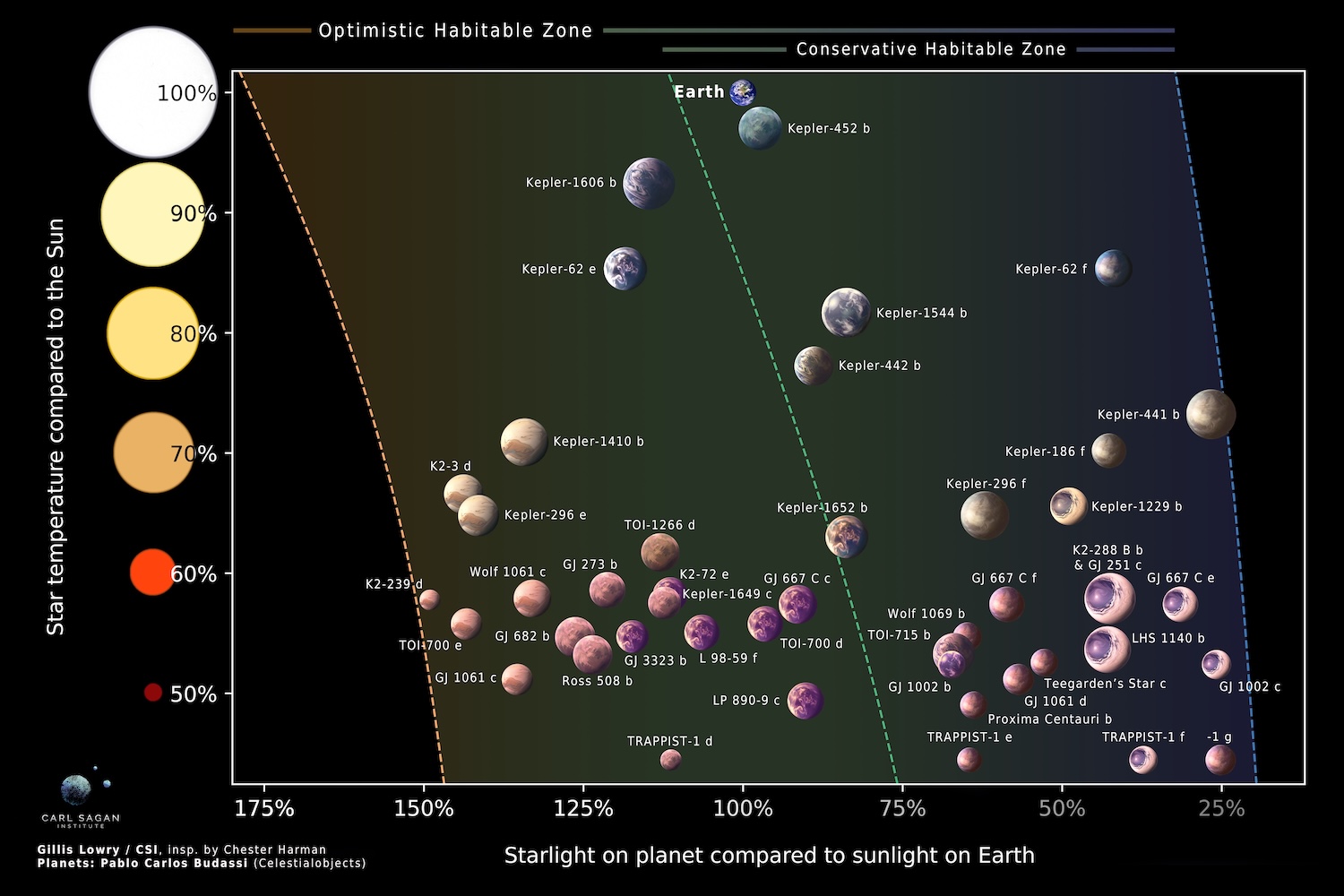
Unfortunately, the roster is a bit slim. According to their study published on March 19 in Monthly Notices of the Royal Astronomical Society, scientists believe only 45 rocky planets are located in a habitable zone near their respective stars—and that’s being generous. A more conservative estimate, factoring in a narrower habitable zone based on solar heat, lowers the number down to 24 worlds.

Credit: Gillis Lowry / Pablo Carlos Budassi
Recognizable planets include Proxima Centauri b, which at approximately 4.2 light-years away remains one of the closest potentially lifebearing exoplanets to Earth. Other notable locales on the list include four planets in the TRAPPIST-1 system. Located around 40 light-years from Earth, TRAPPIST-1 d, e, f, and g all orbit their red dwarf star at distances that hypothetically could support liquid water.
This is assuming humanity develops technology that allows us to get there in a reasonable amount of time, of course. It may only take light about 4 years to reach Proxima Centauri b from Earth, but that’s because it moves at a speed of about 186,282 miles per second. Apollo 10—the fastest vehicle piloted by humans—maxed out at 24,791 mph. So without somehow breaking the code lightspeed or faster-than-lightspeed travel (something many physicists doubt is even possible), it will take our species about 114,000 years to reach our nearest exoplanet neighbors.
Credit: NASA/ JPL-Caltech
Even if life on certain planets—and our ability to reach them—sounds more far-fetched than on others, the team explained that further observations will still help advance the search for extraterrestrial life. For example, studying planets with elliptical orbits around a star can provide information on whether or not dramatic heat shifts prohibit any chance for organisms to evolve.
“We know Earth is habitable, while Venus and Mars are not. We can use our Solar System as a reference to search for exoplanets that receive stellar energy between what Venus and Mars get,” study coauthor Abigail Bohl said in a statement.
The new list also serves as a guidebook for observations using the James Webb Space Telescope, as well as the upcoming Nancy Grace Roman Space Telescope set to launch in 2027.
“While it’s hard to say what makes something more likely to have life, identifying where to look is the first key step—so the goal of our project was to say ‘here are the best targets for observation’,” added study coauthor Gillis Lowry.
The post The 45 planets most likely to host alien life, according to astronomers appeared first on Popular Science.