Trump says God approves of US war in Iran, doubles down on threat to ‘decimate’ country
TheGrio...

“I mean complete demolition,” said President Trump, as he discussed the latest on the U.S.-Israeli military operation ahead of a Tuesday deadline to open the Strait of Hormuz.
President Donald Trump isn’t backing down after threatening to commit potential war crimes in Iran if leaders in the gulf country do not open the Strait of Hormuz, where Iranians are currently blocking oil ships, which is driving up gas prices domestically and internationally.
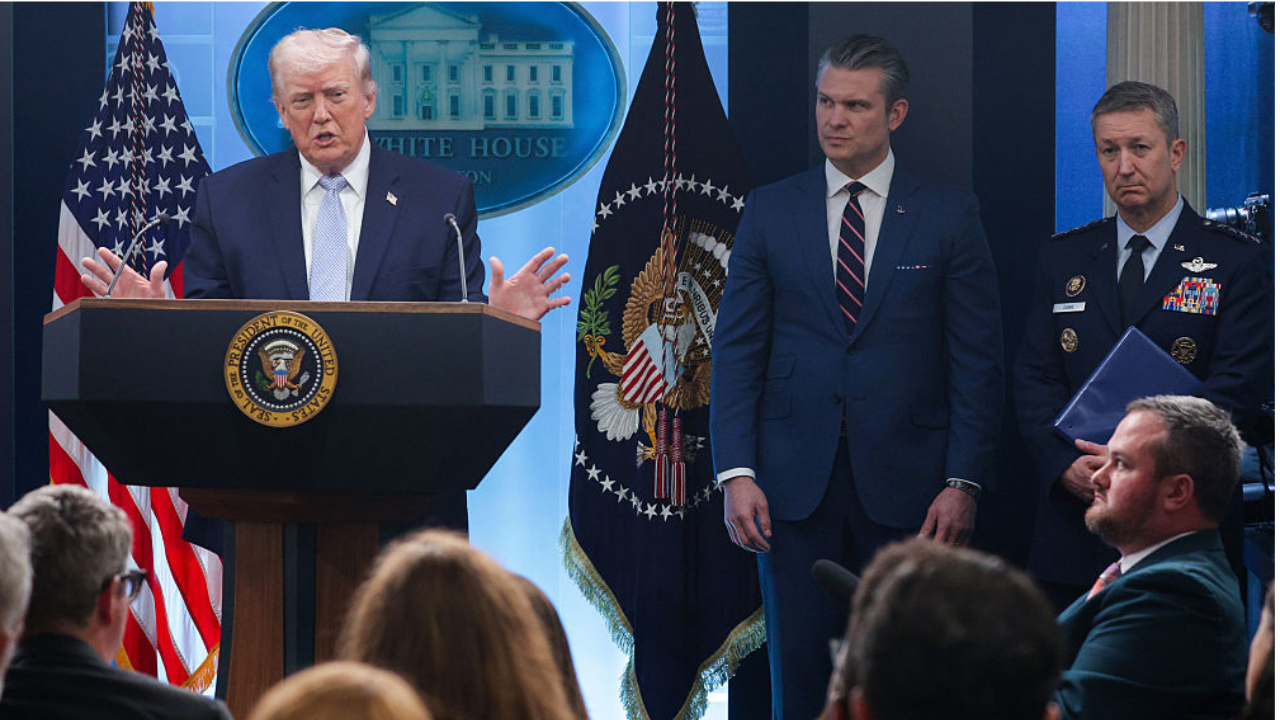
During a packed White House press conference on Monday, the president presented contradictory statements about the state of the US-Israeli war in Iran. While he claimed to have defeated Iran militarily, he presented no timeline to end the war, which is driving up energy costs and crippling the U.S. and global economies.
The president is giving Iran until Tuesday at 8 p.m. ET to stop blocking the Strait of Hormuz. If not, he said they are “going to have no bridges, they are going to have no power plants,” and described the potential destruction as the “stone ages.”
Trump’s doubling down on attacking Iranian civilian infrastructure comes a day after he wrote on Truth Social, “Open the f–king strait, you crazy bastards, or you’ll be living in hell.”
Asha Castleberry-Hernandez, a U.S. Army veteran who worked in the Middle East, tells theGrio that the president’s escalatory threat is a “pressure point” for Iran to open up the Strait of Hormuz, as critics of his initial plan to pull out of Iran without doing so would be a victory for the Iranian regime.
However, Castleberry-Hernandez, who is the founder of the Diversity in National Security Network, warned that there could be “legal ramifications” for targeting critical infrastructures like bridges and power plants, as they are considered war crimes by most measures under international law.
“It could be catastrophic in terms of of creating instability in Iran,” she said.
When asked if he thought God would approve of the U.S.’s war in Iran, President Trump told reporters, “I do.” He added, “God doesn’t like what’s happening. I don’t like what’s happening. Everyone says I enjoy this. I don’t enjoy this. I don’t enjoy it.”

The president then began talking about the Nobel Peace Prize, which he has repeatedly campaigned for to no avail.
“I don’t like seeing people killed. I’ve ended eight wars. Nobody’s ever done it,” he said.
As concern grows for the fate of innocent Iranian civilians, namely children, President Trump said the U.S. is prepared to “decimate” every bridge and power plant in Iran by midnight Tuesday if Iran does not adhere to his demands and deadline.
“I mean complete demolition,” said the president.
Castleberry-Hernandez said attacking Iran’s infrastructure will impact the “basic needs” of civilians and “inflame issues involving energy, issues involving travel, as well as the economy itself.”
The military expert warned that it would also provoke the Iranian Revolutionary Guard to “proportionately target” the United States “in terms of similar critical infrastructure.”
“It’d be harder for them to do so as far as executing that, but they would want some sort of proportionate reaction, as far as now trying to target our critical infrastructure that will also create similar impacts,” she explained.
As the war in Iran appears headed toward potentially months of continued conflict, Americans stand to pay a heavy price. As The Washington Post reports, “A Middle East conflict that lasts for several more months would almost certainly spread higher prices and supply chain disruption beyond Asia and Europe to American shores.”
The outlet added, “If the war lasts for six months, the global economy — starved of 13 million barrels of oil each day — would sink into a recession.”
Additionally, Americans could see inflation for certain commodities, including aluminum and helium, which are used to produce semiconductors. What’s more, American farmers would also suffer by end of summer when they order next year’s fertilizer. Black farmers, who are disproportionately suffering from debt and the the threat of foreclosure, will especially feel the economic pains.
John Boyd, president and founder of the National Black Farmers Association, told theGrio, “We’re in the situation that we’re in because of the President’s bad policies on tariffs and this war and all this other stuff.”