Watch a classified FM radio training video from WW2
Popular Science...
It’s worth remembering that one of today’s most commonplace pieces of technology frequently confounded the public when it first hit the marker. While fewer and fewer people are listening to FM radio today, it was hot stuff amid its widespread rollout during the late 1930s and early 40s. Short for frequency modulation, FM’s appeal compared to AM (amplitude modulation) were immediately apparent: a clearer sound, less static, and more reliable transmissions.
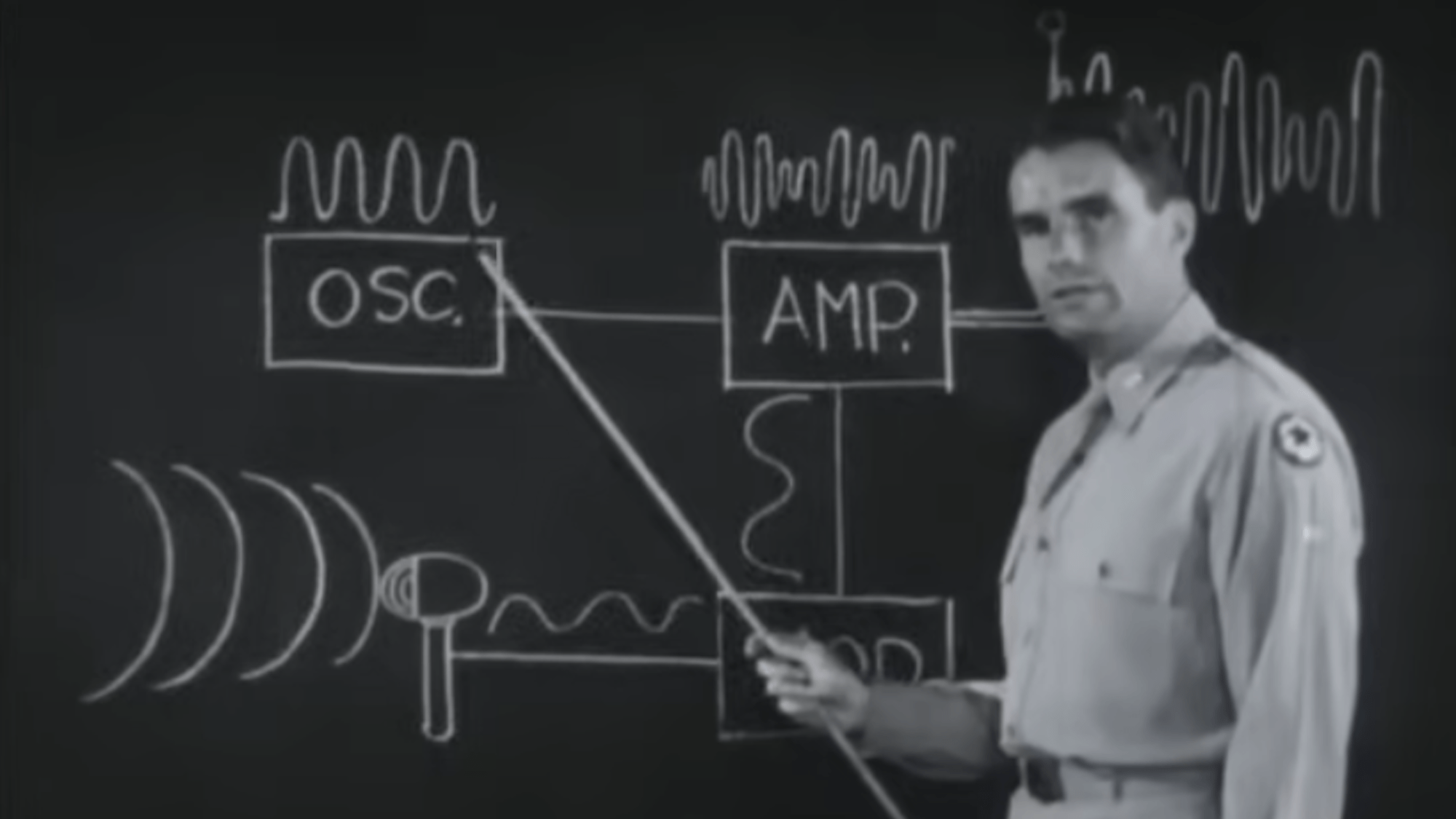
While most audiences only cared about the improved radio experience, understanding FM’s technicalities was crucial if you were expected to rely on it during actual life-or-death situations. The matter was so serious during World War II that the United States government funded a classified, 30-minute educational video in 1944 for its armed forces called “Basic Principles of Frequency Modulation.”
Prior to FM, the military transmitted a lot of its communications through AM frequencies that are highly susceptible to static interference.
“Frequency modulation licks this problem, and that’s why we want you to know something about it,” a square-jawed army actor informs viewers early on in the movie.
To send messages with AM, an oscillator first generates a carrier wave that feeds into an amplifier. Audio from a microphone is then funneled into a modulator as electrical energy before it heads to the amplifier. From there, the energy is pressed onto the wave and beamed out to receivers. The problem with AM is that information is transmitted based on the strength of its carrier, making it highly susceptible to a range of electrical interferences. As the film illustrates at the outset, even something as simple as a nearby electric razor is enough to create static on AM radio.
“Frequency modulation, or FM, is a big step forward in radio. When you tune in, you hear what the studio mic hears,” the narrator proclaims.
With FM, a carrier wave uses frequency instead of its amplitude so that static only affects the amplitude This means that any interference simply mucks with the portion of the signal that doesn’t carry the message.
It may feel a bit hokey and outdated in 2026, but as BoingBoing recently highlighted, the movie still provides an impressively concise breakdown of radiowaves, as well as discriminators, limiters, modulators, and oscillators.
“When frequency modulation is used, you can be sure that electrical interference won’t hash up your messages,” promises the training video’s host.
Roger that, sir.
The post Watch a classified FM radio training video from WW2 appeared first on Popular Science.