Why some Democratic socialists are winning Black voters — and others aren’t
TheGrio...

Political strategists say Black voters are rewarding candidates who connect progressive policies to their lived experiences.
As Democratic socialists and politically adjacent candidates continue to win major elections, from Congress to mayoral contests, the question of where Black voters stand remains mixed. But experts say there’s a reason some members of the Democratic Socialists of America (DSA) are capturing the support of the Democratic Party’s most loyal base, while others are not.
On Tuesday in Michigan, Democratic socialist Donavan McKinney defeated incumbent Rep. Shri Thanedar in the primary for Michigan’s 13th Congressional District. His victory follows recent wins for other DSA and progressive candidates as part of a wave of successes in districts with large Black voter populations, including Darializa Avila Chevalier in New York’s 13th Congressional District and Chris Rabb in Pennsylvania’s 3rd Congressional District.
Black voters also helped elect DSA candidate Janeese Lewis George over a more centrist Democrat, Kenyan McDuffie, as the Democratic nominee for mayor in Washington, D.C., and, most notably, Zohran Mamdani as mayor of New York City.
But not all DSA and progressive candidates experienced the same success with Black voters. In Tuesday’s closely watched U.S. Senate Democratic primary for Michigan, Abdul El-Sayed, who is not a Democratic socialist but aligns with most of their policies, pulled off an upset win against “establishment” Democrat U.S. Rep. Haley Stevens. However, most Black voters backed Stevens over El-Sayed in several counties with significant Black populations, including Detroit’s Wayne County, Oakland County, and Macomb County.
Additionally, in Missouri, DSA candidate and former U.S. Congresswoman Cori Bush was overwhelmingly defeated by incumbent Rep. Wesley Bell for the nomination in Missouri’s 1st Congressional District.
Black voters remain savvy

The contrasting performance of DSA and progressive candidates speaks to the pragmatism and savvy of Black voters, says Democratic strategist Joel Payne.
“People hear pragmatic, and they think moderate or centrist, but sometimes, pragmatic is progressive. Black voters are very savvy and very discerning with their vote individually and as a group, and I think oftentimes Black voters want to see proof of concept, and they want to see how the change that’s being proposed shows up for them,” Payne, who worked on Hillary Clinton’s 2016 presidential campaign, told theGrio.
As Black Americans are suffering the most under the Trump economy, including a disproportionately high unemployment rate and the worst financial position in a decade, Payne says Black voters are voting “existentially.”
“They are voting for survival, and voting for survival requires you to be highly discerning and highly pragmatic with your vote,” he explained.
Payne said that while Democratic socialists are not entirely defined politically, the group is a “decentralized” and “very distributed” part of the Democratic coalition, and “how that shows up in different parts of the country also varies.”
He added, “I think it shows up differently in D.C. versus how it might show up in New York City or how it might show up in Michigan for people living in Detroit, and how it might show up in a place like Atlanta. I do think that the labels mean different things to different people at different times in different locations.”
How DSA is messaging to Black voters
Dr. Alvin Tillery, Jr., co-founder and CEO of 2040 Strategy Group and an adviser to the campaign of DSA’s Chris Rabb in Pennsylvania, tells theGrio that there are common threads among Democratic socialists who have been successful with Black voters.
“If you can couch the economic message of the progressives in a historically cognizant narrative of the Black experience, it hypermobilizes Black voters,” said Tillery, who is also a political scientist at Northwestern University.
He said that’s especially true for candidates who can sophisticatedly contrast progressive policies with the harmful policies of President Donald Trump.
“Trump’s attacks on the Black community are potent and understood by Black voters. So if you can place the progressive economic agenda in the context of pushing back against Trump’s attacks against the Black community, that’s the special sauce that’s going to bring a lot of Black voters to the polls in this cycle,” Tillery argued.
The Democratic consultant said white candidates, like U.S. Senator and former presidential candidate Bernie Sanders, “struggle” to land the plane with Black voters, but several Black candidates have managed to do it successfully.
“Don’t just tell Black folks that you’re going to help them secure jobs. Tell them that you understand that Trump’s attacks on DEI are killing Black families right now,” said Tillery. “Black economic pain and realities are attached to our historic legacy as a discriminated, underfunded people in this country.”
While El-Sayed did not outperform his opponent with Black voters, he did make it competitive in Detroit counties.
“He was actually able to very effectively talk about how Black voters in Michigan were a part of his vision. We can see how that played out,” said Payne. “We can all analyze that, but I think El-Sayed made an earnest pitch to those folks and did it in a way where he was actually able to build some meaningful relationships.”

There’s no single secret ingredient for DSA and progressive candidates courting Black voters; however, Dr. Tillery says it comes down to the “quality” of the candidate.
Pointing to Cori Bush’s loss in Missouri, he explained, “In that election, Israel became the central issue largely because it’s the one reason Bell was put there, and it seems to be the the thing that animates Bush the most, but in most of the areas where the DSA are picking up seats, Chevalier v. Espaillat in Harlem, Rabb v. Sharif Street in Philadelphia, you know McKinney [in Michigan]…candidate quality is very high in those instances.”
He added, “They’re able to translate the message over on affordability, and these kinds of things that Black voters are very interested in, effectively.”
Because of the savviness and sometimes skepticism of Black voters, Payne said candidates must also be able to “demonstrate and show that they can win before they start to earn broader trust among the Black community.”
He explained, “They want to see that [you] can actually do the retail politics in their community and show how [your] vision matches up to their experience.”
Generational divide of Black voters
There’s also a clear generational divide when it comes to Black voters who are willing to support Democratic socialist candidates versus those who are not.
Although Mayor Mamdani won more than 60% of Black New Yorkers in last year’s general election, it was younger Black voters who helped carry him over the finish line.
“There is very clearly a generational divide,” said Payne. “It showed up in parts of 2024 [election], where the types of folks who were more likely to stay home and the types of folks who were more likely to say vote third party or even in some cases vote for Trump.”
He added, “It feels like that was more likely to come from a younger Black voter, which tells me that a younger Black voter is less wedded to conventional wisdom and less wedded to kind of a historical relationship with the Democratic Party.”
Tillery qualifies that “the Black electorate is shifting in composition,” telling theGrio, “Millennials are now the largest segment of Black voters, and they are far more open to new people than the boomers were.”

The political strategist says he believes the shift in the Black electorate is permanent and warned establishment Democrats to wake up to the new realities of where Black voters stand on the issues and who are the best messengers to rally them to the polls.
“The reason we lost in ’24 is that Democrats thought that the Black churches and all these civil rights groups could still turn out voters like they used to do, but like 4 in 10 Black voters don’t go to church at all anymore,” he explained. “The messengers are going to matter more–dynamic people, messaging strategy, ad strategy–and it’s also going to be very clear that these old machines can no longer deliver, and so that’s going to open up the space more for challengers.”
No longer are the years of the Barack Obama coalition, the experts tell theGrio.
“When Barack Obama won, he talked about the hope and the inspirational prophetic Black tradition, and that’s how he was able to hypermobilize Black voters. I don’t think Barack Obama could win anymore doing that,” said Tillery.
Payne similarly told theGrio, “There has been enough evidence that has surfaced itself in the last few cycles that shows that Democrats can’t rely on that Obama model going forward because he was a unique messenger and a unique moment with a unique appeal.” He added, “Black participation on behalf of Democrats has kind of almost leveled back off to pre-Obama levels… you’ve got to make the investment year-round, constantly, and you’ve got to rebuild relationships to win back that trust.”
DSA clashes with the Congressional Black Caucus
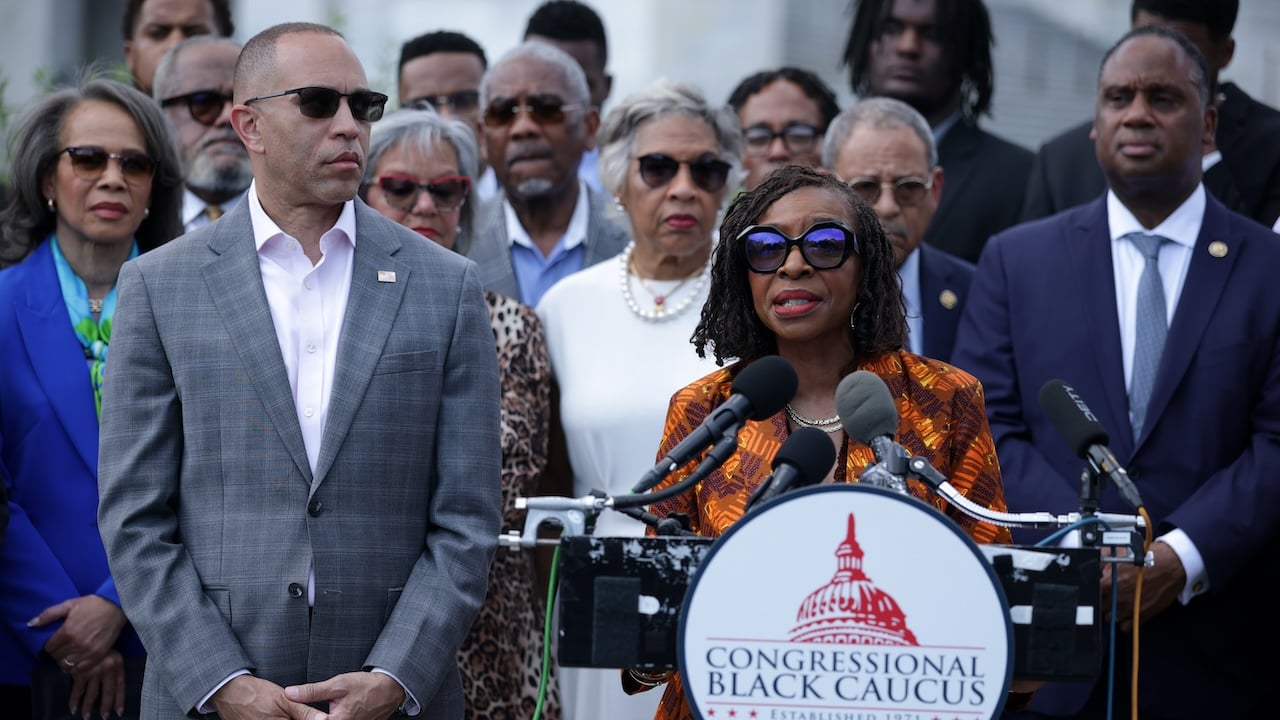
There’s also tension between the rising Democratic-socialist class within the party and the Congressional Black Caucus.
If Democrats win back the U.S. House majority, U.S. Rep. Hakeem Jeffries (D-N.Y.), the Democratic Caucus leader, would become U.S. Speaker of the House, becoming the first Black lawmaker to hold the gavel. However, some DSA candidates have been critical of Jeffries’ centrist leadership — placing them squarely in opposition to the CBC.
Black Democratic socialist nominees Chevalier in New York, Chris Rabb in Pennsylvania, and Melat Kiros have declined to commit to voting for Jeffries as speaker. As a result, some CBC members reportedly suggested that their CBC memberships should be rejected.
Tillery says that would be a mistake.
“The Black progressives or the DSA, the things that they’re saying are much more in tune with what the rising millennial voter demographic in the Black community is,” he told theGrio. “I think this is really a moment of generational change. A lot of these people balking at the rise of the DSA, they’re these Clinton-era Democrats. Where, from my perspective, generationally, they haven’t really done anything essential.”
Tillery said CBC Democrats could learn from Black DSA and progressive candidates who are more explicitly discussing race-specific policies such as reparations or police reform.
“They certainly seem to be talking about it less than the progressives. When you go back to the Black Lives Matter movement, very few sitting CBC members even tweeted Black Lives Matter or talked about it,” he recalled, adding, “They were very scared to.”
Reluctant or not, it appears the “far left” wing of the Democratic Party is already beginning to influence the mainstream.
Tillery recalled Democrats in Congress initially expressing skepticism over Mamdani’s rising mayoral campaign.
“They were saying that Zohran Mamdani was going to be the end of capitalism, and now they’re all running on his message of affordability,” he told theGrio.
Pointing to the Democratic Party barely leading Republicans in generic polling, he added, “This should be a blowout wave election for them, and it’s not because the voters detect their lack of authenticity.”