With viral 'Shout' moment, Nebraska's Matt Rhule revealed the trap that can derail even the best coaches

NCAAF College Football News, Photos, Stats, Scores, Schedule & Videos...
If you've ever suspected coaching and voodoo to be kinfolk in the universe of dark arts, Nebraska coach Matt Rhule let the mask slip once and for all on Monday.
Before we get to the grand reveal, though, let's set the stage. After most of America had gone to sleep Saturday night, Rhule's team was leading Oregon 14-6 after three quarters and generally feeling good about itself. The tradition at Oregon's Autzen Stadium is to play the song "Shout" in between the third and fourth quarters, which is a big enough part of the experience that Rhule and his coaching staff discussed how to handle it.
"Part of our thing was like, 'UCLA did it,'" Rhule said.
The 'it' he’s referring to was UCLA players out on the field dancing in unison as the song played, shortly before they held on — barely — to a 17-15 win over that same Oregon team the week before.
Some Nebraska players did the same dance to the same song in the same stadium against the same opponent and did not hang on to a win — also barely.
A 2026 trend: opponents dancing to “Shout” at Autzen Stadium as the Oregon Ducks remain still.
OREGON 6 – NEBRASKA 14@OregonDucks_SI#oregonducks#nebraska#cfb#cornhuskerspic.twitter.com/HQaaRmKP3A
— Ally Osborne (@allysosborne) October 18, 2026
Back in Nebraska, the dance predictably became a capital-T Thing. It became a Thing because Nebraska hasn't beaten a ranked team since 2016. And also because Nebraska blew a lead to Indiana the week before. And also because there's been a general sense of dread around Nebraska fans for two solid decades that they're about to lose their college football royalty birthright when in reality the collectors came for it years ago.
So because the job of a head coach is partly being a pseudo-psychologist for both his locker room and his fan base, Rhule had to address the dance because he is smart enough to know that a large segment of his fan base will see a correlation between players having fun during the heat of a big game and being unable to pull a tough one out in the fourth quarter.
"I will never do that again," Rhule said. "That's emb…"
Then he stopped himself and invoked UCLA.
"Coming off Indiana, I was like, 'Hey, we're gonna play our tail off.' I mean, it goes back to what Coach Osborne said when he first got here. Like, 'Hey, you play physical for three quarters to win the fourth quarter.' And I was like, 'We're gonna be so physical when the fourth quarter comes they're gonna try to intimidate you with that song. Have fun, enjoy it, lock back in.' And our guys got back in and we didn't win the fourth quarter. And that's not my DNA, so I have to own that."
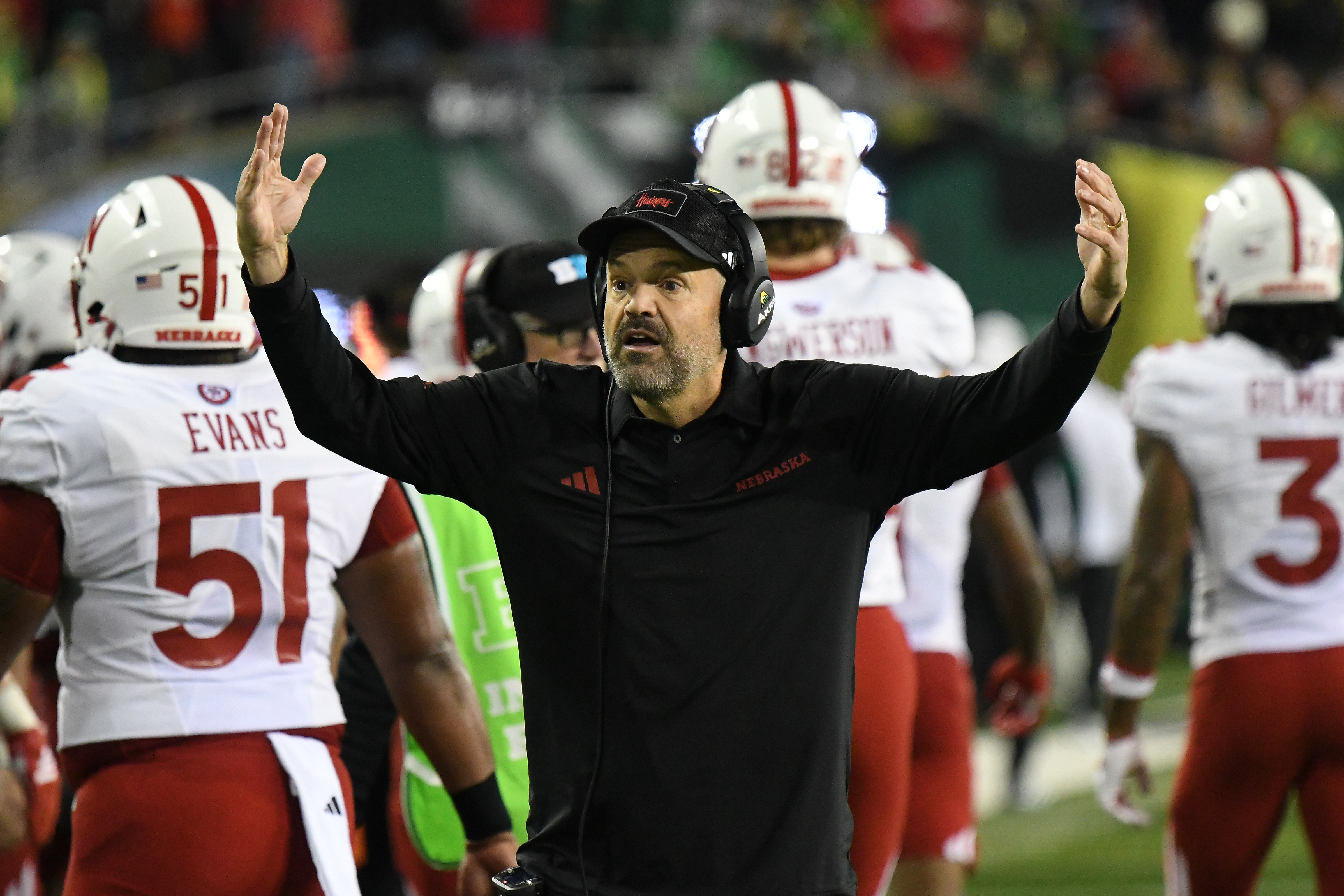
Though it was a turbulent descent before Rhule landed the plane on his point, what he seems to be saying is that he allowed something his coaching instincts told him not to because he saw a program that is currently having more success than Nebraska do it.
Coaching has always been a copycat profession, but that admission was a jaw-dropper.
Think about it for a moment. Here's Matt Rhule — a guy who did such a great coaching job at Temple (historically bad program) and Baylor (another historically bad program gutted by NCAA sanctions) that he got hired by an NFL team. OK, so it didn't work out with the Carolina Panthers, but he exited the NFL and quickly landed at a program that has won national championships in the modern era and still has a lot of resources and want-to. The media almost universally hailed it as a great fit.
That's Matt Rhule. Really good, accomplished football coach. And yet, he's in a job where what he really, really needs right now is to beat a team like Indiana or Oregon just so everyone — including the fans — can have some gosh darn confidence the next time they play one of those teams. But every time they don't get it done, the scar tissue just layers over the last wound, and at some point the natural human response is to do what even a terrific coach like Rhule did.
He stopped trusting himself.
It would be the height of insincerity for someone writing about sports to say with any certainty that the dance had anything to do with Nebraska's performance in the fourth quarter. Maybe it did, maybe it didn't. In another incident from Saturday night that became a viral social media clip, New Mexico coach Jason Eck went crazy on the sidelines as his defense celebrated a turnover with a heavyweight belt that, like many programs, the Lobos use as a sideline prop.
Even though it wasn't necessarily the defense's fault that New Mexico was trailing 10-7 early in the fourth quarter, Eck didn't like how his team was playing and didn't want any celebrations until the job was done. Did Eck send the right message in that moment? It's easy to say that now because New Mexico came back to win, but whether there's any relationship between the two is one of those things in sports that none of us can really ever know.
You can say the same about Nebraska's failure after the dance. It's impossible to say if one led to the other, but understanding sports are often like interpreting a piece of art. Whatever you see in front of you can be confirmation of your prior beliefs. If, indeed, Nebraska's players weren't focused enough on the task at hand, it probably had little to do with the dance itself and is probably more of a Monday through Friday disease with Saturday symptoms.
But this is where the witchcraft comes in.
UCLA's Bob Chesney could be just as right for allowing or even encouraging the dance at Oregon as Rhule was wrong.
Or, to put it another way, what works in Chesney's culture may not work in a different culture.
But everyone in the coaching profession right now is looking at Chesney much like they did Curt Cignetti before him. Here's this guy who came out of nowhere, inherited a UCLA program that had long since been left for dead, and instantly has the Bruins playing a tough and respectable brand of winning football. They also do it in a way that seems cool and fun and different, with a heavy emphasis on stuff like knowing the janitors' names in the football facility and saying thank you to everyone and singing the fight song every day as a team.
Does that stuff actually matter on the football field? Who knows, but the important part is that Chesney gets his players to believe it does. They all buy into it, and when it works, it fits into a neat little narrative of 'New Guy Doing New Thing' even though it's a complete guess how much of it is genius and how much is the boring stuff like blocking and tackling.
But anyone new on the national stage who has success like Chesney is a fascination. It would be natural if other coaches were asking themselves, "What's he doing right that I'm doing wrong?"
They just usually don't admit it the way Rhule did. It's not great for the brand, and goodness knows it would be bad for the profession's collective bank account if they ever gave administrators and boosters reason to believe they didn't have absolute certainty about what they're doing 100 percent of the time.
But Rhule's honesty was much appreciated because if you take the righteous anger of being a Nebraska fan right now out of the equation, what you saw should be educational.
Rhule did not lose the last two weeks because he can't win those games. It's plainly obvious that he can and that he has done it in the past, and if a play or two in the fourth quarter goes the other way the entire mood of millions of people in the state of Nebraska instantly changes. Imagine how frustrating and awful that must feel to be the one responsible for that, knowing there has been real improvement in the program and the big win is right within grasp … only to have to push the rock up the hill again.
That will mess with your mind, and Rhule is not running from it. The dancing is the irrelevant part. In a profession where it's easy for coaches to second-guess themselves on nearly every big decision, Rhule whiffed on a small one that should have been easy and went home with regrets, even though there may be no correlation between the two at all.
But that never-ending sense of what-if, and an eternal search for how to get the best out of young people, is what makes college coaching such a fascinating profession. In the end, there's no one answer. But there is a price to pay for deviating from your own process to chase someone else's result.
More at NCAAF College Football News, Photos, Stats, Scores, Schedule & Videos