World’s smallest QR code is thinner than a lightwave
Popular Science...
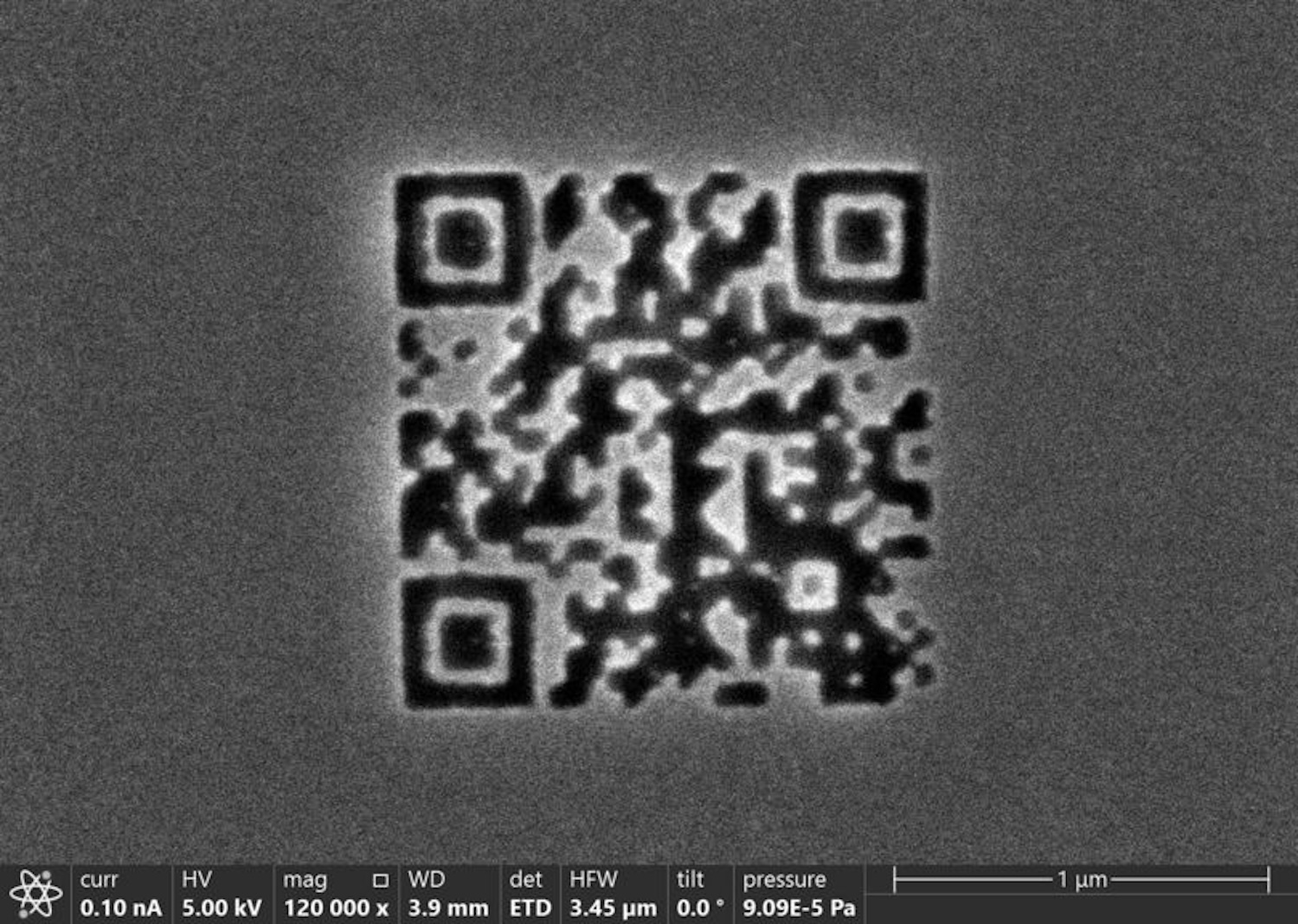
QR codes are designed to be used as quickly and easily as possible. But while tens of millions of the black-and-white gridworks are used every day, few people are likely to find much use in one that requires an electron microscope to read. Regardless, an example crafted at Austria’s Technical University of Wien (TU Wien) measuring only 1.98-square-micrometers now officially holds the Guinness World Record for world’s tiniest QR code.
It may come as a surprise, but the QR code has been around for over 30 years. First introduced in 1994 by Japanese engineer Masahiro Hara, the “quick-response” system initially helped manufacturers streamline automotive part labeling. But while barcodes are machine-readable optical images tied to individual items, QR codes store significantly more data. This is how they incorporate so many different types of additional information. Such as location, identifier details, and even web tracking. Within a few years, the tech expanded to assist an increasingly digitized world. By 2020, QR codes were literally saving lives during the COVID-19 pandemic by allowing contactless interactions and payments around the world.
The new micrometer-sized design created by researchers at TU Wien isn’t intended to direct your smartphone to a restaurant’s brunch menu, but it does showcase promising advancements in the field.

“The structure we have created here is so fine that it cannot be seen with optical microscopes at all,” materials scientist Paul Mayrhofer said in a statement. “But that is not even the truly remarkable part. Structures on the micrometer scale are nothing unusual today—it is even possible to fabricate patterns made of individual atoms. However, that alone does not result in a stable, readable code.”
Working with data storage technology company Cerbyte, Mayrhofer and colleagues were especially interested in identifying a material durable enough to use repeatedly at an atomic level. The answer came in the form of extremely thin, stable ceramic films traditionally utilized to coat high-powered performance cutting equipment.
Instead of a standard printer, researchers relied on focused ion beams to mill the QR code into a layer of ceramic. Each pixel measured only 49 nanometers in size, or about 10 times smaller than a visible light wavelength. This makes it literally impossible to see with not only the human eye, but most optical equipment.Researchers likened it to hands as callused as an elephant’s foot attempting to feel Braille.. This is where electron microscopy became crucial to the project. By imaging and resizing the QR code on a computer screen allowed the team to pull out their smartphone cameras and successfully scan the data.
Data storage is already vital to present-day society, and it’s only going to become more critical over time—but time isn’t on the side of most current storage options. Despite containing vast amounts of information, physical forms like Blu-ray and even solid-state drives all eventually deteriorate.
“We live in the information age, yet we store our knowledge in media that are astonishingly short-lived,” said materials researcher Alexander Kirnbauer.
Developing new storage methods that are economical, environmentally sound, and reliable is essential to ensuring data resiliency for generations to come. In some ways, it’s a story that’s come full-circle: similar to prehistoric civilizations etching information into stone, scientists are now doing nearly identical tasks—just on a much, much smaller scale. The team estimates that an area equal to a sheet of printer paper could contain over 2 terabytes of data if printed with their QR codes.
“With ceramic storage media, we are pursuing a similar approach to that of ancient cultures, whose inscriptions we can still read today,” Kirnbauer added. “We write information into stable, inert materials that can withstand the passage of time and remain fully accessible to future generations.”
The post World’s smallest QR code is thinner than a lightwave appeared first on Popular Science.