Dae'Quan Wright's eligibility fight highlights another huge college sports problem: Coaches refuse to say 'no'

NCAAF College Football News, Photos, Stats, Scores, Schedule & Videos...
The ruling out of a Baton Rouge courtroom allowing tight end Dae'Quan Wright to blaze a trail from Cleveland Browns training camp to LSU's roster is like a ship slamming into an iceberg on a sunny day.
Why couldn't the NCAA avoid something that was so easy to see in the distance?
If we were to slice up the pie of blame for the latest legal embarrassment that turns eligibility for college football into a fly-by-lawsuit mockery, the NCAA of course gets a huge piece. By changing the rule this year to allow athletes five years of eligibility but cutting out the recruiting class of 2022 from an extra year of NIL riches, it practically guaranteed the NCAA would get sued and lose. (What else is new?)
Another slice would go to the judge who, like so many of his colleagues across the country, was dragged into a legally ambiguous case with relatively low stakes and opted for the locally beneficial outcome.
And there are certainly a cadre of lawyers who get a slice for taking any decision made by the NCAA and seeing a new vacation home in their future.
All of these competing absurdities have accidentally conspired to put college sports in a truly bizarre position: For many players currently in NFL training camps, they'd make more money by getting cut and returning to college.
But do you know who deserves more blame? The people who lack the willpower to say one simple word: No.
"Because of the rulings, they are going to play for you or play somewhere else around the country," LSU coach Lane Kiffin told reporters Monday. "So [we] made the decision to recruit them probably like most people are."
Put it on the side of NCAA headquarters in Indianapolis. Because when you can no longer describe the north star of your enterprise as helping people go pro in something other than sports, "They are going to play for you or someone else" at least gets points for being honest.
Kiffin, his enablers at LSU and every other coach who is scouring the NFL waiver wire for potential help on the eve of the college season could easily end this farce. All they have to do is nothing.
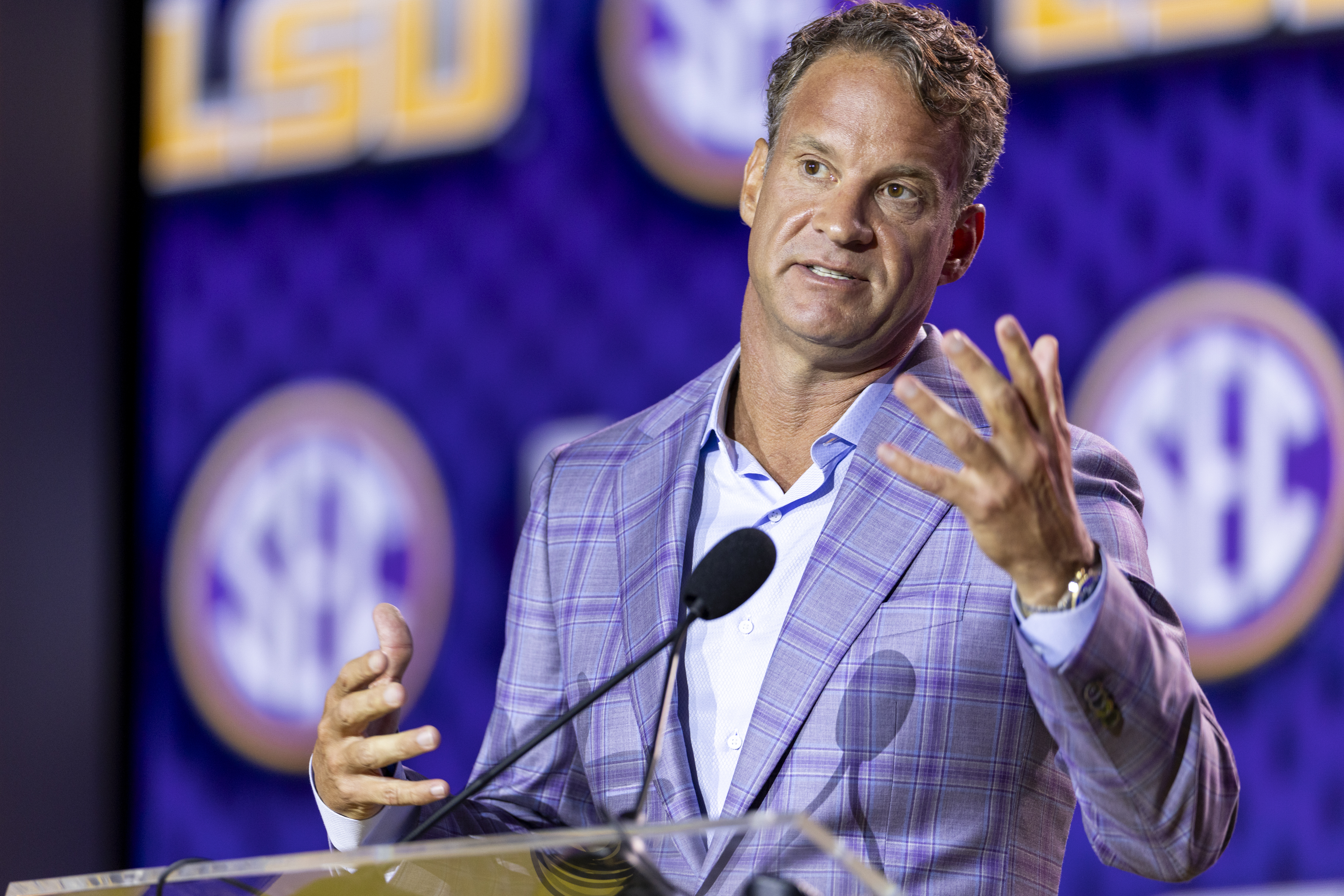
Instead, many coaches and administrators — none quite so shame-free as those at LSU — are merely continuing in the grand tradition of college sports that says the mere threat of your competitors doing something ethically questionable justifies being the first to do something ethically questionable.
College athletics has a lot of difficult-to-solve problems. But as we've seen in stark relief over the last calendar year, particularly as the SEC and Big Ten have struggled to get on the same page with Congress over the national regulations it has spent seven years begging for, their collective action problem is the one they can never solve.
Who is truly willing to give up a perceived advantage to do what's right for the sake of the sport? At the end of the day, almost no one.
"Do I like anything about it? Absolutely not," Ohio State coach Ryan Day told reporters. "But we gotta do what's right for Ohio State."
It's not clear yet that Ohio State even intends to go fishing in the ex-NFL player pool, which at this point exists thanks to specific injunctions granted at the state level rather than a blanket ruling. But at some point, the "We have no choice but to do the thing we strenuously disagree with" routine only exposes how decades of cowardice in college sports became business as usual.
The mere hint of a competitor operating in the gray area becomes instant justification for almost anything, over and over again, until the NCAA's authority to make rules has withered to nothing.
Kiffin even posed the hypothetical of a "boss" at LSU inquiring why they didn't recruit any of the ex-NFL players who are helping teams around the country win games. After all, if LSU didn't do it, "We may end up playing against them," Kiffin said.
And for Kiffin's $13 million-per-year salary, LSU certainly can't allow that.
To Kiffin's credit, he did present a part of the argument Monday that's more sympathetic.
The so-called "5-for-5" rule is essentially an outgrowth of the extra year that was granted to college athletes whose seasons were impacted by COVID-19 issues in 2020 and 2021. So, in essence, everyone who entered college before the class of 2022 got a fifth year and everyone after them will get it.
It was a no-brainer that class of 2022 athletes would sue to get that year back given the significant amounts of money at stake for a player like Wright, who went undrafted and was likely headed for the Browns' practice squad. And Kiffin is correct that if Wright had known back in December that a fifth year was going to be available to him, he very likely would have taken it at the time and put the NFL Draft on hold.
You can have some sympathy for that situation while also carrying deep suspicion about how much of this seems to have been orchestrated by and for LSU.
That's where administrators and coaches have a responsibility to say no, to ignore what's going on at the SEC's current rogue-and-in-vogue program and to stand firm on the belief that the NCAA-to-NFL/NBA/NHL/MLB pipeline should be a one-way street.
After all, any coach adding an NFL player two weeks before the season is pretty much signaling to the locker room that the team they've practiced with for the last few weeks just isn't good enough.
"Once you go to the NFL, to me, you're in the NFL and you don't get the opportunity to come back," Oregon's Dan Lanning told reporters. "And No. 2, most of us built our rosters and you have a roster limit now. So if you invited somebody back on your team, that means you're kicking somebody else off to match your roster limits. I don't think that's fair to the players who worked all summer."
Unfortunately, fairness in college sports tends to be in short supply. Someone always has more roster money, a bigger stadium, a better schedule, better advocates among the talking heads on TV. Now those who have the more creative and effective legal strategy tend to come out on top.
For years, college sports has tried to solve this quagmire by begging Congress for friendly legislation that is now stuck in a legislative gridlock. Plan B for the SEC and Big Ten is an attempt at self-governance. But there's no evidence that conference-level rules enforcement would be any more effective — particularly when the SEC has taken legal stands against its own schools in the past to no avail.
No matter what kind of bureaucracy college sports builds, it can only function if schools are willing to collectively function within the rules and put what's best for their enterprise ahead of what's best for a particular coach.
But it requires occasionally saying no, which just so happens to be the one word that seems impossible for most of them to say.
More at NCAAF College Football News, Photos, Stats, Scores, Schedule & Videos